

The Enduring Enigma: Unpacking the Physics of Space and Time
The concepts of space and time are so fundamental to our experience that we often take them for granted. Yet, for millennia, philosophers and physicists alike have grappled with their true nature. This article delves into how physics has shaped, and continues to shape, our understanding of these foundational elements, moving beyond mere intuition to reveal a universe far more intricate than initially conceived. From the ancient Greeks pondering the void to Einstein's revolutionary spacetime, we explore the philosophical implications of viewing space and time not just as backdrops for existence, but as active participants in the cosmic drama, each a measurable quantity pregnant with profound meaning.
The Philosophical Canvas: Early Conceptions of Space and Time
Before the advent of modern physics, space and time were primarily subjects of philosophical speculation. Thinkers from the Great Books of the Western World, such as Aristotle, conceived of space as a system of places relative to a body, and time as the quantity of motion. Plato, in turn, posited a more abstract realm where perfect forms of space and time resided. These early ideas laid the groundwork, defining the initial terms of the debate: Are space and time absolute, independent entities, or are they merely relational, emergent from the objects and events within them?
Space: A Container or a Relationship?
The debate over the nature of space intensified with the scientific revolution.
- Absolute Space: Isaac Newton, a towering figure whose work profoundly influenced subsequent philosophy and physics, championed the idea of absolute space. For Newton, space was an independent, immutable, and infinite container, existing uniformly without relation to anything external. It was a quantity in its own right, a stage upon which the universe's drama unfolded. This absolute frame provided the necessary reference for his laws of motion, allowing for objective measurements of velocity and acceleration.
- Relational Space: Gottfried Leibniz, a contemporary of Newton, offered a compelling counter-argument. He posited that space is not an entity in itself, but rather a system of relations between objects. Remove all objects, and space itself would cease to exist. For Leibniz, space was an order of coexistences, a quantity derived from the arrangement of matter. This philosophical divide, between absolute and relational views, would echo through centuries, challenging physicists to devise experiments that could distinguish between them.
The advent of Einstein's theories of relativity would dramatically shift this perspective, blurring the lines between these classical viewpoints.
Time: The Elusive Flow and Its Measurement
Like space, the nature of time has been a persistent philosophical puzzle. Is it a flowing river, carrying us from past to future, or is it a static dimension, where past, present, and future coexist?
- The Arrow of Time: Historically, our experience of time is one of irreversible progression – the "arrow of time." This intuitive understanding is deeply embedded in our language and thought. From Heraclitus's ever-changing river to Augustine's reflections on time as a quantity existing only in the mind, the subjective experience of time's passage has dominated philosophical discourse. Physics, however, offers a more nuanced view. While thermodynamics provides a physical basis for the arrow of time (entropy always increases), many fundamental laws of physics are time-symmetric, meaning they work equally well forwards or backwards in time.
- The Block Universe: Einstein's special relativity introduced the concept that there is no universal "now." Events that are simultaneous for one observer may not be for another, depending on their relative motion. This led to the "block universe" theory, where all moments in time – past, present, and future – are equally real and exist as part of a four-dimensional spacetime block. This view challenges our intuitive sense of a flowing present, suggesting that time is more like a spatial dimension, a quantity to be traversed rather than a dynamic process.
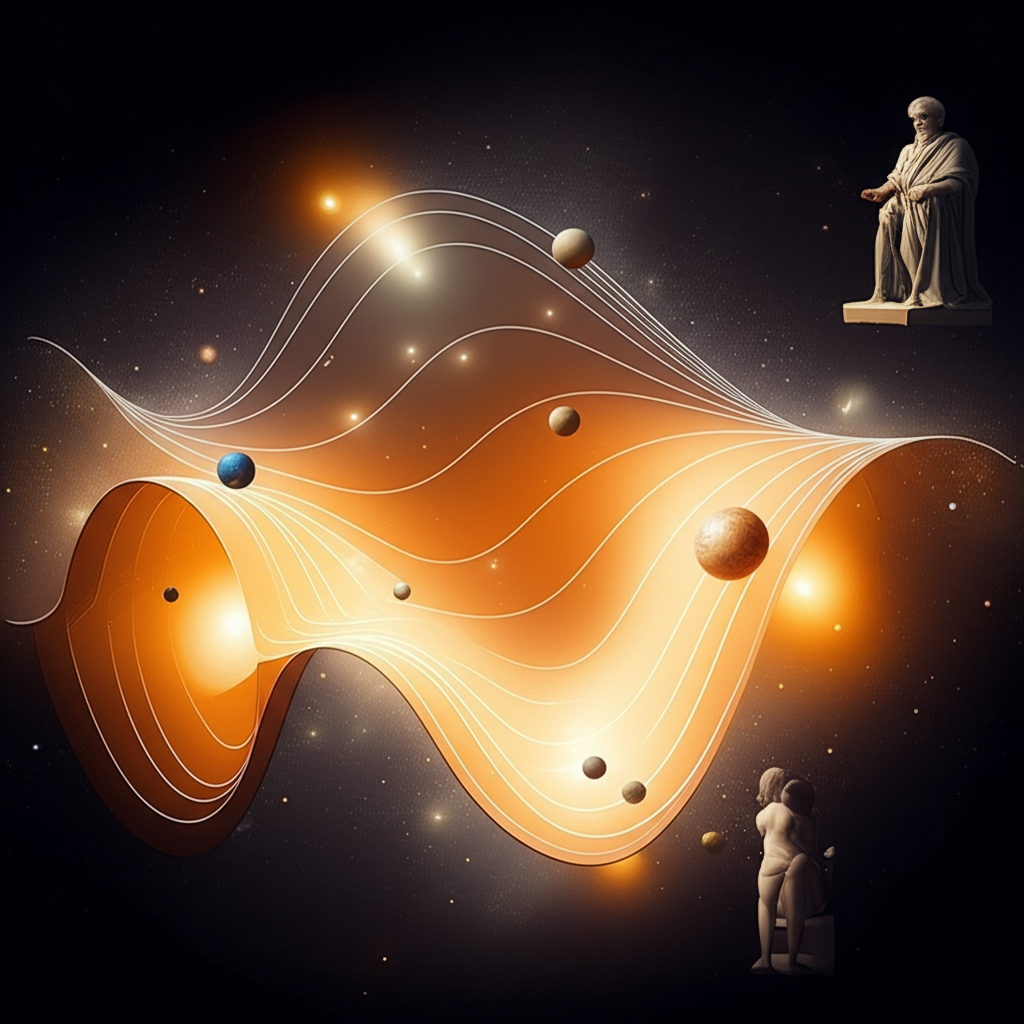 observing from the edges of the cosmic fabric, representing the enduring human quest to comprehend these fundamental dimensions.)
The Inseparable Dance: Spacetime
Perhaps the most profound revolution in our understanding of space and time came with Albert Einstein's theories of relativity. He did not merely combine space and time; he unified them into a single, four-dimensional entity: spacetime.
- Relativity and the Fabric of Reality: General relativity demonstrated that spacetime is not a passive backdrop but an active participant, a flexible quantity that can be warped and curved by mass and energy. This curvature is what we perceive as gravity. The physics of spacetime dictates that the presence of matter tells spacetime how to curve, and spacetime tells matter how to move. This elegant formulation fundamentally altered our understanding of both space and time, showing them to be inextricably linked and dynamic.
- Philosophical Implications: This scientific revelation has deep philosophical ramifications. If space and time are not absolute and independent but relative and dynamic, what does this imply for concepts like causality, determinism, and even free will? The very quantity of duration and extent becomes observer-dependent, challenging our most basic assumptions about objective reality.
Quantity, Measurement, and Reality
In physics, space and time are often defined by their quantity – their measurable extent and duration. We speak of meters, seconds, light-years, and Planck times. These measurements allow us to build predictive models and understand the universe with astonishing precision.
- The Measurable vs. The Real: But does the ability to quantify space and time fully capture their essence? Philosophers, from Plato contemplating ideal forms to Kant distinguishing between phenomena and noumena, have questioned whether our measurements truly grasp the ultimate reality. Is the quantity of time merely a human construct for ordering events, or does it reflect an intrinsic property of the cosmos?
- The Limits of Physics: While physics provides powerful tools for describing space and time, it also reveals their inherent mysteries. Concepts like singularities within black holes, the nature of time before the Big Bang, or the possibility of extra spatial dimensions push the boundaries of current theories, forcing a continued dialogue between scientific inquiry and philosophical contemplation. The quest to unify general relativity with quantum mechanics further highlights the incomplete nature of our understanding, suggesting that our current models of space and time may be approximations of an even deeper reality.
In conclusion, the physics of space and time offers a compelling narrative of intellectual progress, continuously redefining our perception of reality. From the static stage of Newton to the dynamic fabric of Einstein, our understanding of these fundamental quantities has evolved dramatically. Yet, each scientific breakthrough only deepens the philosophical questions, reminding us that the universe’s most basic elements remain its most profound mysteries.
YouTube Video Suggestions:
-
📹 Related Video: What is Philosophy?
Video by: The School of Life
💡 Want different videos? Search YouTube for: ""Absolute vs Relational Space Time Philosophy Physics""
2. ## 📹 Related Video: ARISTOTLE ON: The Nicomachean Ethics
Video by: The School of Life
💡 Want different videos? Search YouTube for: ""Brian Greene Fabric of the Cosmos Time""