

Unveiling Reality: The Enduring Dance of Matter and Form
A Fundamental Dichotomy: What Things Are and What They're Made Of
Hello, fellow explorers of thought! Chloe Fitzgerald here, ready to dive into a concept so fundamental it underpins our entire understanding of existence: the profound interplay of Matter and Form. This isn't merely an ancient philosophical musing; it's a foundational principle that continues to shape our perception of the physical world, bridging the gap between what things are made of and what they are. From the smallest element to the grandest cosmos, the physics of how matter is organized by form is a story as old as philosophy itself, and one that remains incredibly relevant today. Let's unpack this timeless tango!
Echoes from Antiquity: Pioneering Minds on Matter and Form
Our journey into matter and form begins, as so many profound philosophical inquiries do, in ancient Greece. The great thinkers of the Western world grappled with the question of change and permanence, and their answers laid the groundwork for centuries of scientific and philosophical inquiry.
Plato's Ideal Realm: The Forms Aloft
For Plato, as explored in the Great Books of the Western World, particularly in works like The Republic, true reality resided not in the shifting, imperfect physical world we perceive, but in an eternal, immutable realm of perfect Forms or Ideas. These Forms – whether of beauty, justice, or even a perfect circle – exist independently of any physical manifestation. Physical objects, for Plato, are merely imperfect copies or shadows of these perfect Forms. Think of it: a beautiful rose is beautiful because it participates in the Form of Beauty, but it is not Beauty itself. Here, Form is transcendent, existing separately from matter.
Aristotle's Hylomorphism: Inseparable Principles
Aristotle, Plato's student, offered a different, yet equally influential, perspective. Rejecting the idea of Forms existing in a separate realm, Aristotle argued that Form is inherent in matter itself. His concept of hylomorphism (from the Greek hyle for matter and morphe for form) posits that every individual substance in the physical world is a composite of both matter and form.
Consider a bronze statue:
- Matter: The bronze itself – the raw material, the potential.
- Form: The specific shape of the statue – what makes it a statue of, say, a horse, rather than a lump of bronze or a different sculpture.
For Aristotle, matter is the potentiality for something to be, while form is the actuality – what makes it that specific thing. They are not separable in reality, only in thought. This Aristotelian view profoundly influenced the development of physics and metaphysics for millennia.
Deconstructing Reality: Defining Matter and Form
To truly grasp this philosophical cornerstone, let's delineate these two fundamental principles more clearly.
Matter: The Canvas of Potentiality
When we talk about matter in this philosophical sense, we're not just referring to the particles studied by modern physics. Instead, it's the underlying substratum, the raw material that has the potential to become something.
Here are some key characteristics of philosophical matter:
- Indefinite and Undifferentiated: In itself, matter lacks specific characteristics. It's not this or that until form is imposed upon it.
- Pure Potentiality: It is the capacity to receive form. A block of marble has the potential to become a statue, a table, or even dust.
- Substratum: It's what persists through change. When a tree burns, its matter changes form into ash and smoke, but the underlying "stuff" remains.
Form: The Blueprint of Actuality
If matter is the potential, then form is the actualization of that potential. It's the organizing principle, the essence, the structure that makes something what it is.
Consider these aspects of philosophical form:
- Definite and Specific: Form gives matter its specific identity, structure, and function.
- Actuality: It's what makes something actually exist as a particular kind of thing. The form of a human being is what makes a collection of biological matter a human being, rather than a collection of cells or a different animal.
- Organizing Principle: Form dictates how matter is arranged and behaves. It’s the blueprint, the pattern, the structure.
Table 1: Matter vs. Form (Aristotelian Perspective)
| Feature | Matter | Form |
|---|---|---|
| Nature | Potentiality, Indefinite Substratum | Actuality, Definite Organizing Principle |
| Role | What something is made of | What something is (its essence) |
| Change | What persists through change | What gives identity, can be gained/lost |
| Example | Bronze (for a statue), Clay (for a pot) | The shape of the statue, The design of the pot |
The Physics of Becoming: When Form Shapes Matter
The ancient Greek word for nature, phusis, is where we derive our term physics. For philosophers like Aristotle, physics was the study of things that have within themselves a principle of motion and rest – things that change. And central to understanding this change is the dynamic relationship between matter and form.
When a sculptor carves marble into a statue, they are imposing a new form onto existing matter. When an acorn grows into an oak tree, the inherent form (the blueprint) within the acorn guides the assimilation of matter from its environment to actualize the potential of becoming an oak.
Elements and Essence: Building Blocks of Being
Even the concept of elements ties into this. Ancient philosophers often posited fundamental elements (like earth, air, fire, water) as basic kinds of matter. But even these elements have their own distinct forms that define them. In modern physics, we talk about chemical elements like hydrogen or oxygen. Each element is defined by its atomic structure – its unique form – which dictates how its constituent matter (protons, neutrons, electrons) is organized and behaves. The form of an atom determines its elemental identity.
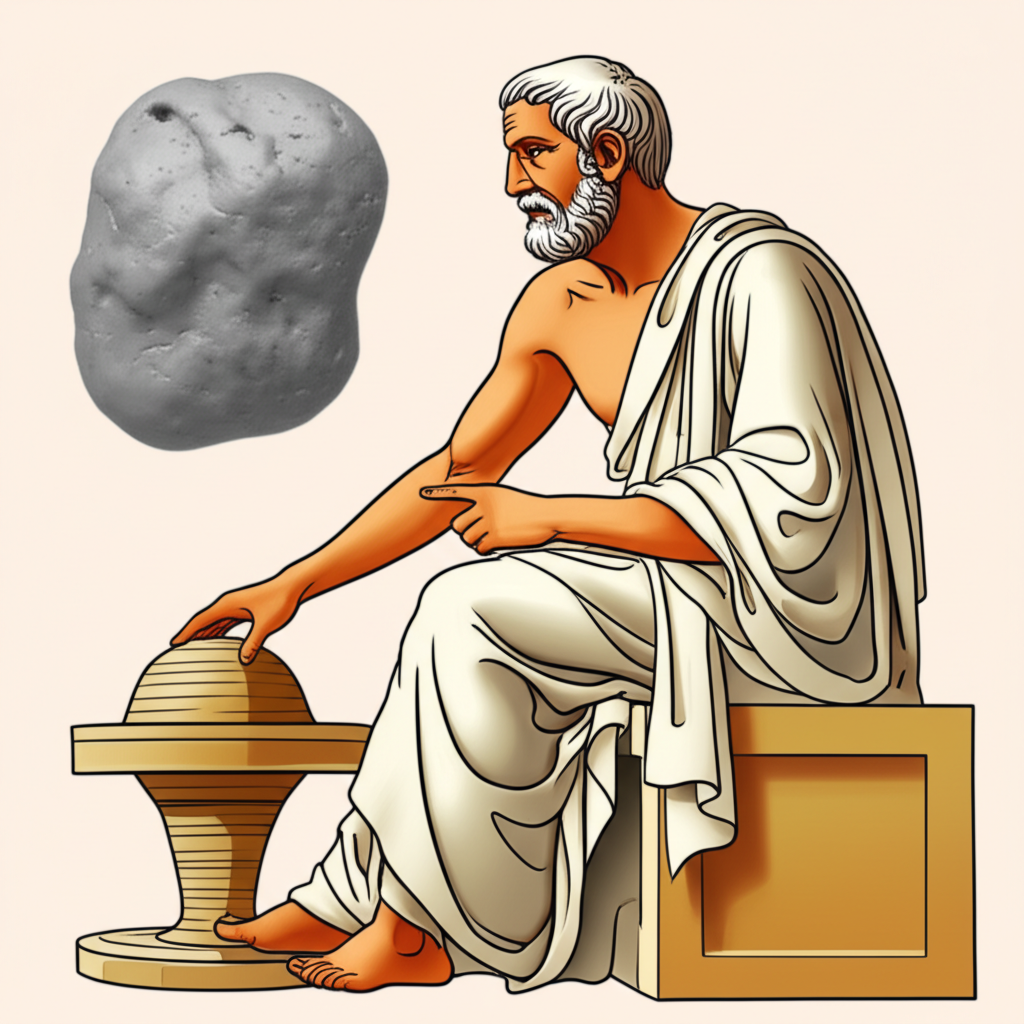 , while the potter's hands are actively giving it the distinct shape of a vase (representing form). Rays of light or conceptual lines connect the idea of the "vase" in the philosopher's mind to the emerging shape on the wheel, emphasizing the imposition of form onto matter.)
A Timeless Legacy: Modern Science and Ancient Wisdom
Isn't it fascinating how these ancient philosophical insights continue to resonate in contemporary scientific discourse? While modern physics has moved far beyond the four elements, the underlying principles of matter and form persist.
Think about genetics:
- Matter: The raw biochemical materials – amino acids, nucleotides, cellular components.
- Form: The specific sequence of DNA, the genetic code, which dictates the structure and function of proteins, ultimately giving an organism its unique form and characteristics. The form of the DNA guides the matter to create life.
Or consider information theory:
- Matter: The physical medium – a hard drive, a book, electrical signals.
- Form: The arrangement of data, the words, the code – the information itself, which gives meaning and structure to the inert matter.
Conclusion: The Unfolding Story of Existence
The distinction and relationship between matter and form offer a powerful lens through which to view the entire universe. It helps us understand not just what things are but also how they come to be and how they change. From the fundamental elements that compose our world to the complex organisms that inhabit it, the physics of matter receiving its form is the continuous, unfolding story of existence.
As we continue to explore the intricate workings of the cosmos, remembering these foundational philosophical concepts helps us appreciate the depth and interconnectedness of all reality. Keep questioning, keep exploring, and remember that even the most complex scientific discoveries often have roots in these ancient, profound philosophical inquiries!
YouTube Video Suggestions:
-
📹 Related Video: ARISTOTLE ON: The Nicomachean Ethics
Video by: The School of Life
💡 Want different videos? Search YouTube for: "Aristotle Hylomorphism Explained | Matter and Form Philosophy"
2. ## 📹 Related Video: PLATO ON: The Allegory of the Cave
Video by: The School of Life
💡 Want different videos? Search YouTube for: "Plato's Theory of Forms | An Introduction to Metaphysics"