

The Enduring Dance: Exploring the Physics of Matter and Form
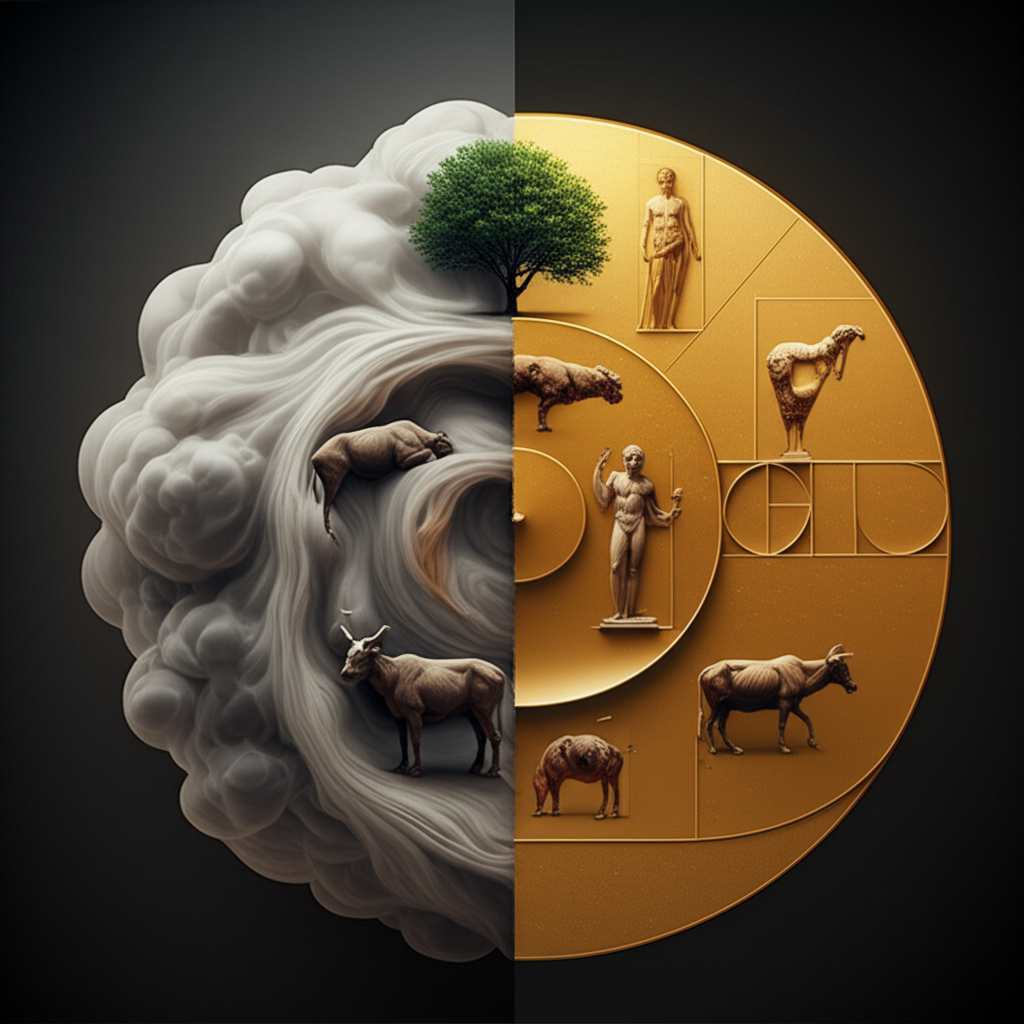
The world around us, from the smallest grain of sand to the sprawling cosmos, presents itself as a tapestry of things. But what are these things, fundamentally? This isn't just a scientific question; it's a deep philosophical inquiry that has captivated thinkers for millennia. At its heart lies the profound relationship between Matter and Form, a dynamic duo that ancient philosophers, particularly those whose wisdom is preserved in the Great Books of the Western World, explored with remarkable insight. This article delves into how these concepts, often seen as the very "Physics" of existence, shape our understanding of reality, identity, and change.
The Philosophical Bedrock: What is Matter? What is Form?
To truly grasp the world, we must first dissect its fundamental components. For ancient Greek philosophers, this wasn't about subatomic particles, but about underlying principles.
Matter (from the Greek hyle) can be understood as the raw potential, the indeterminate "stuff" out of which things are made. It's the clay before it's molded, the wood before it's carved. In itself, matter is formless, possessing only the capacity to receive form. Think of it as pure potentiality.
Form (from the Greek eidos or morphe), on the other hand, is what gives matter its specific structure, its essence, its "whatness." It's the blueprint, the shape, the purpose, the defining characteristic that makes a thing that thing. The form of a statue is what makes it a statue, not just a lump of clay.
Ancient Insights from the Great Books
The ideas of Matter and Form are central to the philosophical traditions documented in the Great Books, particularly in the works of Plato and Aristotle.
- Plato's Ideal Forms: For Plato, Forms were transcendent, perfect, and eternal archetypes existing independently of the physical world. A physical chair, for instance, is merely an imperfect copy or participation in the ideal Form of "Chairness." Matter, in this view, is the receptacle, the medium through which these perfect Forms are imperfectly manifested in our sensory world. The true reality lies in the Forms, not in their material instantiations.
- Aristotle's Hylomorphism: Aristotle, a student of Plato, offered a different, more immanent perspective. He argued that Matter and Form are inseparable principles existing within every individual substance. A substance (like a tree or a human) is a composite of matter and form.
- The Matter of a tree is its wood, bark, leaves – the physical components.
- The Form of a tree is its specific structure, its capacity to grow, photosynthesize, and reproduce – its essence that makes it a tree and not a rock.
For Aristotle, Form is not just shape but also the telos or purpose, the driving principle that organizes matter and gives it its identity and function. This concept, known as hylomorphism, is fundamental to his Physics and metaphysics, explaining how things come to be, change, and persist.
The Dynamic Interplay: Change, Identity, and Elements
The relationship between Matter and Form isn't static; it's the very engine of change and the foundation of identity.
Change: Aristotle used Matter and Form to explain change. When something changes, its matter remains, but its form is altered. For example, when a block of marble (matter) is sculpted into a statue (form), the marble persists, but it takes on a new form. This is a fundamental concept in understanding the "Physics" of transformation in the natural world.
Identity: A thing's identity is derived from its form. A human being, for instance, is defined by its human form (rational soul, specific biological structure), even though the matter (cells, tissues) is constantly changing. The form provides continuity and identity despite the flux of matter.
Elements and Fundamental Matter: Before Plato and Aristotle, earlier philosophers, often called Presocratics, grappled with the concept of fundamental Elements. Thales proposed water, Anaximenes air, and Empedocles famously suggested four root elements: earth, air, fire, and water. These early theories represent an attempt to identify the most basic "matter" from which everything else is composed, a precursor to both philosophical discussions of matter and modern scientific inquiry into fundamental particles. While their specific elements differ, the underlying quest to find the ultimate material constituents of the universe resonates throughout philosophical and scientific history.
Modern Echoes: Bridging Ancient Wisdom and Contemporary Physics
While ancient philosophers didn't have particle accelerators or quantum mechanics, their conceptual framework of Matter and Form offers surprising resonance with modern "Physics."
| Ancient Concept | Modern Analogy (Simplified) |
|---|---|
| Raw Matter | Subatomic particles (quarks, leptons), energy fields – the fundamental "stuff" before organization. |
| Form | The laws of physics, emergent properties, structure of atoms/molecules, biological organization, information theory. |
| Elements | The periodic table of elements, fundamental particles, the Standard Model – the basic building blocks of the universe. |
| Hylomorphism | The idea that particles arrange according to specific laws to form atoms, which arrange to form molecules, and so on, creating complex structures with emergent properties. |
Modern physics seeks to understand the "matter" of the universe at its most fundamental level, constantly breaking it down into smaller and smaller constituents. Yet, it also seeks to understand the "forms" – the laws, symmetries, and interactions that govern how this matter behaves and organizes itself into stars, galaxies, and living organisms. The philosophical questions about what constitutes identity, how change occurs, and the relationship between potentiality and actuality continue to be explored, albeit with new tools and in a different lexicon.
Conclusion: The Enduring Quest
The philosophical exploration of Matter and Form, deeply rooted in the Great Books of the Western World, provides an indispensable framework for understanding reality. From Plato's transcendent Forms to Aristotle's immanent hylomorphism, these concepts offer profound insights into the nature of existence, change, and identity. Far from being archaic ideas, they lay the groundwork for understanding the very "Physics" of our world, reminding us that the quest to comprehend the fundamental structure of reality is a timeless human endeavor, one that continues to bridge the gap between ancient wisdom and contemporary scientific discovery.
📹 Related Video: ARISTOTLE ON: The Nicomachean Ethics
Video by: The School of Life
💡 Want different videos? Search YouTube for: ""Aristotle Matter and Form Explained""
📹 Related Video: PLATO ON: The Allegory of the Cave
Video by: The School of Life
💡 Want different videos? Search YouTube for: ""Plato's Theory of Forms Explained Simply""