

The Physics of Matter and Form: Unpacking the Structure of Being
Summary: From the ancient Greeks to the cutting edge of quantum theory, philosophers and scientists have grappled with the fundamental nature of reality, primarily through the lens of Matter and Form. This article delves into how these enduring concepts, central to Physics and metaphysics, have shaped our understanding of existence, exploring their evolution from the Great Books of the Western World to contemporary thought. We'll trace the journey from Aristotle's hylomorphism and Plato's transcendent Forms to the mechanical worldview of early modern science, and finally, to hints of their re-emergence in the informational universe of today, always questioning what truly constitutes an Element of reality.
Unpacking the Primal Questions: What Is and How It Is
For millennia, humanity has been captivated by two fundamental questions: What is the stuff of reality, and how is that stuff organized? These aren't merely scientific inquiries; they are deeply philosophical, probing the very Physics of being. When we speak of Matter and Form, we're touching upon the most foundational distinctions in Western philosophy, distinctions that have profoundly influenced everything from cosmology to ethics. The Great Books of the Western World are replete with attempts to articulate these concepts, offering frameworks that, even today, resonate with our scientific explorations.
Aristotle's Hylomorphism: The Inseparable Pair
Perhaps no philosopher articulated the relationship between Matter and Form with greater precision than Aristotle. For him, every physical substance (from a tree to a human to a rock) is a composite of these two inseparable principles.
- Matter (Hyle): This is the underlying potentiality, the "stuff" out of which something is made. It is indeterminate in itself, capable of taking on various forms. Think of clay – it's Matter that can become a pot, a statue, or a brick. In its purest sense, prime Matter is pure potentiality, never existing independently.
- Form (Morphe): This is the actuality, the organizing principle that gives Matter its specific structure, essence, and function. It's what makes the clay this pot, rather than that statue. The Form is what defines a thing, giving it its "whatness" (its essence).
For Aristotle, Physics was precisely the study of natural things, which are defined by their inherent principles of change and rest – principles rooted in their Matter and Form. He saw change not as the annihilation of one thing and creation of another, but as Matter taking on a new Form or shedding an old one. Even the Elements (earth, air, fire, water) were understood as combinations of prime Matter with specific fundamental Forms (hot/cold, wet/dry).
| Concept | Aristotle's View | Example |
|---|---|---|
| Matter | Potentiality, indeterminate "stuff" | The wood of a chair, the bronze of a statue |
| Form | Actuality, organizing principle, essence | The design of the chair, the shape of the statue |
| Substance | Inseparable composite of Matter and Form | The chair itself, the statue itself |
| Physics | Study of natural things, their change & motion | How a seed grows into a plant |
| Element | Prime Matter combined with fundamental Forms | Fire (hot & dry), Water (cold & wet) |
Plato's Forms: A Realm Beyond the Physical
In stark contrast to Aristotle, Plato posited a realm of transcendent, eternal, and unchanging Forms (or Ideas) that exist independently of the physical world. For Plato:
- Forms: These are the perfect blueprints or archetypes of everything we perceive in the sensible world. A beautiful horse in our world is beautiful only because it participates in the universal Form of Beauty. These Forms are more real than their physical manifestations.
- Matter: The physical world, which is composed of Matter, is merely a shadowy imitation or imperfect copy of these perfect Forms. Matter itself is often depicted as a chaotic, indeterminate receptacle that receives the impress of the Forms.
In a Platonic universe, true knowledge (episteme) comes from apprehending the Forms, not from studying the ever-changing physical world (doxa). This presented a challenge for Physics as a rigorous science, as the objects of physical study were considered less real and less knowable than the Forms themselves. The physical Elements were seen as imperfect reflections of ideal geometric Forms.
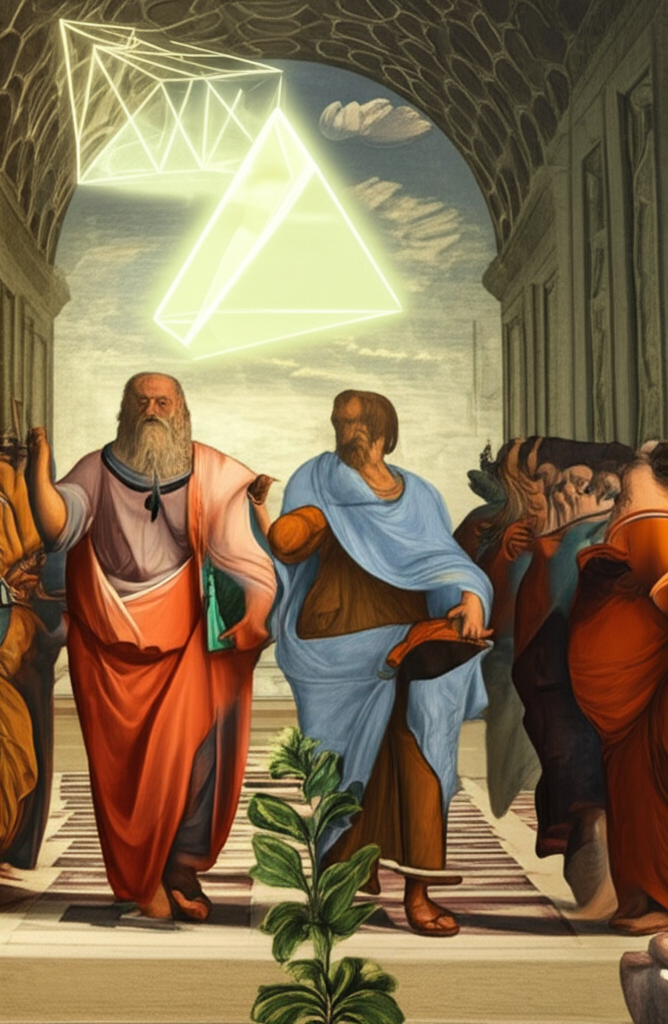
The Medieval Synthesis: Divine Order and Created Being
Medieval scholastic philosophers, most notably Thomas Aquinas, largely adopted and adapted Aristotle's hylomorphism, integrating it into Christian theology. For Aquinas, God was the ultimate source of all Form, imbuing created Matter with its specific essences. The distinction between Matter and Form helped explain the nature of substances, the process of creation, and even the sacraments. The concept of an Element took on a theological dimension, as God's creative act brought both the material substrate and its defining Form into being.
The Dawn of Modern Physics: Mechanism and Redefinition
The scientific revolution dramatically shifted the understanding of Matter and Form. Philosophers like René Descartes and John Locke, alongside scientists like Isaac Newton, began to dismantle the Aristotelian framework.
- Descartes: Advocated for a radical dualism. Mind was pure thought (Form without Matter), and Matter was pure extension (res extensa), essentially quantifiable space. Physics became the study of extended bodies in motion, governed by mechanical laws. Form was reduced to geometrical arrangement.
- Locke: Distinguished between primary qualities (inherent in Matter, like extension, solidity, motion) and secondary qualities (mind-dependent perceptions, like color, taste). Matter was seen as an inert substratum, its Form being its arrangement of imperceptible particles.
- Newtonian Physics: Solidified this mechanical view. Matter consisted of hard, impenetrable, moving particles. Form was their configuration, their interactions dictated by universal laws. The philosophical Element gave way to the empirically discoverable chemical Element, defined by its atomic structure and properties, not by abstract qualities like "hot" or "dry."
This era largely stripped Form of its inherent, teleological (purpose-driven) power, reinterpreting it as mere structure or organization imposed upon inert Matter.
Contemporary Echoes: Quantum Physics and the Informational Universe
Modern Physics, particularly quantum mechanics and information theory, offers intriguing new perspectives that, in some ways, echo the ancient debates about Matter and Form.
- Quantum Indeterminacy: At the quantum level, particles don't have definite properties until observed or measured. Is the "unobserved particle" akin to Aristotelian prime Matter – pure potentiality awaiting Form (measurement/interaction) to become actual?
- Information as Form: Some contemporary physicists and philosophers propose that information is fundamental to the universe. Could Form be understood as the informational content that structures Matter? The specific arrangement of atoms in a DNA molecule (its Form) carries the information that defines life.
- Emergence: Complex Forms (like consciousness or biological systems) emerge from simpler Elements and their interactions, suggesting that Form is not always imposed externally but can arise from within the material system itself.
The philosophical quest for the ultimate Element continues, now exploring whether it is a particle, a field, or even a bit of information, constantly challenging our definitions of Matter and Form.
The Enduring Dialogue: Why Matter and Form Still Matter
The journey through the Physics of Matter and Form is far from over. From the ancient insights preserved in the Great Books to the perplexing realities of quantum mechanics, these concepts remain vital tools for understanding the cosmos and our place within it. They force us to question the nature of change, identity, and what truly makes a thing what it is. As Chloe Fitzgerald, I find it endlessly fascinating how these seemingly abstract philosophical distinctions continue to inform and challenge our most advanced scientific theories, proving that the fundamental questions posed millennia ago are still the ones driving our search for truth today.
YouTube Video Suggestions:
-
📹 Related Video: ARISTOTLE ON: The Nicomachean Ethics
Video by: The School of Life
💡 Want different videos? Search YouTube for: ""Aristotle Hylomorphism Explained""
-
📹 Related Video: PLATO ON: The Allegory of the Cave
Video by: The School of Life
💡 Want different videos? Search YouTube for: ""Plato Theory of Forms vs Aristotle Metaphysics""