

Unveiling Reality: The Physics of Matter and Form
The journey to understand what constitutes reality is as old as philosophy itself. At its heart lies the profound distinction between matter and form – concepts that have captivated thinkers from ancient Greece to the frontiers of modern physics. This article delves into how philosophy, particularly through the lens of the Great Books of the Western World, grappled with these fundamental ideas, and how their echoes resonate in our contemporary scientific understanding of the universe. We'll explore the philosophical underpinnings of matter as potentiality and form as actuality, revealing how these concepts are not merely abstract notions but essential tools for dissecting the very fabric of existence.
The Ancient Roots: Defining Substance and Structure
For millennia, philosophers have pondered the fundamental constituents of the world around us. How do things come to be? What makes a tree a tree, distinct from a rock or a river? These questions led to the articulation of matter and form as core explanatory principles.
Aristotle's Hylomorphism: Matter as Potential, Form as Actuality
Perhaps no philosopher explored the relationship between matter and form more thoroughly than Aristotle. In his Physics and Metaphysics, he introduced the concept of hylomorphism, proposing that every individual substance in the natural world is a composite of both.
- Matter (Hyle): For Aristotle, matter is the undifferentiated substratum, the raw potentiality. It is what can be something, but isn't yet. Think of a block of marble. Before the sculptor begins, it is raw matter, possessing the potential to become a statue, but it is not yet a statue.
- Form (Morphe): Form, on the other hand, is what gives matter its specific nature, its actuality, its essence. It is the organizing principle that structures the matter into a particular kind of thing. The sculptor's design, the shape of the human figure carved into the marble – that is the form that actualizes the marble's potential.
This dynamic interplay means that form is not separate from matter; it is inherent within it, guiding its development and defining its being. A living organism, for instance, has its form (its species-specific structure and functions) actualizing its biological matter. The ancient concept of elements (earth, air, fire, water) could be seen as early attempts to categorize fundamental types of matter, each possessing inherent qualities, or primitive forms, that defined their behavior.
Plato's Realm of Perfect Forms: Beyond the Physical
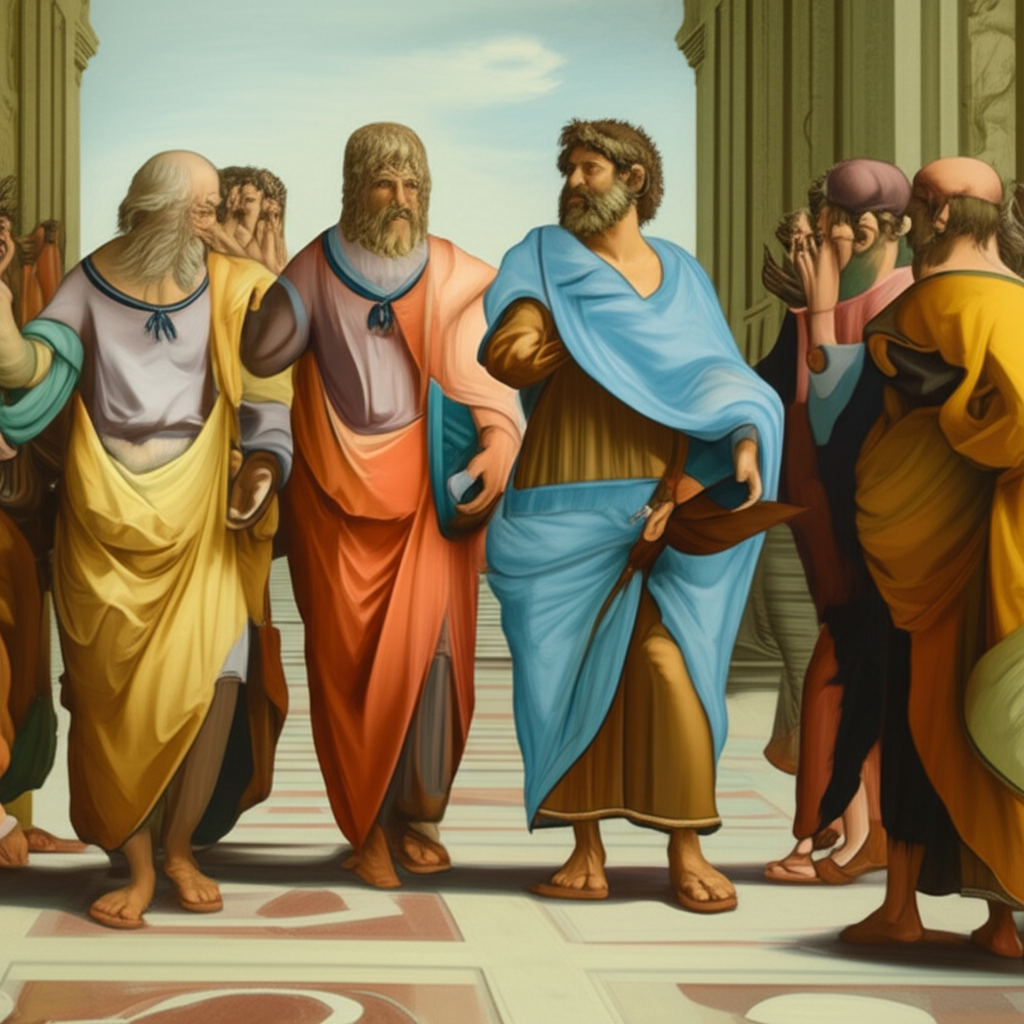
While Aristotle grounded form within the material world, his teacher Plato offered a different perspective. In works like Phaedo and Republic, Plato posited a separate, transcendent realm of Forms (or Ideas) that exist independently of the physical world. For Plato:
- Forms are eternal, unchanging, and perfect archetypes. The form of "beauty" or "justice" exists independently of any beautiful object or just act.
- Physical objects are imperfect copies or participations in these Forms. A beautiful painting is beautiful only insofar as it partakes in the perfect Form of Beauty.
While this might seem less directly related to physics as we understand it today, Plato's theory profoundly influenced subsequent philosophical and scientific thought by emphasizing the existence of underlying, immutable structures that govern the diverse and changing world of appearances. It introduced the idea that there's an ideal blueprint behind everything we perceive.
Bridging the Millennia: Modern Physics and the Echoes of Form and Matter
Fast forward to the era of modern physics, and the language may have changed, but the fundamental questions about the nature of reality persist. While contemporary physics doesn't explicitly use "hylomorphism," the concepts of matter and form find fascinating analogues in our understanding of the universe.
Matter in the Quantum Age
What we now understand as matter has evolved dramatically. From the ancient elements to the atomic theory, and now to the Standard Model of particle physics, matter is no longer seen as an inert, undifferentiated substance. Instead, it's a vibrant tapestry of fundamental particles: quarks, leptons (like electrons), and bosons (force carriers). Even these are often described as excitations in quantum fields, blurring the line between particle and energy. This "raw potential" of the universe, the fundamental stuff, is our modern matter.
Form in the Laws of Physics
If fundamental particles are our modern matter, then the laws of physics, symmetries, and emergent properties are our modern forms. These are the principles that organize, structure, and dictate the behavior of matter.
Consider the following parallels:
| Philosophical Concept | Modern Physics Analogue | Description |
|---|---|---|
| Matter | Fundamental Particles (Quarks, Leptons) & Energy Fields | The basic "stuff" or potentiality of the universe; the raw ingredients. |
| Form | Laws of Physics (Gravity, Electromagnetism, Quantum Mechanics) | The organizing principles, rules, and symmetries that dictate how matter interacts and structures itself. |
| Form | Emergent Properties & Structures | The specific arrangements and behaviors that arise from matter following the laws – e.g., atoms, molecules, crystals, galaxies, life. |
| Element | Chemical Elements (Periodic Table) | Specific stable "forms" of matter composed of protons, neutrons, and electrons, each with unique properties defined by their atomic structure (form). |
The periodic table itself is a testament to the power of form. Each element (hydrogen, oxygen, iron, etc.) is defined by the form of its atomic nucleus (number of protons) and the form of its electron shell configuration. These forms dictate their chemical properties and interactions, giving rise to the incredible diversity of substances we observe. The universe, in a very real sense, is matter shaped by form.
The Enduring Dialogue: Philosophical Resonance in Contemporary Science
The philosophical distinction between matter and form is not a relic of ancient thought; it continues to inform and enrich our understanding of scientific inquiry. When scientists search for a "theory of everything," they are, in a way, seeking the ultimate form – the unifying principles that govern all matter and energy. When biologists study the intricate structures of DNA or the complex organization of an ecosystem, they are exploring the forms that life takes, actualizing the potential of biological matter.
The questions posed by Aristotle and Plato about what constitutes a "thing" and how it acquires its identity remain profoundly relevant. Modern physics provides increasingly detailed answers about the matter itself and the forms it can embody, but the philosophical framework provides the enduring conceptual tools to ask why and how these things come to be and what it means for them to exist.
📹 Related Video: ARISTOTLE ON: The Nicomachean Ethics
Video by: The School of Life
💡 Want different videos? Search YouTube for: ""Aristotle Hylomorphism explained" and "Quantum Fields and the Nature of Reality""