

The Enduring Dance of Existence: Unpacking the Physics of Matter and Form
Have you ever looked at a magnificent oak tree or a finely crafted sculpture and pondered what it really is? It's a question that has captivated thinkers for millennia, from the earliest philosophers to today's quantum physicists. This article delves into the philosophical "physics" of matter and form, exploring how these fundamental concepts have shaped our understanding of reality, building on the profound insights found within the Great Books of the Western World. We'll journey from ancient Greek thought to the enduring questions these ideas pose, considering how the very fabric of existence is woven from these two inseparable threads.
What's It All About? A Snapshot
At its heart, the "physics" of matter and form is a philosophical inquiry into the composition of reality. It's about distinguishing between the raw stuff an object is made of (its matter) and the specific structure, essence, or defining characteristics that make it what it is (its form). This ancient distinction, particularly refined by Aristotle, offers a powerful lens through which to understand change, identity, and the very nature of being. Far from being an outdated concept, it provides a foundational framework for appreciating how philosophy grapples with the tangible world, setting the stage for scientific inquiry.
The Ancient Blueprint: Aristotle's Hylomorphism
When we talk about Matter and Form in a philosophical sense, we're often stepping into the intellectual landscape of ancient Greece, particularly the brilliant mind of Aristotle. He proposed a concept known as hylomorphism (from the Greek hyle for matter and morphe for form), which posits that every physical substance is a composite of these two principles.
- Matter (Hyle): Think of this as the potentiality or the undifferentiated "stuff" from which things are made. It's the bronze before it's a statue, the wood before it's a table, or the flesh and bones before they're a person. Matter, in itself, is indeterminate; it has the capacity to become many things. It's not nothing, but it's also not something specific until form is imposed upon it.
- Form (Morphe): This is the actuality or the principle that gives matter its specific nature, structure, and purpose. It's what makes the bronze a statue of a specific figure, the wood a table with a particular design, or the flesh and bones a human being with rational capacities. Form is what defines, organizes, and actualizes the potential inherent in matter.
For Aristotle, matter and form are not separate entities floating around; they are inherent in every existing substance. You can't have matter without some form, nor form without some matter (at least in the physical world). They are two sides of the same existential coin, constantly interacting to bring about the world we experience.
A Table of Hylomorphic Examples
| Object | Matter (Potentiality) | Form (Actuality) |
|---|---|---|
| Bronze Statue | Bronze, metal alloys | The specific shape of the figure, its artistic design |
| Wooden Chair | Wood, timber | The structure that makes it a chair, its purpose for sitting |
| Human Being | Flesh, bones, organs, cells | The soul (as the animating principle), rationality, specific human characteristics |
| A Building | Bricks, mortar, steel, glass | The architectural design, its function as a dwelling or office |
Echoes of Plato: Forms as Perfect Blueprints
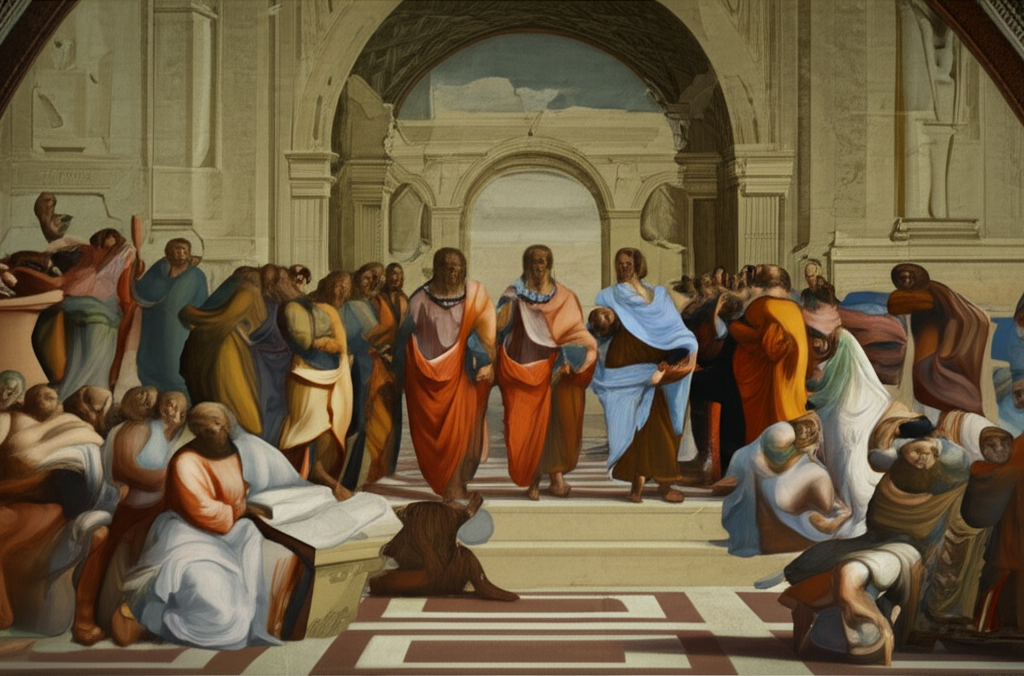
While Aristotle saw form as immanent—existing within the objects themselves—his teacher Plato had a more transcendental view. Plato's famous Theory of Forms (or Ideas) posits that perfect, unchanging, and eternal Forms exist in a separate, non-physical realm. Physical objects in our world are merely imperfect copies or shadows of these ideal Forms. For example, all beautiful things in our world participate in the single, perfect Form of Beauty. This concept, also richly explored in the Great Books, offers a powerful contrast to Aristotle's more grounded approach, highlighting a fundamental divergence in how philosophers have conceived of reality's ultimate structure.
The Philosophical Concept of "Element"
Before modern chemistry, the concept of an Element was also deeply philosophical. Ancient thinkers, notably Empedocles and later Aristotle, proposed that all things were composed of fundamental constituents.
- Ancient Elements: The classical elements were typically identified as Earth, Air, Fire, and Water. These weren't seen merely as substances but as embodying fundamental qualities (hot, cold, wet, dry) and serving as the foundational matter that, through various combinations and transformations, gave rise to all other substances. For instance, the form of a rock was seen as a particular arrangement and quality of Earth.
This ancient understanding of elements was a philosophical attempt to simplify the complexity of the physical world, much like modern physics seeks fundamental particles. It was a precursor to the scientific method, though driven by observation and reason rather than empirical experimentation in the modern sense.
From Philosophy to Modern Physics: A Shifting Lens
As humanity's understanding of the natural world evolved, the philosophical "physics" of matter and form began to diverge from what we now call science. The advent of the scientific method, empirical observation, and sophisticated instrumentation led to the discovery of atoms, subatomic particles, and the complex forces that govern them.
Modern Physics now describes Matter in terms of quarks, leptons, bosons, and fields—a far cry from undifferentiated potential. Yet, the underlying philosophical questions persist. When a physicist talks about the fundamental properties of a particle, are they not, in a way, discussing its "form" or intrinsic nature? When we consider the arrangement of atoms into molecules, and molecules into complex structures like DNA, aren't we seeing "form" emerge from "matter" at a new level of sophistication?
The shift isn't a rejection of the ancient ideas but a recontextualization. While science describes how matter behaves and what forms it takes, philosophy continues to ask why there is matter and form at all, and what these concepts tell us about the nature of being itself.
The Enduring Philosophical Questions
Even with our advanced scientific knowledge, the concepts of matter and form continue to fuel profound philosophical inquiry:
- The Problem of Identity: What makes a thing the same thing over time, even as its matter changes? (e.g., a ship whose planks are gradually replaced). Is it its form that persists?
- The Nature of Change: How can something transform from one state to another? Aristotle's answer was that potentiality in matter becomes actuality through the imposition of a new form.
- Mind and Body: Is the mind the "form" of the body, or is it a separate substance? This classic debate draws heavily on the matter-form distinction.
- The Emergence of Complexity: How do simple forms of matter give rise to incredibly complex forms of life and consciousness?
These questions remind us that philosophy isn't just about ancient texts; it's about grappling with the fundamental mysteries of existence that science can describe but not always fully explain in terms of meaning or ultimate purpose.
Conclusion: An Unfinished Dialogue
The "Physics of Matter and Form" represents a timeless philosophical endeavor to understand the world around us. From Aristotle's profound hylomorphism to Plato's transcendent Forms, these ideas from the Great Books laid the groundwork for centuries of thought, providing essential tools for dissecting the nature of reality. While modern science has taken its own path, delving into the empirical details of Physics and identifying new Elements and particles, the philosophical questions concerning Matter and Form remain vibrant. They challenge us to look beyond the surface, to appreciate the intricate dance between potentiality and actuality, and to continually ponder what it means for something to simply be.
📹 Related Video: ARISTOTLE ON: The Nicomachean Ethics
Video by: The School of Life
💡 Want different videos? Search YouTube for: "Aristotle Matter and Form Explained"
📹 Related Video: PLATO ON: The Allegory of the Cave
Video by: The School of Life
💡 Want different videos? Search YouTube for: "Plato Theory of Forms vs Aristotle"