

The Dance of Existence: Unpacking the Physics of Matter and Energy
A Philosophical Journey Through the Fabric of Reality
From the ancient inquiries into the fundamental Element of the cosmos to the bewildering complexities of quantum mechanics, the physics of matter and energy has always been a bedrock of philosophical contemplation. This article delves into how our understanding of the physical world, from the tangible to the unseen forces that govern it, shapes our perception of existence itself. We'll trace this journey from the earliest philosophical speculations to the profound insights of modern science, revealing that the quest to understand the universe's fundamental constituents is, at its heart, a deeply philosophical one.
The Primordial Quest: Defining the Fundamental Element
For millennia, thinkers have wrestled with a singular question: what is the universe made of? This pursuit, the very genesis of physics, began with the pre-Socratic philosophers. Thales posited water as the ultimate Element, Anaximenes suggested air, and Heraclitus championed fire, each seeking a singular, underlying substance from which all else derived. These early inquiries, documented in the fragments that echo through the Great Books of the Western World, laid the groundwork for understanding matter not just as "stuff," but as something with inherent properties and transformations.
Later, Democritus and Leucippus introduced the revolutionary concept of atomism, asserting that all matter is composed of indivisible particles – "atoms" – moving in a void. This was a profound philosophical leap, proposing an ultimate, unchangeable element that, through its arrangement and movement, gave rise to the kaleidoscopic diversity of the world. It was an early form of mechanics, explaining change and interaction through the collision and rearrangement of these fundamental units.
From Atoms to Quarks: The Evolution of Matter
Modern physics has, in many ways, vindicated and vastly expanded upon these ancient atomic theories. We no longer see atoms as indivisible; instead, we've peered into their very core, discovering a menagerie of subatomic particles: protons, neutrons, electrons, and the even more fundamental quarks and leptons. This journey of discovery has redefined our understanding of matter itself. It's not just solid, immutable substance, but a dynamic interplay of fields and particles, governed by precise laws.
The concept of matter has thus evolved from a simple, tangible "thing" to an intricate, energetic construct. We've moved beyond merely identifying the elements of the periodic table, recognizing them as manifestations of deeper, more fundamental particles and forces. This shift forces us to ask: If matter is ultimately energy, what does that mean for our perceived reality?
The Grand Mechanics: Forces and Interactions
The observable universe operates according to specific rules, and the study of these rules is the domain of mechanics. Classical mechanics, famously articulated by Isaac Newton, provided a deterministic framework where the motion of matter could be precisely predicted given initial conditions. This worldview profoundly influenced philosophy, suggesting a clockwork universe, a grand machine set in motion by a divine architect.
However, the 20th century introduced revolutionary shifts:
- Relativistic Mechanics (Einstein): Challenged absolute space and time, demonstrating their relativity to the observer's motion and the equivalence of matter and energy (E=mc²). This equation is not just a scientific formula; it's a philosophical statement about the intrinsic relationship between substance and dynamism.
- Quantum Mechanics: Plunged us into a realm where determinism gives way to probability, where particles can be in multiple places at once, and where observation itself influences reality. This has sparked profound philosophical debates about the nature of reality, causality, and consciousness.
These developments in mechanics have shown us that the universe is far stranger and more subtle than our everyday experience suggests, continually forcing us to re-evaluate our most basic assumptions about what is real and how it behaves.
Energy: The Universal Mover
If matter provides the 'what,' then energy provides the 'how' and the 'why.' Energy is the capacity to do work, the driving force behind all change and interaction in the universe. It is the invisible architect shaping galaxies, powering stars, and enabling the chemical reactions that constitute life.
Consider these aspects of energy:
- Conservation: The law of conservation of energy states that energy cannot be created or destroyed, only transformed. This principle underpins all physical processes, from nuclear fusion to metabolism, suggesting a fundamental balance and continuity in the cosmos.
- Mass-Energy Equivalence (E=mc²): Einstein's famous equation reveals that matter and energy are two sides of the same coin. A tiny amount of matter can release an enormous amount of energy, and vice versa. This means that the very "stuff" of the universe is intrinsically energetic, a dynamic potential rather than a static presence.
- Fields: Energy often manifests as fields – gravitational, electromagnetic, nuclear. These fields mediate interactions between matter, dictating how particles attract, repel, and bind together.
The omnipresence of energy means that the universe is not a static collection of elements, but a perpetual dance of transformation, a vibrant, ever-changing tapestry woven from the threads of matter and force.
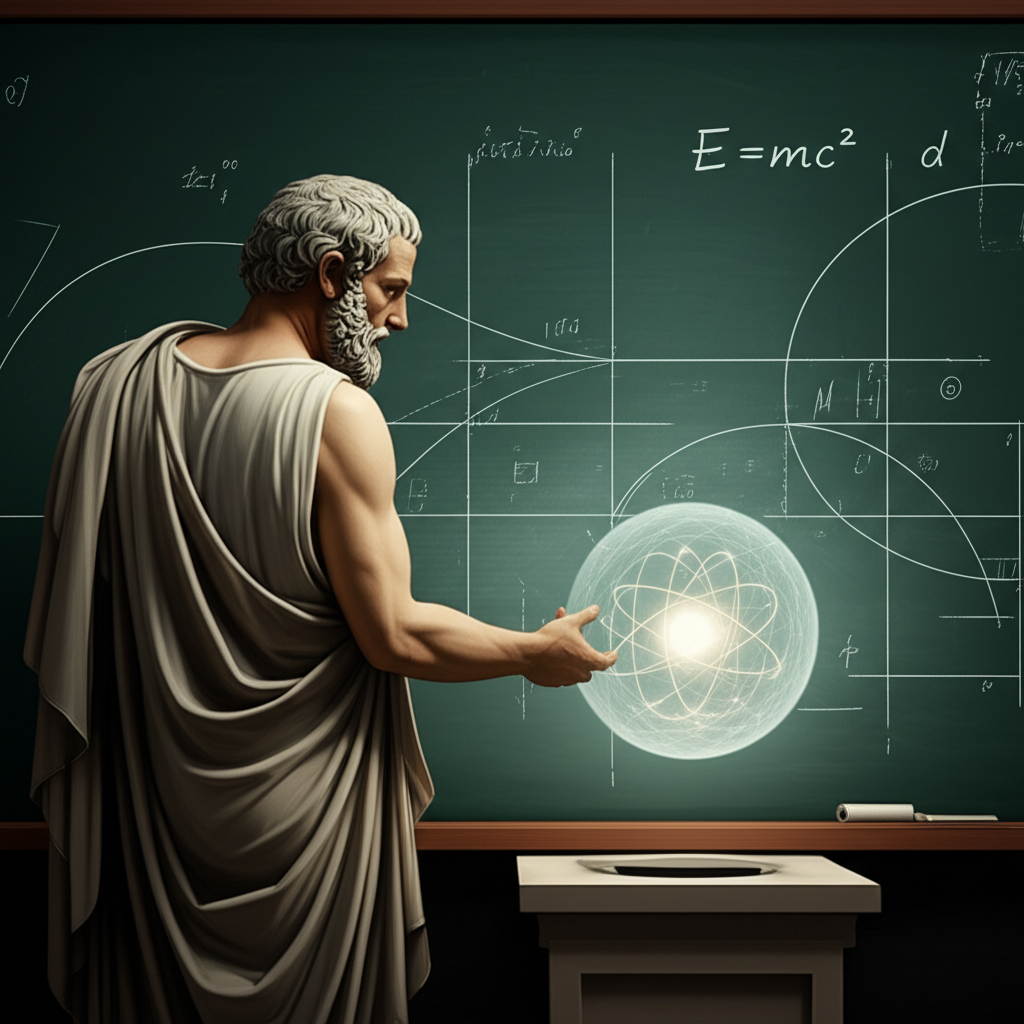
The Philosophical Echoes of Physics
The journey through the physics of matter and energy is more than a scientific expedition; it's a profound philosophical odyssey. From the pre-Socratics to quantum theorists, humanity has grappled with the same core questions: What is reality made of? How does it behave? What are its fundamental elements?
Modern physics offers incredible answers, but it also opens new philosophical chasms. The probabilistic nature of quantum mechanics challenges our intuitive understanding of cause and effect. The vastness of cosmic energy forces us to reconsider our place in the universe. The unification theories, seeking a "theory of everything," echo the ancient dream of a single, unifying Element.
The Great Books of the Western World provide a continuous dialogue, showing how these scientific discoveries are not separate from philosophy but are, in fact, its most powerful expressions. The pursuit of understanding matter and energy is the pursuit of understanding existence itself, an endless quest that bridges the gap between the measurable and the truly profound.
Conclusion: A Universe of Wonder
The physics of matter and energy unveils a universe of astonishing complexity and elegance. From the foundational elements conceived by ancient minds to the intricate mechanics governing quantum phenomena, every discovery deepens our appreciation for the intricate dance of existence. This journey reminds us that science and philosophy are inextricably linked, each informing the other in our ongoing quest to comprehend the fundamental nature of reality. The universe, in its rawest physical form, remains the greatest philosophical text.
YouTube: "Ancient Greek Atomism Philosophy Explained"
YouTube: "Quantum Mechanics Philosophical Implications"
📹 Related Video: What is Philosophy?
Video by: The School of Life
💡 Want different videos? Search YouTube for: "The Physics of Matter and Energy philosophy"