

The Unseen Threads: Chloe Fitzgerald on the Physics of Matter and Energy
Summary:
Our world, seemingly solid and predictable, is at its core a dance of matter and energy, governed by the intricate laws of physics. This article delves into the fundamental nature of these constituents, exploring how ancient philosophical inquiries into elements evolved into modern scientific understanding. We'll examine the role of mechanics in describing their interactions and ponder the profound philosophical implications these scientific insights hold for our perception of reality and existence itself.
As a student of philosophy, I've always been captivated by the underlying structure of reality. We often take the world around us for granted – the solidity of a table, the warmth of the sun, the very air we breathe. But what is this reality, at its most fundamental level? This is where physics, the grand old discipline, steps in, offering us a window into the core constituents of our universe: matter and energy. For me, understanding their interplay isn't just about scientific facts; it's about deepening our philosophical inquiry into existence itself.
The Elusive Nature of Matter: From Elements to Quarks
From the earliest philosophical musings, humanity has sought to understand the basic elements that compose everything. The ancient Greeks, featured prominently in the Great Books of the Western World, debated whether all was water, air, fire, or earth, or perhaps an "apeiron" – an infinite and indefinite primary substance. These early philosophers, in their own way, were grappling with the very definition of matter.
Today, physics offers a far more granular, and frankly, mind-boggling, perspective. We've moved beyond simple elements to a periodic table of over a hundred, each defined by its atomic structure. But even atoms aren't fundamental; they're composed of protons, neutrons, and electrons. And those, in turn, are made of quarks and leptons. It makes one wonder: where does the "stuffness" of matter truly end?
- Ancient Philosophical Views on Matter:
- Thales: Proposed water as the primary substance.
- Anaximenes: Suggested air as the fundamental element.
- Heraclitus: Believed fire was the ever-changing essence of all things.
- Empedocles: Advocated for four root elements (earth, air, fire, water) combined by love and strife.
- Democritus: Developed the concept of indivisible atoms, a striking precursor to modern thought.
This journey from macroscopic observation to subatomic particles highlights a profound philosophical shift. Our understanding of matter is not static; it's a continually evolving narrative, pushing the boundaries of what we perceive as "real."
Energy: The Universe's Dynamic Currency
If matter is the stuff, then energy is the doing. It's the capacity to do work, to cause change, to move. Without energy, matter would be inert, frozen, and utterly meaningless. Physics defines energy in myriad forms: kinetic (motion), potential (stored), thermal, chemical, electrical, nuclear, and radiant (light).
What's truly fascinating is the intimate relationship between matter and energy. Einstein's iconic equation, E=mc², didn't just revolutionize physics; it profoundly altered our philosophical understanding of existence. It declared that matter and energy are not separate entities but two sides of the same coin, interconvertible. Mass is a concentrated form of energy, and energy can manifest as mass. This revelation collapses the perceived duality, suggesting a deeper, unified reality.
- Common Forms of Energy:
- Kinetic Energy: The energy of motion.
- Potential Energy: Stored energy (e.g., gravitational, elastic).
- Thermal Energy: Related to temperature and particle motion.
- Electromagnetic Energy: Light, radio waves, X-rays.
- Nuclear Energy: Released from atomic nuclei.
This constant transformation and conservation of energy, a cornerstone of physics, provides a dynamic backdrop to our universe, a ceaseless dance of becoming and unbecoming.
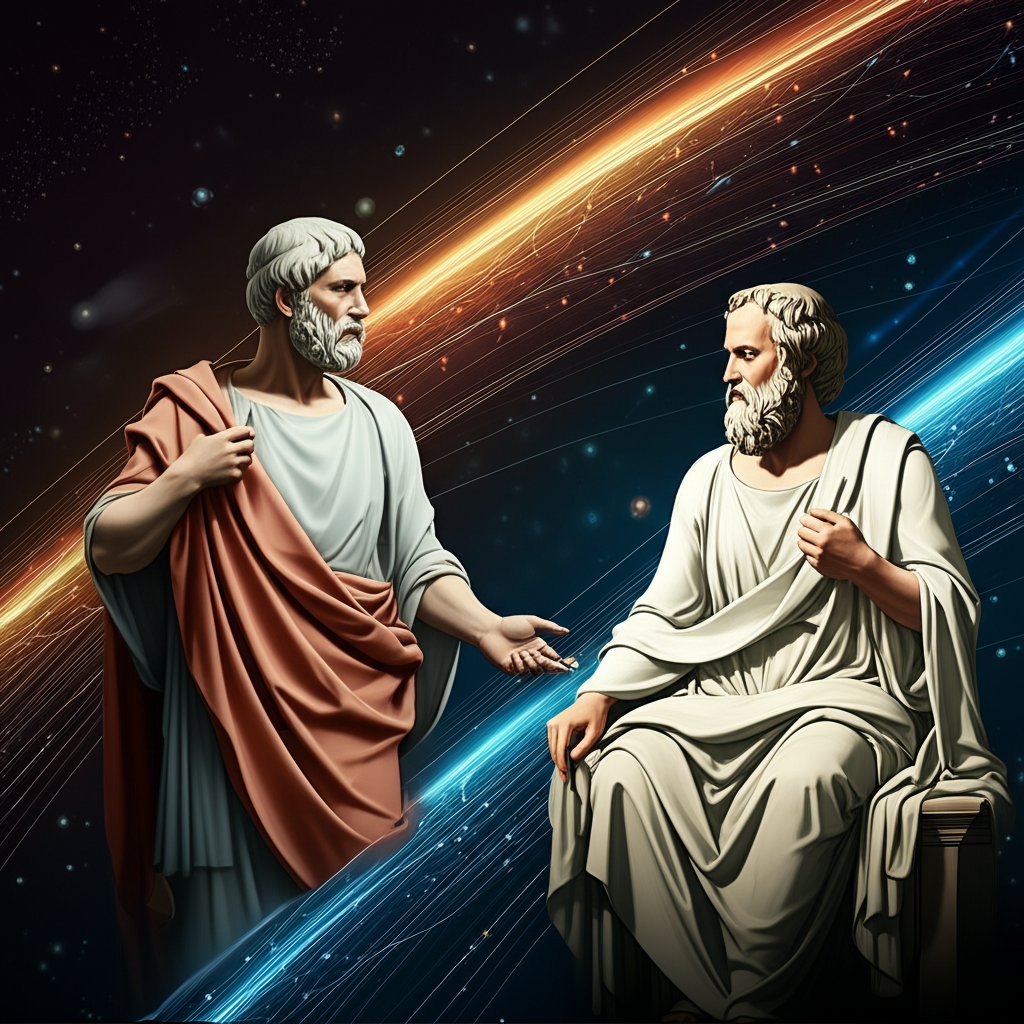
Mechanics: The Rules of the Game
To understand how matter and energy interact, we turn to mechanics. This branch of physics provides the foundational laws governing motion, forces, and the behavior of physical systems. From the predictable swing of a pendulum to the complex orbits of planets, classical mechanics, largely codified by Isaac Newton, gave us a deterministic universe where every action had a predictable reaction. This was a powerful philosophical tool, suggesting a grand, clockwork universe.
However, as physics delved deeper into the subatomic realm, classical mechanics proved insufficient. Quantum mechanics emerged, introducing concepts like wave-particle duality, superposition, and uncertainty. Here, predictability gives way to probabilities, and the act of observation itself seems to influence reality.
- Key Branches of Mechanics:
- Classical Mechanics: Describes macroscopic motion and forces (Newton's laws).
- Relativistic Mechanics: Describes motion at very high speeds, approaching the speed of light (Einstein's theories).
- Quantum Mechanics: Describes the behavior of matter and energy at atomic and subatomic scales.
The philosophical implications of quantum mechanics are staggering. If reality is inherently probabilistic at its deepest level, what does that mean for free will? For causality? It challenges our very notions of what it means to "know" or "observe" the world.
The Philosophical Resonance of Physics
The journey through the physics of matter and energy is not merely a scientific expedition; it's a profound philosophical odyssey. It forces us to confront fundamental questions:
- What is the true nature of reality? Is it solid, or is it an emergent property of fields and probabilities?
- How do we define existence when matter and energy are interconvertible?
- What are the limits of human knowledge when the act of observation itself becomes a variable?
From the earliest inquiries into elements in the Great Books of the Western World to the cutting-edge theories of quantum gravity, physics continually reshapes our metaphysical landscape. It challenges us to rethink our assumptions, to embrace uncertainty, and to marvel at the intricate, dynamic tapestry of the cosmos. Understanding the mechanics of how it all works isn't just about formulas; it's about understanding our place within this magnificent, ever-unfolding mystery.
Conclusion
The physics of matter and energy is a testament to humanity's relentless quest for understanding. It's a discipline that constantly pushes the boundaries of our perception, transforming our ancient philosophical inquiries into elements into a complex, beautiful, and often counter-intuitive modern science. As Chloe Fitzgerald, I find immense philosophical richness in this scientific exploration. It reminds us that reality is far more intricate and wondrous than we often imagine, a continuous source of wonder and intellectual challenge.
YouTube Video Suggestions:
-
📹 Related Video: KANT ON: What is Enlightenment?
Video by: The School of Life
💡 Want different videos? Search YouTube for: ""Quantum Mechanics for the Perplexed Philosopher""
2. ## 📹 Related Video: What is Philosophy?
Video by: The School of Life
💡 Want different videos? Search YouTube for: ""The Great Courses Physics and Philosophy""