

The Unseen Symphony: Exploring the Physics of Matter and Energy
A Philosophical Journey into the Fabric of Reality
From the earliest human inquiries, the fundamental nature of existence has captivated thinkers. What is the world made of? How does it move and change? These aren't merely scientific questions; they are deeply philosophical, probing the very fabric of our reality. This article delves into the profound intersection of physics, matter, and energy, exploring how our understanding of these core concepts has evolved and continues to shape our perception of the universe. We'll examine the historical quest to define the irreducible element of existence, the intricate dance of mechanics that governs all motion, and the philosophical implications arising from our scientific discoveries. It's a journey into the unseen symphony that composes everything we know and experience.
I. The Enduring Quest: Defining Matter
The concept of matter has been a cornerstone of philosophical and scientific inquiry since antiquity. For millennia, thinkers grappled with identifying the irreducible components of the world.
A. Ancient Seeds: From Elements to Atoms
The ancient Greeks, as documented in the Great Books of the Western World, offered some of the earliest systematic approaches. Plato, in his Timaeus, posited ideal geometric forms as the underlying elements of the cosmos, shaping the visible world. Aristotle, in his Physics and Metaphysics, introduced the concepts of matter and form, potentiality and actuality, suggesting that matter itself is a substratum awaiting form.
- Early Philosophical Views on Matter:
- Thales: Water as the primary substance.
- Anaximenes: Air as the fundamental element.
- Heraclitus: Fire and constant change.
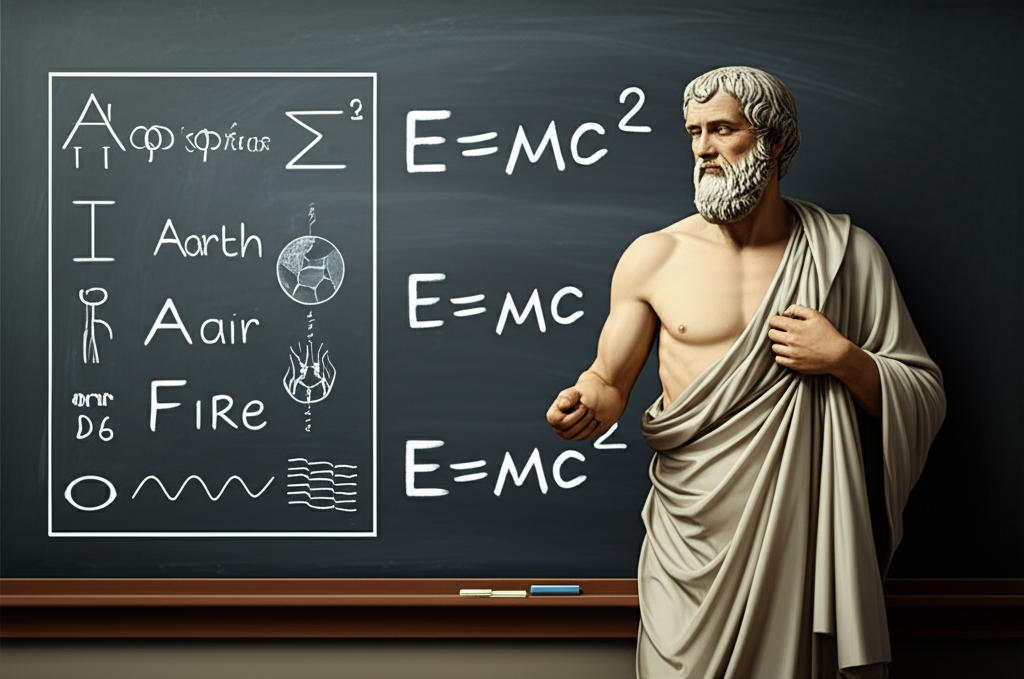
- Empedocles: Four roots – Earth, Air, Fire, Water – combined by Love and Strife.
- Democritus & Leucippus: The revolutionary idea of indivisible particles – atoms – moving in a void. This atomistic view, though speculative, remarkably prefigured modern atomic theory.
The transition from these philosophical speculations to empirical science was gradual, marked by the Renaissance and the Scientific Revolution. The alchemists' pursuit of transmuting elements eventually paved the way for modern chemistry, which definitively established the periodic table of elements, composed of atoms.
B. Modern Physics: Beyond the Tangible
Contemporary physics has pushed our understanding of matter far beyond the classical atom. We now know that atoms themselves are composed of subatomic particles: protons, neutrons, and electrons. Further still, protons and neutrons are made of quarks, and electrons are fundamental particles. The Standard Model of particle physics describes these fundamental constituents and the forces that govern their interactions.
- Key Concepts in Modern Matter Theory:
- Particles: Quarks, leptons (electrons, neutrinos), bosons (force carriers like photons).
- Fields: Quantum field theory posits that particles are excitations of underlying quantum fields that permeate all of space.
- Mass: No longer just a measure of "stuff," but an intrinsic property related to interaction with the Higgs field.
This journey from an abstract element to a complex tapestry of particles and fields challenges our intuitive grasp of what matter truly is. Is it discrete entities, or is it merely localized energy in a field? The philosophical implications are profound, questioning the very substance of reality.
II. Energy: The Dynamic Force of Existence
If matter is the "stuff," then energy is the dynamic principle, the capacity for doing work, for causing change. It is the unseen mover, the silent architect of all cosmic processes.
A. The Conservation Principle and Its Roots
The concept of energy as a conserved quantity is one of the most fundamental principles in physics. Although often attributed to 19th-century scientists, the idea that something is preserved through change has much older philosophical echoes. Aristotle's concept of potentiality and actuality, where a thing's potential is realized, hints at a transformation of states rather than an annihilation of intrinsic value.
Modern physics quantifies this: the total energy of an isolated system remains constant; it can only be transformed from one form to another (kinetic, potential, thermal, chemical, nuclear, etc.). This principle underpins everything from the motion of planets to the workings of a cell.
B. Einstein's Revelation: Matter-Energy Equivalence
Perhaps no equation has more profoundly altered our understanding of matter and energy than Albert Einstein's E=mc². This simple formula reveals a revolutionary truth: matter and energy are not distinct entities but two facets of the same fundamental reality. Mass (m) can be converted into energy (E), and energy can be converted into mass, with the speed of light (c) squared as the conversion factor.
This equivalence blurs the lines, suggesting that what we perceive as solid matter is, in essence, highly concentrated energy. It offers a compelling, albeit abstract, answer to the ancient question of the element of existence – it is a dynamic interplay between these two fundamental aspects.
III. The Mechanics of the Cosmos: Governing Motion and Interaction
Mechanics is the branch of physics concerned with the motion of bodies and the forces that cause them to move. It provides the framework for understanding how matter and energy interact and evolve.
A. Classical Mechanics: The Predictable Universe
Isaac Newton, building on the work of Galileo and Descartes (also prominent figures in the Great Books of the Western World), formalized classical mechanics. His laws of motion and universal gravitation described a universe that operated like a grand, predictable machine. Given initial conditions, the future state of any system could, in principle, be determined.
- Key Principles of Classical Mechanics:
- Inertia: An object at rest stays at rest, and an object in motion stays in motion with the same speed and in the same direction unless acted upon by an unbalanced force.
- Force and Acceleration: Force equals mass times acceleration (F=ma).
- Action-Reaction: For every action, there is an equal and opposite reaction.
- Gravitation: Every particle attracts every other particle with a force directly proportional to the product of their masses and inversely proportional to the square of the distance between their centers.
This deterministic worldview profoundly influenced philosophy, giving rise to ideas of a clockwork universe and challenging notions of free will.
B. Quantum Mechanics: The Unpredictable Subatomic Realm
At the turn of the 20th century, classical mechanics began to break down when applied to the subatomic world. Quantum mechanics emerged as a revolutionary new framework, revealing a universe far stranger and less deterministic than previously imagined.
| Feature | Classical Mechanics | Quantum Mechanics |
|---|---|---|
| Nature of Particles | Discrete particles with definite positions and momenta. | Wave-particle duality; particles exist as probability distributions. |
| Predictability | Deterministic; future states are predictable given initial conditions. | Probabilistic; exact outcomes cannot be predicted, only probabilities. |
| Observation | Observer is separate from the system. | Act of observation influences the system (e.g., Heisenberg's Uncertainty Principle). |
| Continuity | Continuous changes in energy and momentum. | Discrete "quanta" of energy; changes occur in jumps. |
Quantum mechanics forces us to reconsider the very nature of reality, causality, and even our role as observers. It challenges the traditional philosophical notions of objective reality and determinism, opening new avenues for metaphysical inquiry.
IV. Physics and Philosophy: An Ongoing Dialogue
The scientific exploration of matter and energy is not merely a technical exercise; it is a profound philosophical endeavor that continually reshapes our understanding of ourselves and our place in the cosmos.
A. The Search for a Unified Theory
Modern physics continues its quest for a "theory of everything" – a unified framework that reconciles general relativity (describing gravity and the large-scale structure of the universe) with quantum mechanics (describing the subatomic world). Such a theory would offer an unparalleled glimpse into the fundamental element of reality, potentially revealing a deeper symmetry or underlying principle that governs all matter and energy.
B. Consciousness in a Physical Universe
Perhaps one of the most enduring philosophical puzzles at the intersection of physics and philosophy is the nature of consciousness. If the universe is ultimately composed of matter and energy governed by mechanics, how does subjective experience arise? Is consciousness an emergent property of complex physical systems, or is it something fundamentally different, an element that transcends purely physical description? Quantum mechanics itself, with its emphasis on observation and probability, has even been invoked by some to suggest a more central role for consciousness in shaping reality.
Conclusion: The Unfolding Mystery
The journey to understand the physics of matter and energy is far from over. From ancient philosophical inquiries into the fundamental element to the cutting-edge theories of quantum gravity, humanity's quest to comprehend the universe is an ongoing dialogue between empirical observation and profound philosophical reflection. The intricate mechanics of the cosmos, the dynamic interplay of matter and energy, and the very nature of reality itself continue to unfold, inviting us to perpetually question, explore, and marvel at the unseen symphony that defines our existence.
YouTube Suggestions:
-
📹 Related Video: What is Philosophy?
Video by: The School of Life
💡 Want different videos? Search YouTube for: ""Physics and Philosophy: The Nature of Reality""
-
📹 Related Video: ARISTOTLE ON: The Nicomachean Ethics
Video by: The School of Life
💡 Want different videos? Search YouTube for: ""What is Matter? Crash Course Physics""