

The Physics of Change: A Universe in Constant Flux
Summary: At its very core, physics is the study of change. From the ancient Greek contemplation of nature (physis) to the intricate equations of modern mechanics, understanding how things transform, move, and interact has been the central pursuit. This article explores how our evolving comprehension of the physical world profoundly shapes our philosophical understanding of reality, identity, and existence itself, revealing a universe where flux is not an exception but the fundamental rule.
The Enduring Enigma of Transformation
From the moment we first gaze upon the world, we are confronted by an undeniable truth: everything changes. Leaves unfurl, seasons turn, empires rise and fall, and even the seemingly immutable mountains erode over millennia. This observation, so simple yet so profound, has been a cornerstone of philosophical inquiry since antiquity. How can something be and change simultaneously? What is the nature of this constant becoming?
The pre-Socratic philosophers grappled with this fiercely. Heraclitus famously declared that "you cannot step into the same river twice," asserting that flux is the only constant. Parmenides, on the other hand, argued that true being must be unchanging and eternal, dismissing perceived change as an illusion. This fundamental tension—between the undeniable experience of change and the logical yearning for permanence—sets the stage for centuries of philosophical and scientific exploration, much of which is beautifully documented in the Great Books of the Western World.
Aristotle's Physics: Unpacking the Mechanics of Nature
It was Aristotle, in his seminal work Physics, who provided one of the most comprehensive early frameworks for understanding change. Far from dismissing it, Aristotle embraced change as a fundamental aspect of nature. For him, change (or kinesis) was the actualization of what is potential. He meticulously categorized different types of change:
- Locomotion: Change in place (e.g., a ball rolling).
- Alteration: Change in quality (e.g., a leaf turning yellow).
- Growth and Diminution: Change in quantity (e.g., a child growing taller).
- Generation and Corruption: Change in substance (e.g., a tree growing from a seed, or decaying).
Aristotle's famous four causes—material, formal, efficient, and final—were his way of explaining why things change and what they change into. His mechanics were not mathematical in the modern sense but deeply conceptual, seeking to understand the inherent tendencies and purposes within natural phenomena. This holistic view of nature as a dynamic system, constantly moving from potentiality to actuality, laid the groundwork for future scientific inquiry, even as later scientists would challenge his specific explanations.
The Newtonian Revolution: Clockwork Universe and Predictable Change
Centuries later, the Scientific Revolution, epitomized by Isaac Newton's Philosophiæ Naturalis Principia Mathematica, transformed our understanding of change. Newton's laws of motion provided a rigorous, mathematical mechanics for describing how objects change their state of motion.
Newton's Laws of Motion and the Prediction of Change:
- Law of Inertia: An object at rest stays at rest, and an object in motion stays in motion with the same speed and in the same direction unless acted upon by an unbalanced force. (This describes the resistance to change in motion).
- Law of Acceleration: The acceleration of an object is directly proportional to the net force acting on it and inversely proportional to its mass. (This quantifies how an object changes its motion).
- Law of Action-Reaction: For every action, there is an equal and opposite reaction. (This describes the mechanics of interaction that causes change).
Newton's universe was a grand, deterministic clockwork. Given the initial conditions and the forces at play, the future state of any system could, in principle, be predicted with absolute certainty. This triumph of classical physics profoundly influenced philosophy, fostering a belief in a rational, ordered nature where change was governed by immutable laws. The universe, according to this view, was not arbitrary flux but a precisely orchestrated dance of cause and effect.
Modern Physics: Beyond Predictability, into the Quantum Dance
The 20th century brought new revolutions in physics that radically altered our understanding of change. Einstein's theories of relativity and the advent of quantum mechanics showed that the Newtonian picture, while incredibly powerful, was incomplete.
-
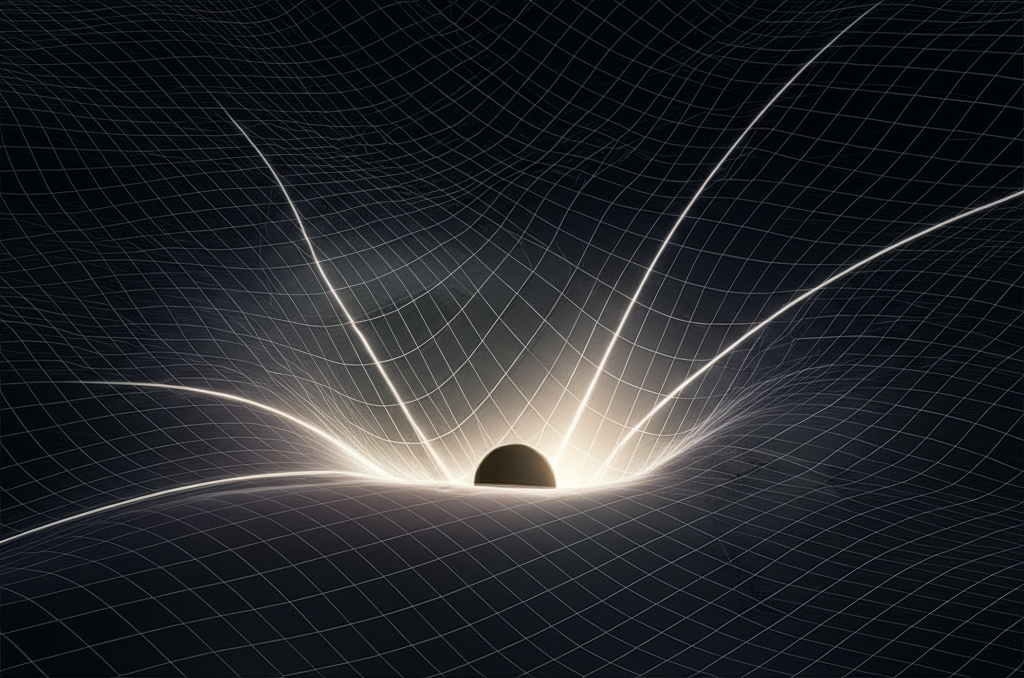
Relativity and the Elasticity of Space-Time: Einstein demonstrated that space and time are not absolute, fixed backgrounds but are relative to the observer and interwoven into a single fabric called space-time. Mass and energy warp this fabric, and this warping dictates the paths of objects. Change in motion is not merely an external force acting on an object, but an interaction with the dynamic geometry of space-time itself. The speed of light, however, stands as an invariant, a constant amidst the relative change.
-
Quantum Mechanics and Inherent Indeterminacy: At the subatomic level, the classical notion of predictable change breaks down. Quantum mechanics describes a reality where particles exist in states of superposition, only "collapsing" into a definite state upon measurement. The change from potentiality to actuality is fundamentally probabilistic, not deterministic. The very act of observation can influence the outcome, challenging the objective reality of change that classical physics assumed. This inherent unpredictability at the most fundamental level forces us to reconsider the nature of causality and determinism in the universe.
Philosophical Echoes: The Shifting Sands of Being
The journey through the physics of change from Aristotle to quantum mechanics is not merely a scientific one; it is a profound philosophical odyssey. Each scientific paradigm shift forces a re-evaluation of our most fundamental concepts:
- Identity: If everything is constantly changing, what constitutes identity? Is a person the same person over time if their cells, thoughts, and experiences are in perpetual flux?
- Reality: Is reality ultimately a stable, underlying substance, or is it an ongoing process, a dynamic unfolding of events? Process philosophy, for instance, argues that processes are more fundamental than static things.
- Knowledge: How can we gain reliable knowledge about a universe that is inherently dynamic and, at its quantum core, potentially indeterminate?
The physics of change teaches us that the universe is not a static stage upon which events unfold, but a vibrant, ever-transforming drama. Understanding its mechanics—from the grand movements of galaxies to the probabilistic dance of subatomic particles—is to grasp the very pulse of existence. The quest to comprehend change is, in essence, the quest to understand nature itself, and in doing so, to understand our place within its ceaseless flow.
**## 📹 Related Video: What is Philosophy?
Video by: The School of Life
💡 Want different videos? Search YouTube for: ""Heraclitus vs Parmenides: The Philosophy of Change" for a foundational discussion on the ancient views."**
**## 📹 Related Video: KANT ON: What is Enlightenment?
Video by: The School of Life
💡 Want different videos? Search YouTube for: ""Quantum Mechanics Explained Philosophically" for a modern perspective on the implications of quantum indeterminacy."**