

The Physical Element of Water: A Philosophical Inquiry into Nature's Fluid Foundation
Water, in its ubiquitous presence and ceaseless motion, has captivated the human mind since antiquity, not merely as a substance but as a profound philosophical element. Before the advent of modern chemistry, the physics of water—its observed physical properties and behaviors—served as a cornerstone for understanding the very fabric of matter and the essence of nature. This article delves into the classical perspective of water, exploring its foundational role in early philosophical thought as presented in the Great Books of the Western World, where its fluid nature offered profound insights into the cosmos.
Water as the Arche: Thales' Primal Principle
Among the earliest inquiries into the fundamental constituents of reality, Thales of Miletus, often considered the first philosopher, famously posited that water was the arche—the ultimate source and underlying element from which all things originate and into which they ultimately return. This bold assertion was not a mere guess but an observation rooted in the physical world.
Thales likely observed:
- Omnipresence: Water is everywhere—in the sky, on land, within living beings.
- Essentiality for Life: All life seems to depend on water for sustenance and growth.
- Transformative Capacity: Water can exist as a liquid, solidify into ice, and evaporate into vapor, suggesting its ability to change forms while retaining its essence.
- Nourishing Power: It moistens and fertilizes the earth, allowing life to flourish.
For Thales, the physics of water's observed transformations and its vital role in nature made it the most logical candidate for the primordial matter from which the diverse world emerged. This perspective established water not just as a substance, but as a philosophical element of immense significance, a lens through which to comprehend the unity underlying the apparent multiplicity of the world.
The Elemental Quartet: Water's Place in Cosmic Physics
Following Thales, later pre-Socratic thinkers refined the concept of fundamental elements. Empedocles, for instance, proposed four "roots" or elements—Earth, Air, Fire, and Water—which, through the interplay of Love and Strife, combined and separated to form all existing matter. Aristotle further systematized this understanding in his Physics and On Generation and Corruption, attributing specific primary qualities to each element.
For Aristotle, these elements were characterized by pairs of fundamental qualities:
- Hot vs. Cold
- Wet vs. Dry
Water, in this schema, was defined by the qualities of cold and wet. This understanding provided a framework for explaining the physical behavior of water in nature. Its coldness accounted for its tendency to move downwards (seeking its natural place at the center of the universe, like Earth), and its wetness explained its fluidity and capacity to mix with other substances. This was the ancient world's grand theory of physics, attempting to explain the composition and dynamics of all matter.
| Element | Primary Qualities | Observed Behavior (Ancient Physics) |
|---|---|---|
| Earth | Cold & Dry | Solid, heavy, tends downwards |
| Water | Cold & Wet | Liquid, fluid, also tends downwards |
| Air | Hot & Wet | Gaseous, light, tends upwards |
| Fire | Hot & Dry | Radiant, lightest, tends upwards |
This elemental physics allowed philosophers to explain phenomena like evaporation (water losing its coldness and becoming air-like), freezing (water losing wetness and gaining dryness, becoming earth-like), and the cyclical processes observed in nature.
The Dynamics of Water: Movement, Change, and Life
The physical attributes of water—its fluidity, its capacity for change, and its life-giving properties—were central to its philosophical consideration. Ancient thinkers observed how rivers carved landscapes, how seas connected distant lands, and how rain nourished crops. These observations led to profound reflections on change, permanence, and the interconnectedness of nature.
Heraclitus, with his famous dictum "You cannot step into the same river twice," underscored the ceaseless flux inherent in water, making it a metaphor for the constant change that defines existence itself. Yet, despite this constant motion, the element of water retains its identity, suggesting a deeper permanence within change.
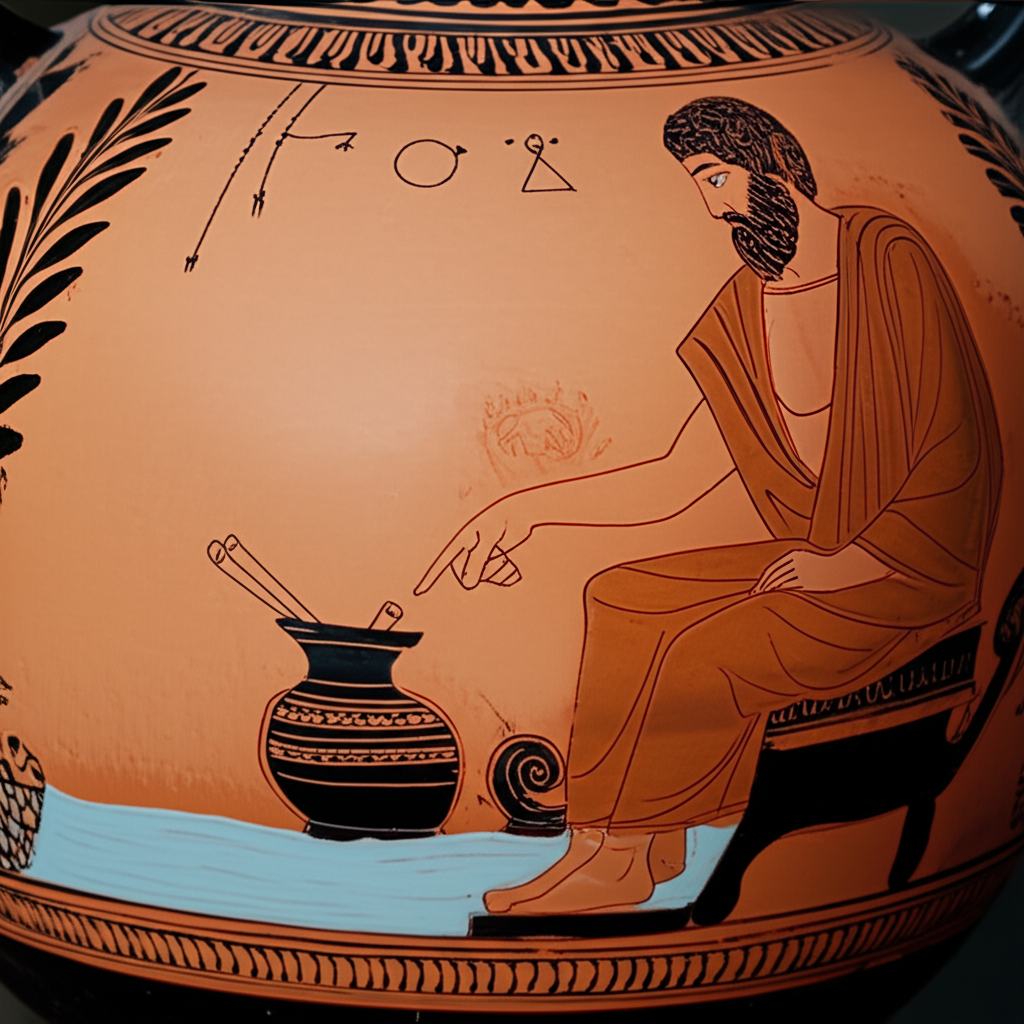
The life-sustaining properties of water further elevated its status. It was not merely an inert substance but an active participant in the generation and maintenance of life, a vital element without which the world of living beings could not exist. This deep connection to life cemented water's role as a fundamental element in the physics of the natural world, influencing everything from biology to cosmology.
From Philosophical Element to Modern Understanding
While modern science has redefined "element" and elucidated water's chemical composition as H₂O, the philosophical journey through water's elemental nature remains profoundly significant. The insights of Thales, Empedocles, and Aristotle, drawing conclusions from the observable physics of water, laid crucial groundwork for scientific inquiry. Their attempts to understand matter and nature through the lens of a primary element represent humanity's earliest systematic efforts to comprehend the universe.
The unique physical properties of water—its high specific heat, its solvent capabilities, its density anomaly—continue to be subjects of intense scientific and philosophical fascination, reminding us that even the most common element holds mysteries that challenge our understanding of physics and matter in nature.
Conclusion
From the primal arche of Thales to one of Aristotle's four fundamental elements, water has consistently occupied a central place in philosophical inquiry into nature. Its observable physical properties were not just facts but profound clues, guiding ancient thinkers in their monumental task of understanding the universe's physics and the composition of all matter. Re-examining these classical perspectives, particularly through the lens of the Great Books, enriches our appreciation for how deeply interconnected our understanding of the physical world is with our philosophical quest for meaning and order.
YouTube Suggestions:
-
📹 Related Video: What is Philosophy?
Video by: The School of Life
💡 Want different videos? Search YouTube for: ""Thales of Miletus Water Principle Philosophy Explained""
-
📹 Related Video: ARISTOTLE ON: The Nicomachean Ethics
Video by: The School of Life
💡 Want different videos? Search YouTube for: ""Aristotle Four Elements Physics and Qualities""