

The Physical Element of Water: A Philosophical Inquiry into Its Material Essence
Water, in its ubiquitous presence and ceaseless transformations, stands not merely as a chemical compound (H₂O) but as a profound philosophical element, a cornerstone of both ancient and modern understandings of matter and nature. This article delves into the physics of water not just as a scientific study, but as a lens through which philosophers, from the pre-Socratics to contemporary thinkers, have grappled with fundamental questions of existence, change, and the very fabric of the cosmos. Its physical properties – its fluidity, its capacity to dissolve, its transitions between solid, liquid, and gaseous states – offer a rich tapestry for exploring the intricate relationship between the observable world and the abstract principles that govern it.
Water: The Primordial Element and Its Philosophical Resonance
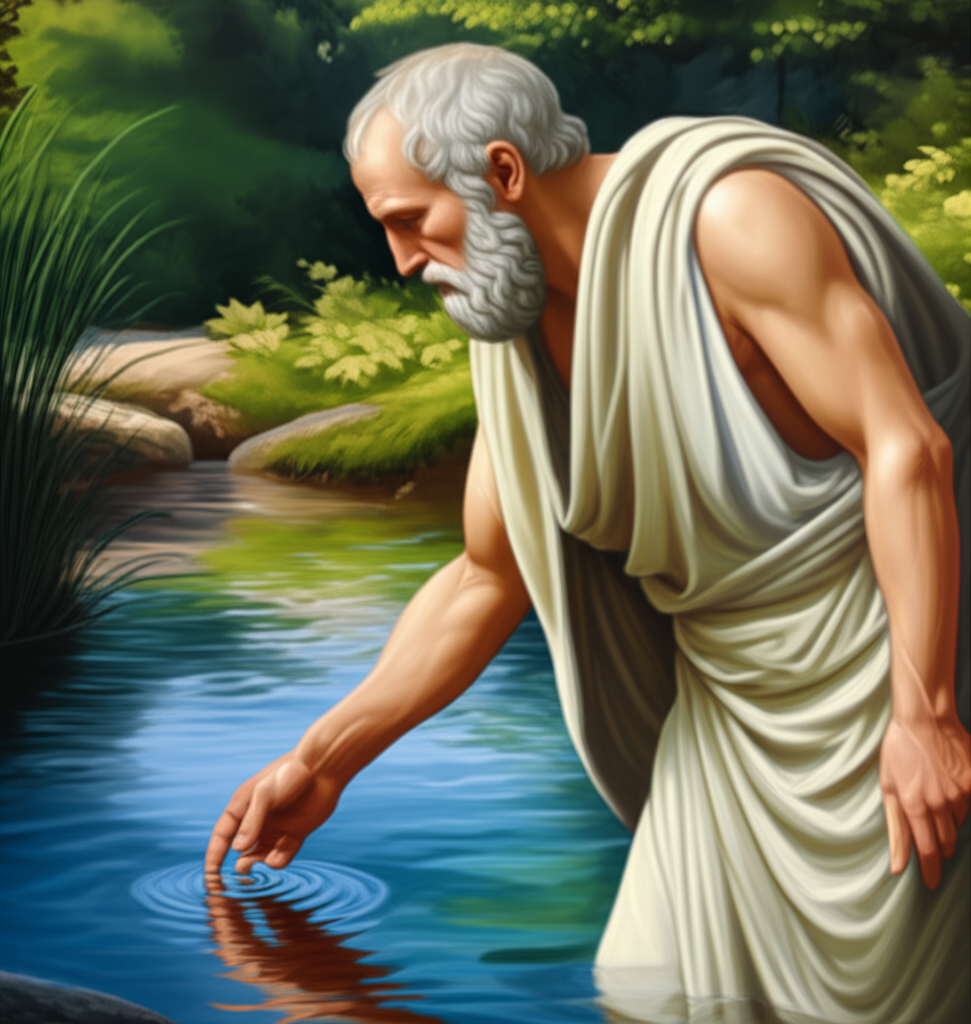
For many early philosophers, particularly Thales of Miletus, water was not simply a substance but the primordial element from which all else derived. This ancient insight, though later refined by empirical science, highlights a profound philosophical intuition: that a single, fundamental matter underpins the diverse phenomena of nature. The Great Books of the Western World, through the works of Aristotle and Plato, reveal how this idea evolved. Aristotle, in his Physics, meticulously examined the qualities of matter and form, placing water as one of the four terrestrial elements, characterized by cold and wetness.
- Thales' Monism: The belief that water is the arche, the originating substance.
- Empedocles' Four Roots: Water as one of the four indestructible roots (alongside earth, air, and fire) that combine and separate to form all things.
- Plato's Geometric Forms: In Timaeus, Plato assigns geometric solids to the elements, with the icosahedron representing water, reflecting its fluidity and the ease with which its particles can roll over one another.
This emphasis on water as a fundamental element underscores a persistent human endeavor to simplify the complex, to find unity in multiplicity, and to understand the underlying physics of creation.
The Physics of Water: A Journey Through States and Substances
The observable physics of water—its fluidity, its capacity to freeze into ice, to evaporate into vapor, and to condense back into liquid—has always fascinated thinkers. These transformations are not merely scientific facts; they are profound philosophical metaphors for change, permanence, and the transient nature of existence.
Consider the following properties:
- Fluidity: Water's ability to flow and take the shape of any container speaks to the concept of form and matter. Is its form inherent, or is it merely a reflection of its container? This question resonates with Aristotelian metaphysics regarding potentiality and actuality.
- States of Matter: The transitions between solid, liquid, and gas illustrate radical changes in physical properties while the underlying element (or compound, as we now know) remains. This prompts reflection on what constitutes identity and persistence through change.
| Aspect | Ancient Philosophical View (e.g., Aristotle) | Modern Scientific View (e.g., Chemistry/Physics) |
|---|---|---|
| Elemental Status | A fundamental, irreducible element | A compound (H₂O) made of hydrogen and oxygen |
| Properties | Cold and Wet; defined by intrinsic qualities | Defined by molecular structure and interactions |
| Transformations | Transmutation between elements; change of form | Phase transitions (solid, liquid, gas) |
| Composition | Prime matter with specific forms | Atoms, subatomic particles |
The shift from viewing water as a simple element to understanding its complex molecular physics represents a monumental leap in human knowledge. Yet, the philosophical questions it provokes—about the nature of substance, the reality of change, and the relationship between parts and whole—remain as pertinent today as they were in the time of the ancient Greeks.
Water's Role in Nature and Human Thought
Beyond its intrinsic physics, water's pervasive role in nature has imbued it with immense symbolic and spiritual significance. It is the giver of life, the cleanser, the destroyer. Rivers symbolize the relentless flow of time, oceans represent the unfathomable depths of the unknown, and rain signifies renewal. These associations are not accidental; they are deeply rooted in our experiential understanding of water's physical power and its essential nature.
- Nature's Mirror: Water reflects the sky, the trees, and ourselves, serving as a metaphor for consciousness and perception.
- The Cycle of Life: The hydrological cycle—evaporation, condensation, precipitation—mirrors the cycles of birth, death, and rebirth found in many philosophical and religious traditions.
- Purity and Cleansing: Its ability to wash away impurities has made it a symbol of purification, both physical and spiritual.
The elemental force of water, its capacity to shape landscapes and sustain ecosystems, continually reminds us of the delicate balance of nature and our place within it. From the smallest dewdrop to the mightiest ocean, water's physical presence challenges us to contemplate the profound mysteries of matter and the ceaseless motion of the cosmos.
YouTube Suggestions:
- "Thales of Miletus: The First Philosopher and Water as Arche"
- "Aristotle's Physics: Understanding Matter and Form"
📹 Related Video: What is Philosophy?
Video by: The School of Life
💡 Want different videos? Search YouTube for: "The Physical Element of Water philosophy"