

The Physical Element of Water: A Philosophical Inquiry into Nature's Quintessence
Water, that ubiquitous substance, often taken for granted, is in fact a profound philosophical Element whose physical properties offer deep insights into the very Nature of Matter and existence itself. From the earliest cosmologies to modern scientific understanding, its unique Physics has compelled thinkers to ponder the fundamental constituents of reality, revealing water not just as a compound, but as a mirror reflecting the essence of change, life, and the material world. This article delves into the enduring philosophical significance of water, exploring how its physical characteristics have shaped our understanding of the universe, as illuminated by the wisdom contained within the Great Books of the Western World.
Water as the Primordial Element: Echoes from Antiquity
Long before the modern understanding of atomic structures, ancient philosophers grappled with the question of the arche, the fundamental principle or substance from which all else originates. Among the earliest, Thales of Miletus, as chronicled in the philosophical traditions found in the Great Books, boldly proposed that water was this ultimate Element. His observation of water's pervasive presence, its essential role in life, and its capacity to transform—from liquid to solid to vapor—likely led him to this conclusion. For Thales, the Physics of water, its fluidity and transformative power, made it the prime candidate for the source of all Matter.
This ancient intuition underscores a profound truth: water’s physical Nature is intrinsically tied to the philosophical quest for understanding origin and substance. It is not merely a component but a foundational Element upon which complex systems, including life itself, are built.
The Physics of Water: Unveiling the Nature of Matter
The peculiar physical properties of water continue to fascinate scientists and philosophers alike. Its capacity to exist naturally in three states—solid (ice), liquid (water), and gas (steam)—at Earth's surface temperatures is a testament to its unique molecular structure. This tri-state existence, a fundamental aspect of its Physics, provides a tangible metaphor for change and permanence, a recurring theme in philosophy.
Consider the following aspects of water's Physics:
- States of Matter: Water's transitions between solid, liquid, and gas demonstrate the dynamic Nature of Matter. It shows how a single Element can manifest in dramatically different forms while retaining its fundamental identity. This fluidity and adaptability stand in stark contrast to more rigid elements, offering a lens through which to view the constant flux of existence.
- Universal Solvent: Water's ability to dissolve a vast array of substances highlights its interactive Nature. Philosophically, this suggests a principle of interconnectedness and the constant interplay of elements within the cosmos.
- High Specific Heat Capacity: Water's capacity to absorb and release significant amounts of heat without drastic temperature changes is crucial for regulating climates and sustaining life. This stability amidst change reflects a balancing force within Nature, a theme often explored in discussions of cosmic order and harmony.
- Anomalous Expansion: Unlike most substances, water expands as it freezes. This peculiar physical trait ensures that ice floats, insulating bodies of water and allowing aquatic life to survive in colder climates. Such an "anomaly" prompts philosophical reflection on the intricate design and self-preservation mechanisms inherent in Nature.
These physical characteristics are not mere scientific data; they are profound indicators of the Nature of Matter and the intricate workings of the universe.
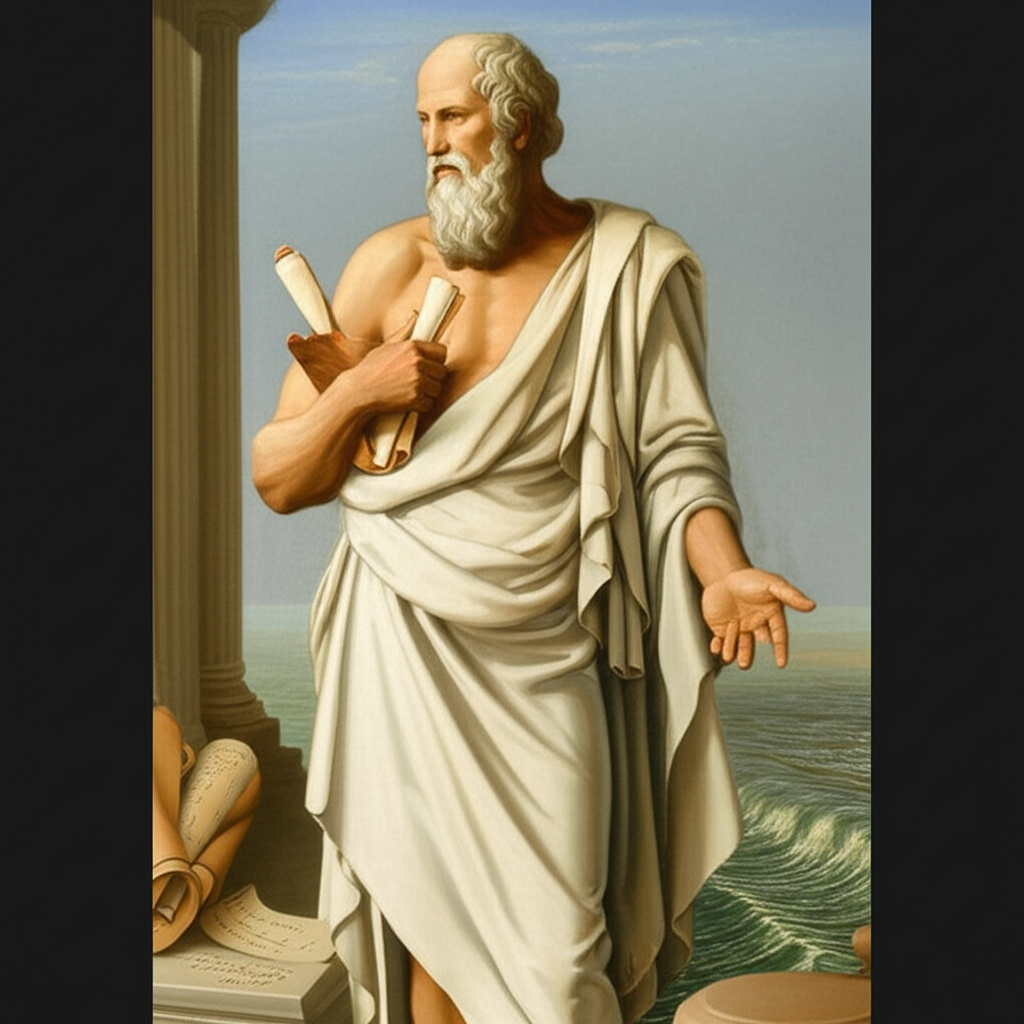
Water in the Great Books: A Philosophical Journey
The Great Books of the Western World are replete with references to water, not merely as a substance, but as a conceptual cornerstone for understanding reality.
- Heraclitus: The idea of constant change, famously encapsulated in "one cannot step into the same river twice," directly employs water's flowing Nature to illustrate the ceaseless flux of existence. Here, the Physics of water becomes a metaphor for the dynamic character of reality itself.
- Plato: In the Timaeus, Plato discusses the elements in terms of geometric forms. While water is assigned the icosahedron, the very act of assigning a form to it underscores its fundamental status as an Element in the construction of the cosmos. Its capacity for transformation into other elements further highlights its pivotal role in the Physics of the material world.
- Aristotle: Building upon earlier thought, Aristotle categorized water as one of the four terrestrial elements, characterized by the qualities of cold and wet. His detailed Physics explores the Nature of Matter, motion, and change, with water serving as a primary example of a substance undergoing generation and corruption, moving towards its natural place.
These philosophical traditions demonstrate a continuous engagement with water's physical Nature as a key to unlocking deeper truths about the universe.
The Philosophical Implications of Water's Nature
Water's physical properties compel us to consider fundamental philosophical questions:
| Physical Property | Philosophical Implication |
|---|---|
| Fluidity & Adaptability | The essence of change, impermanence, and the ability to conform. |
| Life-Giving Force | The source of vitality, renewal, and the interconnectedness of all life. |
| Transformative States | The dynamic Nature of Matter, illustrating generation and decay. |
| Cleansing & Purity | Metaphors for purification, rebirth, and moral virtue. |
The Physics of water, therefore, is not merely a scientific domain but a rich source of metaphor and analogy for understanding human experience, the passage of time, and the cyclical Nature of existence. It teaches us about resilience, the necessity of flow, and the profound interconnectedness of all Matter.
Conclusion: The Enduring Mystery of Water
From the primordial Element of Thales to the subject of intricate quantum Physics, water continues to be a source of wonder and philosophical inquiry. Its unique physical properties—its fluidity, its capacity for change, its life-sustaining power—offer a tangible connection to the abstract concepts of Matter, Nature, and existence. As we delve into the Great Books and contemporary science, the simple act of contemplating water reveals layers of meaning, reminding us that the most fundamental Elements often hold the deepest philosophical truths about our world and ourselves.
YouTube Video Suggestions:
-
📹 Related Video: What is Philosophy?
Video by: The School of Life
💡 Want different videos? Search YouTube for: "Thales of Miletus water element philosophy"
2. ## 📹 Related Video: ARISTOTLE ON: The Nicomachean Ethics
Video by: The School of Life
💡 Want different videos? Search YouTube for: "Aristotle Four Elements explained"