

The Philosophy of Space: From Ancient Intuitions to Modern Cosmos
The concept of space is so fundamental to our experience that we often take it for granted. Yet, when we pause to truly consider its nature, we find ourselves at the precipice of some of the most profound questions in philosophy and physics. Is space a container for all things, an empty void waiting to be filled, or is it merely a description of the relationships between things? This supporting article delves into the rich history of philosophical inquiry into space, exploring how thinkers across millennia have grappled with its perplexing reality, from its metaphysical underpinnings to its physical manifestations.
Ancient Roots: Defining "Place" and "Container"
Our journey into the philosophy of space begins with the ancients, whose initial inquiries laid the groundwork for centuries of debate. They sought to understand not just where things are, but what that "where" truly is.
- Plato's Chora: In his dialogue Timaeus, Plato introduces the concept of chora, often translated as "receptacle" or "space." It's a mysterious, formless entity that provides a "place" for the eternal forms to be imprinted upon, allowing for the creation of the sensible world. It's neither matter nor form, but a third kind of being, difficult to grasp intellectually.
- Aristotle's "Place" (Topos): Aristotle, ever the empiricist, rejected the idea of an empty void. For him, "place" (topos) was not an independent entity but the innermost motionless boundary of the containing body. Essentially, an object's place is defined by what immediately surrounds it. This relational view of space emphasizes the contiguity of bodies rather than an empty expanse. He famously argued against the existence of a vacuum, believing that "nature abhors a vacuum."
These early distinctions set the stage for a recurring tension: is space an independent entity, or is it merely a property or relation of objects?
The Modern Divide: Absolute vs. Relational Space
The scientific revolution brought new urgency to the philosophical debate on space, particularly with the rise of classical mechanics.
- Newton's Absolute Space (Substantivalism): Isaac Newton, in his Principia Mathematica, posited the existence of absolute space. For Newton, space is a real, independent, infinite, and eternal entity, distinct from the objects within it. It acts as an immutable backdrop, a "sensorium of God," against which all motion is measured. This view, known as substantivalism, treats space as a kind of substance. He famously used the thought experiment of a rotating bucket of water to argue for absolute motion, implying the existence of an absolute frame of reference – absolute space.
- Leibniz's Relational Space (Relationism): Gottfried Wilhelm Leibniz vehemently opposed Newton's absolute space. For Leibniz, space is not a substance but merely a system of relations between existing objects. It is the order of coexistence of phenomena, just as time is the order of succession. If there were no objects, there would be no space. This relationist view argues that spatial properties like distance and position only make sense in reference to other objects. Leibniz's "Principle of Sufficient Reason" led him to argue that absolute space would imply indistinguishable points, which would violate God's wisdom in creation.
These opposing views formed the bedrock of the metaphysics of space for centuries, forcing philosophers to confront the very nature of reality and existence.
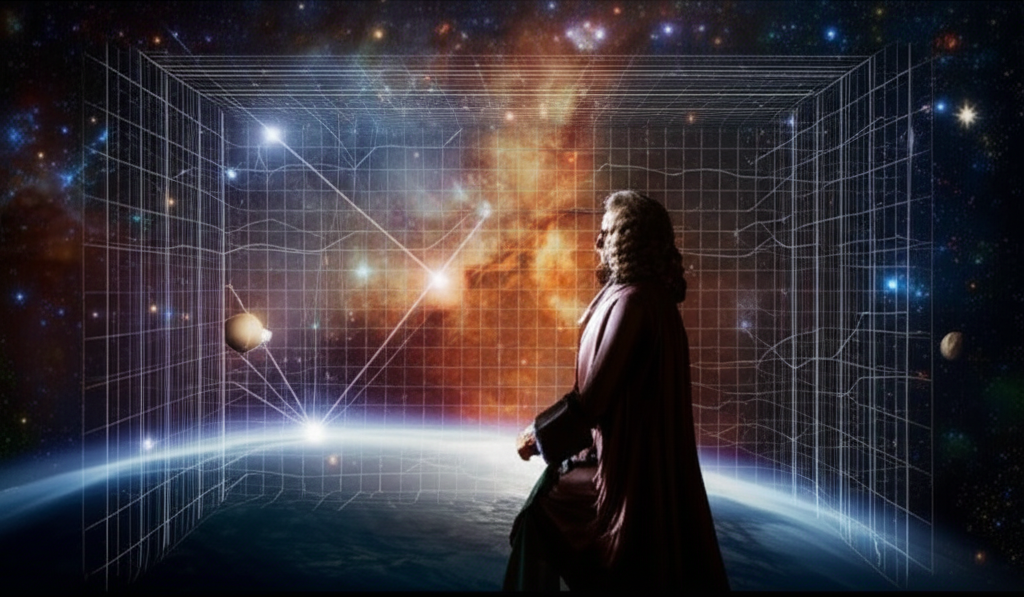
Kant's Transcendental Idealism: Space as an A Priori Intuition
Immanuel Kant offered a revolutionary perspective, attempting to bridge the gap between empiricism and rationalism in his Critique of Pure Reason. He argued that space is neither an objective reality existing independently in the world (as Newton believed) nor merely a conceptual abstraction from relations (as Leibniz held).
Instead, Kant proposed that space is a fundamental, a priori form of our intuition – a necessary condition for us to experience anything at all. We don't perceive space through our senses; rather, our minds are structured in such a way that we must perceive objects as being in space. It's a "transcendental ideal" that structures our understanding of the phenomenal world. This means that while space is not a property of things-in-themselves, it is objectively valid for all possible human experience.
The Twentieth Century: Physics Reshapes Philosophy
The advent of modern physics dramatically altered the philosophical landscape concerning space.
- Einstein and Spacetime: Albert Einstein's theories of Special and General Relativity shattered the Newtonian conception of absolute space and time as separate entities. He introduced the concept of spacetime, a four-dimensional continuum where space and time are interwoven. Gravity, in General Relativity, is no longer a force acting in space, but rather a curvature of spacetime itself caused by mass and energy. This profound shift blurred the lines between the physical and metaphysical, suggesting that the very fabric of reality is dynamic and influenced by matter.
- Quantum Mechanics: The bizarre world of quantum mechanics further challenges our intuitive understanding of space. Concepts like non-locality, entanglement, and the probabilistic nature of reality raise new questions about the continuity and fundamental structure of space at the smallest scales. Does space itself "pixelate" at the Planck length? Is it emergent from more fundamental quantum phenomena?
Contemporary Debates and Future Horizons
The dialogue between philosophy and physics continues to evolve, with contemporary debates revisiting old questions through new lenses.
- Substantivalism vs. Relationism, Revisited: Despite Einstein's work, the debate between substantivalism and relationism persists. While spacetime is dynamic, some argue that it still functions as a kind of substance, a "container" with its own properties. Others argue that even spacetime is ultimately a set of relations.
- The Nature of Spacetime: Is spacetime fundamental, or does it emerge from something deeper, perhaps from quantum gravity theories? What are the implications of theories suggesting extra dimensions or the multiverse for our understanding of space?
- The Problem of "Empty" Space: Even a vacuum in modern physics is not truly empty; it seethes with virtual particles and quantum fields. This raises questions about the definition of "emptiness" and the ontological status of these quantum fluctuations within space.
Conclusion
From the ancient Greeks pondering the nature of "place" to modern cosmologists exploring the curvature of spacetime, the philosophy of space remains a vibrant and essential field of inquiry. It forces us to confront our most basic assumptions about reality, pushing the boundaries of both metaphysics and physics. As our scientific understanding of the cosmos expands, so too does the richness and complexity of the philosophical questions we ask about the very fabric of our existence. The conversation is far from over, and perhaps, like space itself, it is infinite.
YouTube Video Suggestions:
-
📹 Related Video: KANT ON: What is Enlightenment?
Video by: The School of Life
💡 Want different videos? Search YouTube for: ""Leibniz Newton debate absolute space time""
2. ## 📹 Related Video: KANT ON: What is Enlightenment?
Video by: The School of Life
💡 Want different videos? Search YouTube for: ""Kant's Critique of Pure Reason Space Time""