

The Philosophical Role of the Family: A Foundational Inquiry
The family, often perceived as a mere social or biological construct, holds a profound and indispensable philosophical role in human existence. Far from being a peripheral concern, its structure, function, and relationship to the individual and the State have been central to political theory, ethics, and metaphysics throughout Western thought. This article delves into the philosophical significance of the family, exploring its foundational position as a crucible for virtue, a primary locus of Custom and Convention, and a persistent counterpoint or complement to the authority of the State. Understanding the family philosophically reveals its enduring impact on our moral landscapes and the very fabric of society.
Defining the Family Through a Philosophical Lens
To approach the family philosophically is to move beyond its immediate empirical manifestations and inquire into its essence, purpose, and normative implications. From the perspective of Philosophy, the family is not just a unit of procreation or cohabitation; it is:
- A Primary School of Virtue: The initial environment where individuals learn reciprocity, responsibility, love, and sacrifice.
- A Mediator of Individual and State: The first social unit that shapes the individual before their engagement with the broader State.
- A Repository of Tradition: The principal vehicle for transmitting Custom and Convention, cultural norms, and intergenerational wisdom.
- A Site of Natural Authority: The space where concepts of authority, obedience, and freedom are first encountered and negotiated.
This philosophical lens allows us to appreciate the family's intricate role in shaping both personal identity and civic life.
Ancient Foundations: Plato, Aristotle, and the Household
The Great Books of the Western World offer rich insights into the philosophical understanding of the family, beginning with the ancient Greeks.
Plato's Radical Vision in the Republic
In Plato's Republic, the family presents a fascinating, albeit controversial, philosophical challenge. For the guardian class, Plato proposes the abolition of private families, advocating for communal child-rearing and shared spouses. His rationale is purely philosophical:
- Elimination of Partiality: Private family loyalties are seen as a distraction from ultimate loyalty to the State.
- Unity of Purpose: All citizens, particularly guardians, should view each other as one large family, fostering a unified purpose for the common good.
- Optimized Education: Children would receive an education designed solely by the State to produce the most virtuous and capable citizens, unhindered by familial biases or limitations.
Plato's radical proposal underscores the tension between individual familial bonds and the ideal State, positioning the family as a potential obstacle to political perfection if not properly managed or, in his view, superseded.
Aristotle's Natural Household in the Politics
Aristotle, in his Politics, offers a contrasting and profoundly influential view. For Aristotle, the household (oikos) is the fundamental and natural unit from which the village and, ultimately, the State (polis) emerge. He argues that:
- Natural Origin: The family is a natural association, prior to the State, formed for the daily needs of life and procreation.
- Economic Unit: It serves as the primary economic unit, producing and managing resources necessary for survival.
- School of Virtue: Within the family, individuals learn to rule and be ruled, developing the ethical habits necessary for citizenship. The relationship between husband and wife, parent and child, master and slave (a problematic aspect of his era) are all forms of governance that prepare individuals for political life.
- Basis of the State: Without well-ordered families, the State cannot flourish, as it relies on the virtues and stability cultivated within these smaller units.
Aristotle's Philosophy places the family not as a threat, but as the indispensable building block of the State, a place where the seeds of Custom and Convention are first sown and nurtured.
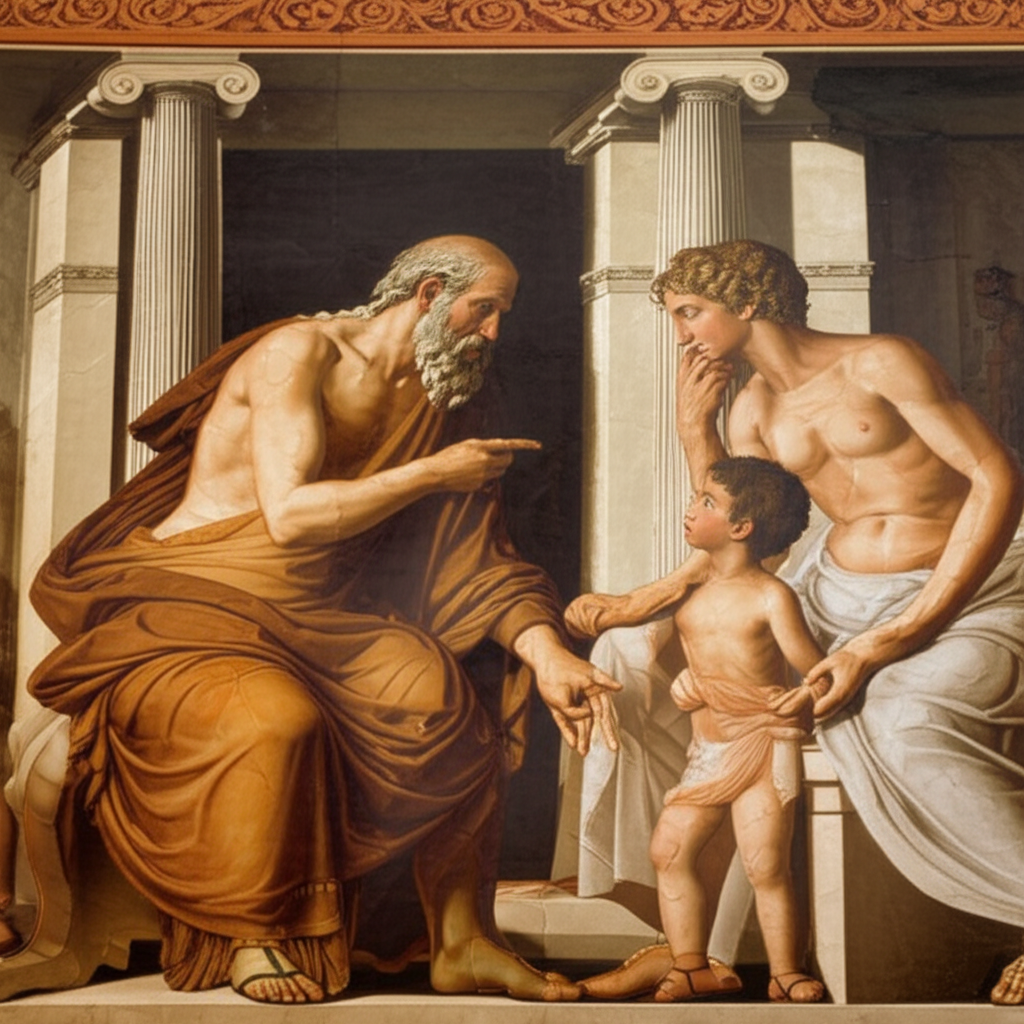
The Family, State, and Individual Liberty in Modern Thought
As Western thought evolved, philosophers continued to grapple with the family's role, particularly concerning individual rights and the legitimate authority of the State.
John Locke and Parental Power
John Locke, in his Two Treatises of Government, critically examines the nature of parental authority. He distinguishes it sharply from political power, arguing that:
- Temporary Authority: Parental power is not absolute or perpetual but temporary, existing only for the child's benefit and until they reach the age of reason.
- Duty-Bound: It is a duty to care for, nurture, and educate children, preparing them for independent life.
- Foundation for Consent: By learning obedience within the family, children are prepared to understand the concept of consent, which is foundational to legitimate government in Locke's Philosophy.
Locke's work highlights the family as a crucial sphere where individuals develop the capacity for self-governance and moral agency, distinct from, yet preparatory for, their role as citizens in the State.
Jean-Jacques Rousseau on the First Society
Rousseau, particularly in Discourse on the Origin of Inequality and Emile, also considers the family. He sees it as:
- The Oldest Society: The only natural society, predating the formation of the State.
- Temporary Bonds: Even within this "first society," the bonds of parental authority are temporary, lasting only as long as the child needs protection. Once children can provide for themselves, the natural bond dissolves, though the convention of staying together may continue.
- Crucible for Natural Education: In Emile, Rousseau emphasizes the family's role in providing a natural education, allowing the child to develop innate goodness before being corrupted by society.
Rousseau's Philosophy underscores the family's natural origins while also pointing to its conventional aspects and the temporary nature of its foundational power.
Custom and Convention: The Family as a Cultural Nexus
Beyond its political implications, the family is the primary institution for the transmission of Custom and Convention. This involves:
- Moral Education: Imparting fundamental ethical principles, a sense of right and wrong, and the development of conscience.
- Socialization: Teaching social norms, etiquette, language, and cultural practices that enable individuals to function within their community.
- Identity Formation: Providing a sense of belonging, heritage, and personal history that shapes an individual's identity.
- Value System: Instilling core values, beliefs, and worldviews that guide an individual's life choices and interactions.
The family, therefore, acts as a bridge between the individual and the larger society, translating abstract societal rules into concrete, lived experiences. It is where the unwritten laws of Custom and Convention gain their power and permanence.
Conclusion: The Enduring Philosophical Significance
The philosophical inquiry into the family reveals its multifaceted and enduring importance. From ancient Greek ideals of the State to modern considerations of individual liberty, the family remains a central concept in Philosophy. It is the initial stage for moral development, the primary incubator of Custom and Convention, and a dynamic entity whose relationship with the State is continuously negotiated. As societies evolve, the philosophical questions surrounding the family's role in shaping individuals and communities persist, reminding us that this fundamental human institution is far more than a simple social unit – it is a cornerstone of our very humanity and civilization.
Further Philosophical Exploration:
- YouTube: Search for "Aristotle Politics Family Oikos" for discussions on the household as the foundation of the polis.
- YouTube: Search for "Plato Republic abolition of family" to explore the radical implications of Plato's guardian class proposals.
📹 Related Video: What is Philosophy?
Video by: The School of Life
💡 Want different videos? Search YouTube for: "The Philosophical Role of the Family philosophy"