

The Enduring Enigma of "How Much": The Philosophical Problem of Quantity
The philosophical problem of Quantity is far more intricate than merely counting apples or measuring distances. It delves into the very fabric of existence, questioning the fundamental nature of "how much" or "how many," and its profound implications for our understanding of reality, knowledge, and even ourselves. This isn't just a mathematical concern; it's a cornerstone of Metaphysics, challenging us to formulate a precise Definition of what quantity truly is and how it relates to being. From the ancient Greeks to modern analytical thought, philosophers have grappled with whether quantity is an inherent property of things, a construct of the mind, or an independent entity unto itself.
Unpacking the Core Problem: Beyond Simple Arithmetic
At its heart, the philosophical problem of quantity asks: What is quantity, fundamentally? Is it a property that substances possess, like color or shape? Or is it a more primary aspect of being, without which nothing could truly exist or be understood? This inquiry pushes us to consider:
- The Nature of Number: Are numbers real, abstract entities (Platonism), or merely mental constructs and tools for measurement (Nominalism)?
- Discrete vs. Continuous: What is the difference between things that can be counted (discrete quantities, like individual objects) and things that can be measured (continuous quantities, like space, time, or magnitude)?
- Quantity and Substance: Can something exist without any quantity? How does quantity relate to the identity and persistence of an object?
- The Infinite: How do we conceptualize infinite quantity, and what are its paradoxes?
This complex interplay of ideas forms a rich tapestry of philosophical inquiry, challenging our intuitive grasp of the world.
A Journey Through Thought: Historical Perspectives on Quantity
The Great Books of the Western World reveal a long and distinguished lineage of thinkers wrestling with the concept of quantity.
Ancient Foundations: Plato and Aristotle
- Plato's Forms: For Plato, numbers and mathematical entities held a special, elevated status. They were not merely human inventions but perfect, eternal Forms existing in a realm separate from the sensible world. A perfect circle or the number two existed independently of any physical manifestation. This view profoundly influenced subsequent thought, suggesting that true knowledge of quantity was not derived from empirical observation but from intellectual apprehension of these ideal Forms.
- Aristotle's Categories: Aristotle, ever the systematizer, placed Quantity as one of his ten fundamental Categories of Being. For him, quantity was a property or attribute that a substance possesses, rather than a substance itself. He meticulously distinguished between:
- Discrete Quantity: Things that are countable, like "ten men" or "two horses." These have distinct, separable parts.
- Continuous Quantity: Things that are measurable, like "a line of three cubits" or "a surface of four square feet." These have parts that are joined at a common boundary, without natural divisions.
Aristotle's analysis provided a foundational Definition for understanding quantity as an inherent characteristic of existing things, crucial for his broader Metaphysics.
Early Modern Explorations: Descartes, Locke, and Kant
The Scientific Revolution brought a renewed focus on measurable properties, elevating the role of quantity in understanding the physical world.
- Descartes and Extended Substance: René Descartes posited that the essence of physical reality (res extensa) was extension – a purely quantitative attribute. For Descartes, the material world was fundamentally spatial, measurable, and geometrically describable. All other properties, like color or sound, were secondary and mind-dependent. This radical view made quantity the primary characteristic of physical existence.
- Locke's Primary Qualities: John Locke, in his Essay Concerning Human Understanding, further developed the distinction between primary and secondary qualities. He argued that primary qualities – such as solidity, extension, figure, motion, rest, and number – are inherent in objects themselves and exist independently of our perception. Secondary qualities – like color, sound, taste, and smell – are powers in objects to produce sensations in us. Quantity, especially number and extension, was firmly placed among the primary qualities, directly reflecting the objective reality of the world.
- Kant's Categories of Understanding: Immanuel Kant, seeking to bridge rationalism and empiricism, proposed that quantity is not just a property of objects but also a fundamental Category of Understanding through which our minds structure experience. We cannot experience the world without imposing concepts of unity, plurality, and totality upon it. For Kant, quantity is therefore both an objective feature of the world (as we perceive it) and a necessary condition of our cognition.
The Problem of Defining Quantity Itself
One of the most persistent challenges is arriving at a universally accepted Definition of quantity. Is it:
- A property? (e.g., "The table has a quantity of four legs.")
- A relation? (e.g., "This is twice as large as that.")
- An abstract concept? (e.g., "The number three.")
- A fundamental aspect of being? (e.g., "All things must have some quantity.")
The choice of Definition has profound Metaphysics implications. If quantity is merely a property, then substances could theoretically exist without it (though this is difficult to imagine). If it's a fundamental aspect, then quantity is inextricably linked to existence itself.
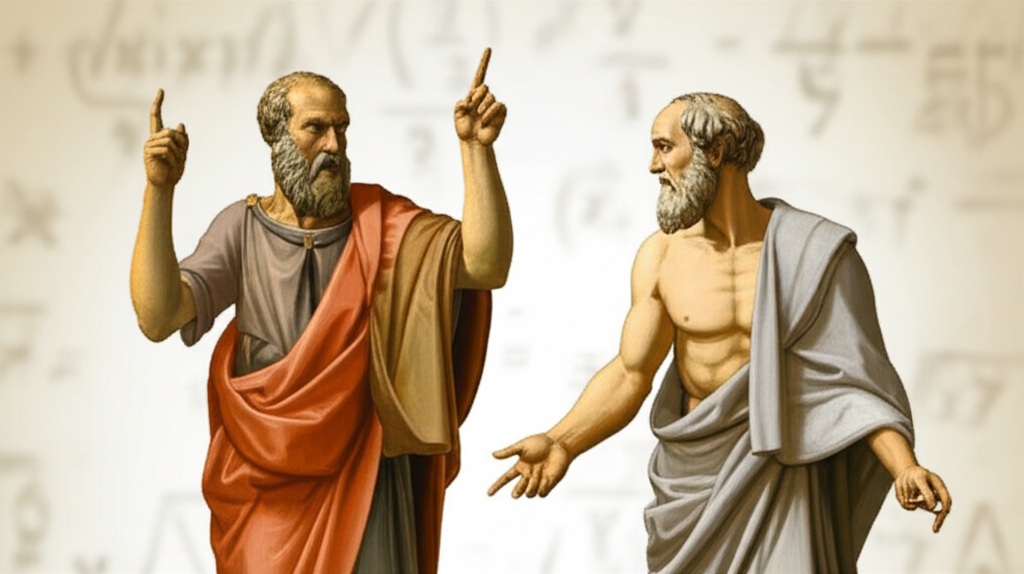
Key Distinctions in the Realm of Quantity
Understanding the nuances of quantity often requires distinguishing between its various forms:
| Type of Quantity | Description | Examples | Philosophical Implications Socrates is not referring to a specific quantity of something but rather to a fundamental aspect of existence. This notion of quantity, or "how much," is not just about the numbers but about the very essence of what it means for something to be.
The Problem of the Infinite: Quantity Without End
The concept of the infinite quantity presents some of the most profound paradoxes in Philosophy and Metaphysics. How can we conceive of something that is "more than any finite quantity"?
- Zeno's Paradoxes: Zeno of Elea's paradoxes, such as Achilles and the Tortoise, highlight the philosophical difficulties of infinite divisibility and the nature of continuous quantity. If space and time are infinitely divisible, how can motion ever begin or end?
- Actual vs. Potential Infinite: Philosophers have long debated whether an actual infinite (a completed set of infinitely many things) can exist, or if only a potential infinite (a process that can continue indefinitely) is possible. This distinction has profound implications for cosmology, theology, and mathematics.
Why Does Quantity Matter Philosophically?
The philosophical problem of quantity isn't an abstract game; it underpins our most basic understanding of the world.
- Ontology: Our view of quantity shapes our Metaphysics – what we believe exists and in what form. If quantity is a primary aspect of being, then our understanding of existence is inherently quantitative.
- Epistemology: How we know and measure quantities impacts our theories of knowledge. Can we truly know objective quantities, or are they always filtered through our subjective experience?
- Science: Modern science, particularly physics, is deeply quantitative. The philosophical foundations of quantity are thus crucial for understanding the very basis of scientific inquiry and its limits.
The question of quantity, therefore, remains a vibrant and essential field of philosophical inquiry, continually challenging us to refine our Definition of reality itself.
Suggested Video Explorations:
📹 Related Video: ARISTOTLE ON: The Nicomachean Ethics
Video by: The School of Life
💡 Want different videos? Search YouTube for: "Aristotle Categories Quantity Philosophy"
📹 Related Video: What is Philosophy?
Video by: The School of Life
💡 Want different videos? Search YouTube for: "Zeno's Paradoxes Philosophy Explained"