

The Elusive Measure: Unpacking the Philosophical Problem of Quantity
The concept of quantity might seem straightforward at first glance – a simple matter of counting or measuring. Yet, for millennia, philosophers have grappled with its true nature, revealing it to be one of the most profound and persistent challenges in metaphysics. This article delves into the philosophical problem of quantity, exploring not merely how much or how many but what quantity fundamentally is, its relationship to reality, and how our understanding of it shapes our entire worldview. From the ancient Greeks to modern thought, the definition of quantity has proven to be an intellectual labyrinth, crucial for comprehending the very fabric of existence.
The Foundation of Being: What is Quantity, Philosophically Speaking?
At its simplest, quantity refers to an attribute of things that allows them to be counted or measured. We speak of "three apples" or "a meter of cloth." But philosophy demands a deeper inquiry: Is quantity an inherent property of objects, existing independently of our minds, or is it a conceptual tool we impose upon reality? This fundamental question lies at the heart of the "Philosophical Problem of Quantity."
The Great Books of the Western World provide ample evidence of this enduring fascination. Aristotle, in his Categories, lists quantity as one of the ten fundamental ways in which things can be predicated. For him, quantity is a property that admits of "more" or "less," or "equal" or "unequal," distinguishing it from qualities (like color or shape) which do not inherently possess such degrees in the same manner. This initial distinction sets the stage for centuries of philosophical debate.
Metaphysics and the Nature of Quantity
The philosophical problem of quantity quickly veers into the realm of metaphysics – the study of the fundamental nature of reality. Here, quantity isn't just a descriptor; it's potentially a constituent of being itself.
Key Metaphysical Questions Regarding Quantity:
- Is Quantity a Substance or an Attribute? Can quantity exist on its own, or is it always a property of something else? Most philosophers agree with Aristotle that quantity is an attribute, yet its omnipresence makes it seem almost foundational.
- The Problem of Universals: When we speak of "twoness" or "largeness," are these universal concepts real entities existing independently (Platonic Forms), or are they merely names we apply to collections of individual instances (Nominalism)? The debate over the reality of numbers and mathematical objects is a direct extension of this.
- Discrete vs. Continuous Quantity: This distinction, prominent since ancient times, highlights a core dilemma.
- Discrete Quantity: Consists of distinct, separable units (e.g., three people, five books). It is countable.
- Continuous Quantity: Forms an unbroken whole, divisible into infinitely smaller parts (e.g., a line, time, space). It is measurable but not countable in the same way. Zeno's paradoxes famously exploited the mind-bending implications of continuous quantity and infinite divisibility.
| Aspect | Discrete Quantity | Continuous Quantity |
|---|---|---|
| Nature | Composed of distinct, separable units | Forms an unbroken whole, infinitely divisible |
| Measurement | Countable | Measurable, but not strictly countable |
| Examples | Number of stars, population, individual objects | Length, time, space, mass, temperature |
| Philosophical Issues | Problem of universals for numbers | Paradoxes of infinity, nature of space-time |
Historical Currents: From Plato to Kant
The journey through the Great Books reveals a rich tapestry of thought on quantity:
- Plato: For Plato, numbers and geometrical figures existed as perfect, immutable Forms in a realm accessible through reason, not the senses. The quantity we perceive in the physical world is merely an imperfect reflection of these ideal quantities.
- Aristotle: As mentioned, quantity is a category, a fundamental way of describing existing things. He meticulously analyzed discrete and continuous quantities, laying groundwork for future mathematical and physical thought.
- Descartes: In his Meditations and Principles of Philosophy, Descartes identified "extension" (a form of continuous quantity) as the primary attribute, indeed the very essence, of physical matter. For him, the quantitative aspect of reality was paramount and knowable through clear and distinct ideas.
- Locke: Distinguishing between primary and secondary qualities, John Locke placed "solidity, extension, figure, motion or rest, and number" (all quantities or related to quantity) as primary qualities, inherent in objects and existing independently of our perception. Secondary qualities, like color or taste, were mind-dependent.
- Kant: Immanuel Kant, in his Critique of Pure Reason, elevated quantity to one of the "Categories of Understanding." For Kant, quantity (unity, plurality, totality) is not merely a property of objects in themselves, but a fundamental structure of the human mind, through which we organize and make sense of our sensory experience. We cannot experience objects without implicitly applying these quantitative categories.
This evolution demonstrates how philosophers have wrestled with whether quantity is "out there" in the world, "in here" in our minds, or some complex interplay between the two.
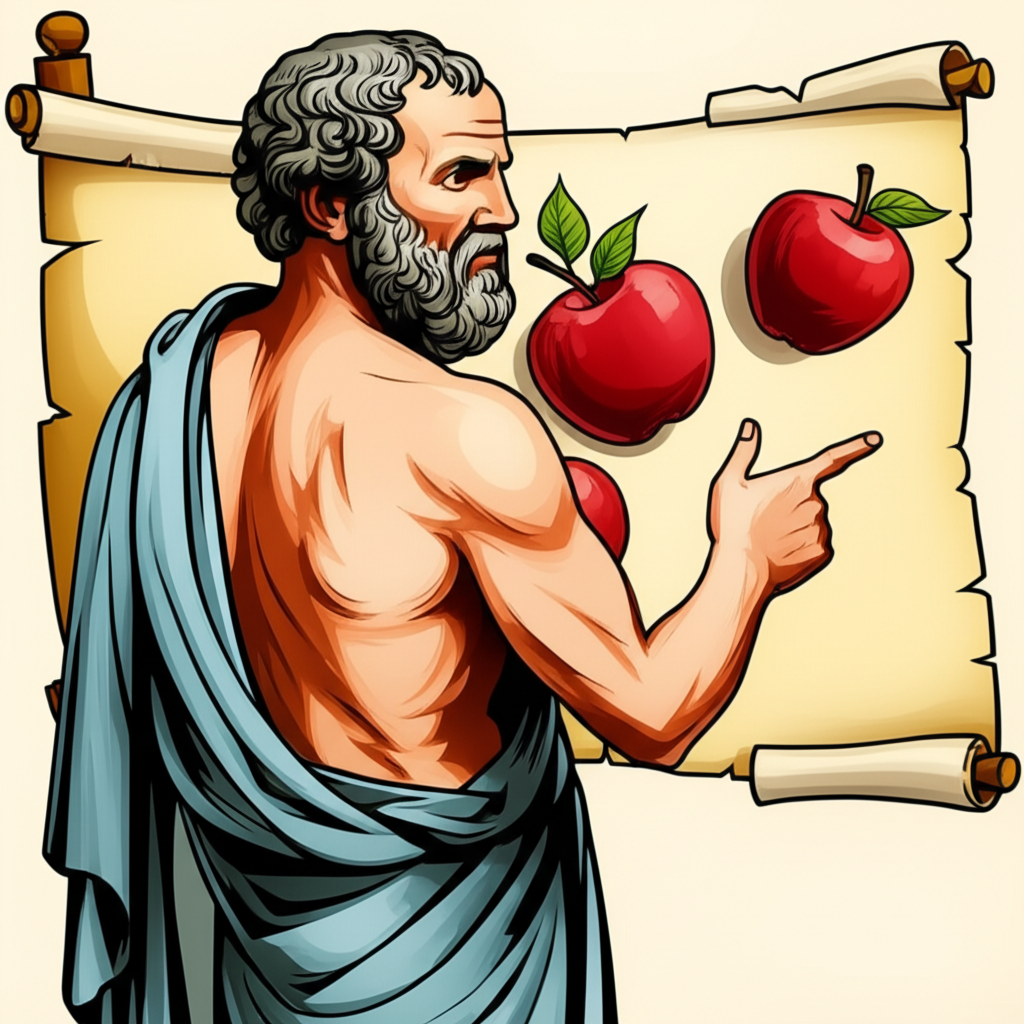 on one side, and a perfectly smooth, infinitely divisible geometric line segment on the other, symbolizing the philosophical distinction between discrete and continuous quantity. The background subtly features abstract mathematical symbols.)
The Enduring Relevance of the Problem
Why does this seemingly abstract problem continue to matter? Because our understanding of quantity underpins our scientific endeavors, our mathematical reasoning, and our very conception of reality.
- Science: Physics, chemistry, and biology are built upon quantitative measurement. Yet, the philosophical questions about the meaning of those measurements – whether they reveal objective truths or merely models – remain.
- Mathematics: The foundations of mathematics, particularly set theory and the nature of numbers, are deeply intertwined with the philosophical problem of quantity.
- Everyday Experience: From budgeting our finances to navigating space and time, our lives are saturated with quantitative judgments. A deeper understanding of quantity helps us critically examine the assumptions embedded in these everyday practices.
The philosophical problem of quantity challenges us to look beyond the superficial act of counting or measuring and to ponder the profound implications of these acts for our understanding of existence itself. It reminds us that even the most seemingly simple concepts harbor a universe of philosophical inquiry.
📹 Related Video: ARISTOTLE ON: The Nicomachean Ethics
Video by: The School of Life
💡 Want different videos? Search YouTube for: ""Aristotle Categories Quantity Philosophy""
📹 Related Video: PLATO ON: The Allegory of the Cave
Video by: The School of Life
💡 Want different videos? Search YouTube for: ""Zeno's Paradoxes and Infinite Divisibility Explained""