

The Elusive Nature of "How Much": A Summary
The philosophical problem of quantity is far more intricate than simple arithmetic. It delves into the very metaphysics of existence, questioning not just how much or how many something is, but what quantity fundamentally is as a property of reality. From the ancient Greeks defining it as a core category of being to modern physics challenging our intuitive understanding of discrete units, philosophers have grappled with its definition, its relationship to quality, and its role in structuring our understanding of the world. This enduring philosophical inquiry reveals that quantity is not merely a tool for measurement but a profound aspect of reality itself, demanding deep reflection.
Unpacking the Philosophical Problem of Quantity
For centuries, thinkers have wrestled with the concept of quantity. It seems straightforward enough in our daily lives: three apples, five meters, ten degrees. Yet, beneath this apparent simplicity lies a profound philosophical challenge. What is quantity? Is it an inherent property of objects, an abstraction of the human mind, or perhaps both? When we speak of something having a certain "quantity," are we describing its essence, or merely its relation to other things? This is the heart of the philosophical problem of quantity, a fundamental inquiry within metaphysics that touches upon nearly every branch of philosophy.
Beyond Mere Counting: The Metaphysical Inquiry
The problem extends beyond mere enumeration. It asks:
- What is the nature of a unit?
- How do discrete quantities relate to continuous ones?
- Is quantity a primary quality of objects, independent of observers, or a secondary one, dependent on our perception?
- How does quantity relate to identity and individuation?
These questions, seemingly simple, have fueled debates across millennia, shaping our understanding of reality, knowledge, and even ethics.
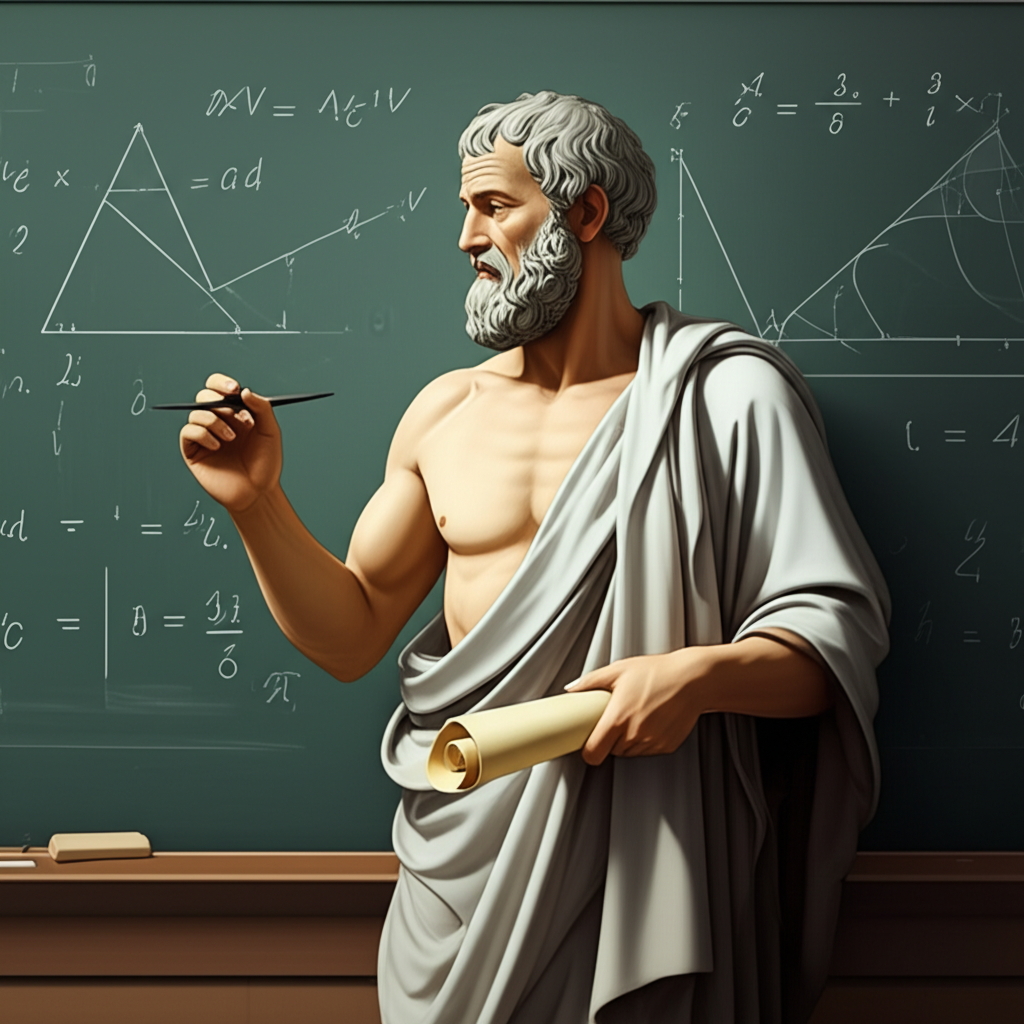
Quantity in the Classical Mind: From Forms to Categories
The origins of this philosophical wrestling match can be traced back to the foundational texts of Western thought, particularly those found within the Great Books of the Western World.
Plato's Ideal Numbers and the Realm of Forms
Plato, in his theory of Forms, posited that true reality resides in unchanging, perfect Forms. For Plato, numbers themselves, and thus ideal quantities, might exist as such Forms – perfect, abstract entities that particular instances in the world imperfectly imitate. A particular group of "three" objects participates in the perfect Form of Threeness. This suggests that quantity is not merely an attribute of physical things but has an independent, ideal existence.
Aristotle's Categorical Imperative: Quantity as a Fundamental Aspect of Being
Aristotle, Plato's most famous student, took a more empirical approach. In his Categories, he identified quantity as one of the ten fundamental ways in which being can be predicated. For Aristotle, quantity is a basic aspect of substances, not an independent entity like Plato's Forms. It answers the question "how much?" or "how many?". He distinguished between discrete quantities (like numbers, which have no common boundary) and continuous quantities (like lines, surfaces, and time, which do).
Aristotle's definition of quantity was crucial for subsequent Western thought, establishing it as a primary characteristic through which we understand the world.
| Aristotle's Categories | Description | Example Pertaining to Quantity |
|---|---|---|
| Quantity | How much, how many | Two meters long, three apples |
| Substance | What something is | A man, a horse |
| Quality | What kind of something is | White, virtuous |
| Relation | How something relates to another | Larger than, father of |
| Place | Where something is | In the market |
| Time | When something is | Yesterday |
| Position | How something is arranged | Sitting, lying |
| State | What something has | Armed, clothed |
| Action | What something is doing | Cutting, burning |
| Affection | What is being done to something | Being cut, being burned |
This clear placement of quantity as a distinct category underscored its importance as a fundamental concept in metaphysics.
The Medieval Bridge: Quantity and Divine Order
Medieval philosophers, deeply influenced by Aristotle, integrated the concept of quantity into their theological frameworks. Thinkers like Thomas Aquinas, in his Summa Theologica, explored how quantity applied to created things, but also how it did not apply to God in the same way. God, being simple and infinite, could not be quantified in the same manner as finite objects. However, the order and measure of the universe, reflecting divine wisdom, often had quantitative dimensions, suggesting a rational, measurable structure to creation. The problem of how angels could occupy space or how many angels could dance on the head of a pin, while often caricatured, points to the very real medieval philosophical engagement with discrete quantity and its relation to immaterial substances.
The Dawn of Modernity: Quantity as a Primary Quality
The Scientific Revolution brought a renewed focus on measurement and the quantitative aspects of the world, profoundly impacting philosophy.
Descartes and the Measurable World
René Descartes, a pivotal figure in modern philosophy, famously distinguished between mind (thinking substance) and matter (extended substance). For Descartes, the essence of matter was its extension in space – its length, breadth, and depth. This meant that quantity (specifically, spatial quantity) was the primary, defining characteristic of the physical world. All other qualities, like color or taste, were secondary, existing only in our perception. This view elevated quantity to a paramount position in understanding the physical universe.
Locke's Distinction: Primary vs. Secondary Qualities
John Locke, an empiricist, further elaborated on this distinction. In his An Essay Concerning Human Understanding, he argued that primary qualities – solidity, extension, figure, motion, rest, and number – are inseparable from bodies themselves and produce ideas in us that resemble the qualities in the object. Quantity (extension, number) was firmly placed among these primary qualities, existing independently of our perception. Secondary qualities, like color or sound, were merely powers in objects to produce sensations in us. This reinforced the objective reality of quantity.
Leibniz's Monads: A Qualitative Universe?
Gottfried Wilhelm Leibniz, while acknowledging the utility of quantity in science, presented a radically different metaphysics. For Leibniz, the ultimate constituents of reality were "monads" – simple, indivisible, mind-like substances, each a unique qualitative center of perception. If reality is fundamentally composed of these non-extended, qualitative monads, then how does quantity emerge? Leibniz argued that quantity, extension, and motion are not primary qualities of monads themselves but rather phenomena or well-founded appearances that arise from the harmonious interaction and aggregation of these qualitative monads. This offered a profound challenge to the Cartesian and Lockean emphasis on quantity as a fundamental objective property.
Contemporary Echoes: Quantity in a Quantum Age
The philosophical problem of quantity continues to evolve, especially with the advent of quantum philosophy and new understandings of reality.
The Problem of Individuation and Discrete Units
Even in classical physics, the question of what makes one quantity distinct from another, or one object a "unit," remains. What defines the boundary of a "thing" that can then be counted? This "problem of individuation" is deeply intertwined with quantity. Are there genuinely discrete units in reality, or are divisions always, to some extent, conceptual?
Quantum Reality: Where Quantity Gets Fuzzy
Modern quantum mechanics introduces even greater complexities. At the subatomic level, particles do not always have definite positions or momentums until measured. The wave-particle duality blurs the lines between discrete particles and continuous fields. Can we speak of a precise "quantity" of energy or position if these values are inherently probabilistic or indeterminate? This challenges our classical definition of quantity and forces philosophers to re-evaluate its objective reality at the most fundamental levels.
Why Quantity Still Baffles Philosophers
The enduring nature of the philosophical problem of quantity stems from several factors:
The Interplay with Other Metaphysical Concepts
Quantity is rarely considered in isolation. Its understanding is deeply intertwined with concepts like:
- Identity: What makes something one thing?
- Substance: What is the underlying reality that possesses quantity?
- Time and Space: Quantity is often defined by its extension in these dimensions.
- Quality: The constant tension between how much and what kind.
The Quest for a Definitive Definition
Despite millennia of inquiry, a universally accepted definition of quantity that satisfies all philosophical and scientific perspectives remains elusive. Is it a primitive, undefinable concept? Is it reducible to something else? Or does its meaning shift depending on the context – mathematical, physical, or everyday? This ongoing quest for clarity is a testament to its fundamental importance.
Conclusion: The Enduring Quest for "How Many" and "How Much"
From Plato's ideal Forms to Aristotle's careful categories, through Descartes' extended substance and Leibniz's qualitative monads, and into the probabilistic world of quantum mechanics, the philosophical problem of quantity has remained a central and persistent inquiry within metaphysics. It forces us to confront not just how we measure the world, but what it means for the world to be measurable at all. The very act of counting, sizing, and ordering reveals profound questions about the nature of reality, perception, and the tools of human understanding. As we continue to explore the universe, the question of "how much" will undoubtedly continue to challenge and inspire philosophical reflection.
YouTube Video Suggestions:
-
📹 Related Video: ARISTOTLE ON: The Nicomachean Ethics
Video by: The School of Life
💡 Want different videos? Search YouTube for: "Aristotle's Categories Quantity Philosophy"
2. ## 📹 Related Video: What is Philosophy?
Video by: The School of Life
💡 Want different videos? Search YouTube for: "Philosophy of Quantity Metaphysics Physics"