

The Enduring Enigma: Confronting the Philosophical Problem of Life and Death
The Problem of Life and Death stands as one of the most ancient and profound inquiries within Philosophy. From the earliest recorded thoughts to contemporary discourse, humanity has grappled with defining existence, understanding consciousness, and confronting the ultimate cessation of being. This article explores how philosophers, particularly those whose works are enshrined in the Great Books of the Western World, have sought to unravel these fundamental mysteries, focusing on the nature of the Soul, the meaning of mortality, and the implications for how we live.
The Ancient Inquiry: Birth, Being, and the Beyond
For millennia, thinkers have wrestled with the core questions: What is life? What constitutes a living being? And what happens when life ceases? These are not merely biological questions but deeply philosophical ones, probing the very essence of existence.
The ancient Greeks, in particular, laid much of the groundwork for Western thought on this subject. They sought not just to observe, but to understand the underlying principles of animation and decay.
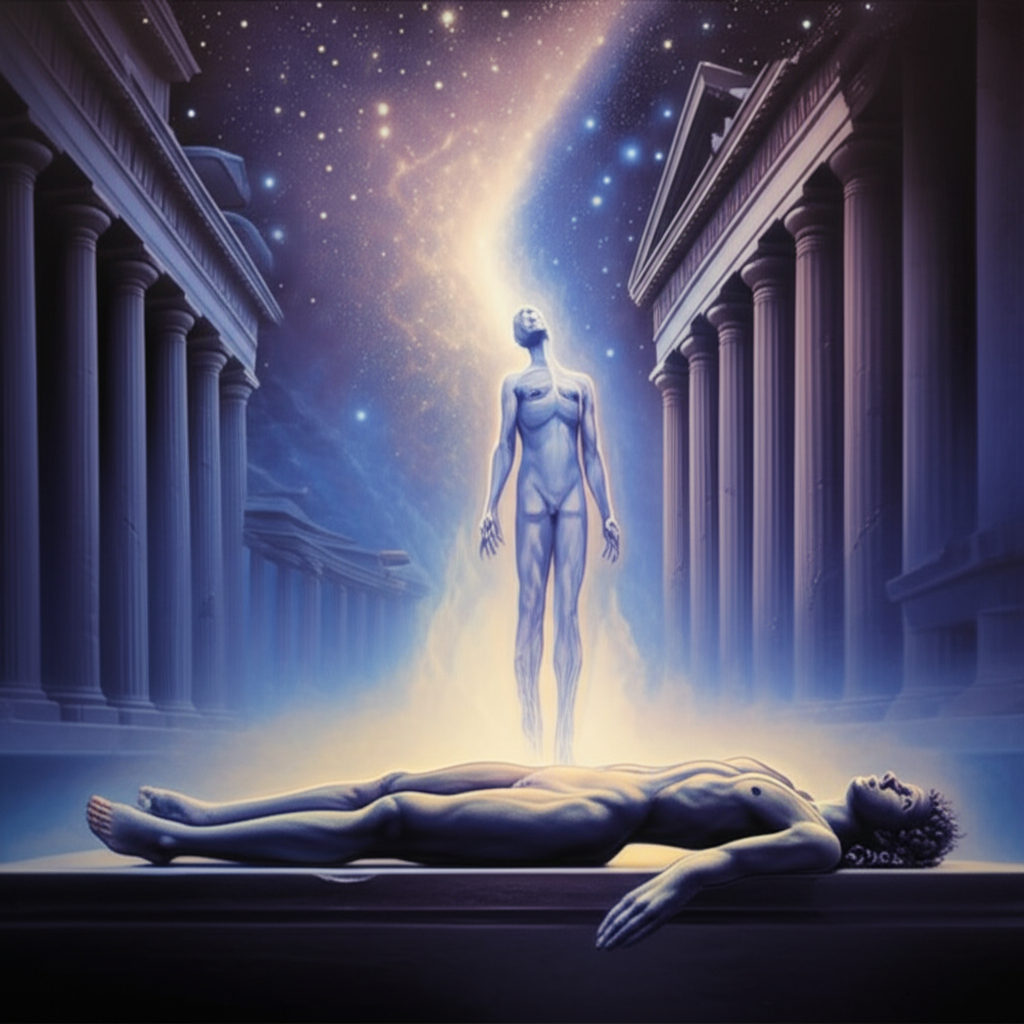
- Plato's Dualism: In works like the Phaedo, Plato famously presents Socrates' arguments for the immortality of the Soul. For Plato, the Soul is distinct from the body, an eternal and unchanging essence that pre-exists birth and survives death. The body is merely a temporary vessel, a prison from which the Soul yearns to escape and return to the realm of Forms. Death, in this view, is not an end but a liberation.
- Aristotle's Hylomorphism: Contrasting Plato, Aristotle, in texts such as De Anima (On the Soul), posits the Soul not as a separate entity but as the form of the body. The Soul is the animating principle, the actualization of a living being's potential. It is what makes a body a living body. While he discusses different types of souls (nutritive, sensitive, rational), the idea of an immortal, individual Soul separate from the body is less clear-cut than in Plato. For Aristotle, the Problem of Life and Death is intrinsically linked to understanding biological functions and the inherent purpose (telos) of living things.
These foundational texts from the Great Books of the Western World illustrate the divergence in early philosophical approaches to defining life and grappling with death, setting the stage for centuries of debate.
The Nature of the Soul: A Persistent Question
The concept of the Soul has been central to the Problem of Life and Death, serving as a bridge between the physical and the metaphysical. Its definition and fate profoundly impact our understanding of human nature and destiny.
Philosophical inquiries into the Soul often revolve around several key questions:
| Key Question Regarding the Soul | Philosophical Perspectives
- Defining the Soul: Is it a distinct, non-physical entity (substance dualism, à la Descartes in his Meditations on First Philosophy)? Is it an emergent property of complex biological systems? Or is it simply the name we give to the sum of mental functions?
- The Soul's Origin and Fate: Is the Soul created at conception, or does it pre-exist? Does it perish with the body, or is it immortal? Different philosophical traditions offer starkly different answers, heavily influencing beliefs about an afterlife, reincarnation, or complete annihilation.
- The Soul and Personal Identity: If the Soul is immortal, how does it retain personal identity across different existences or after separation from the body? This leads to fascinating discussions about memory, consciousness, and the enduring self.
Death as a Philosophical Catalyst
The inevitability of death is perhaps the single greatest motivator for philosophical inquiry. It forces us to confront our finitude, question the meaning of our actions, and define what makes a life well-lived.
- Meaning and Mortality: For many existentialists, like those influenced by Søren Kierkegaard (whose works like Fear and Trembling explore individual existence and dread), the awareness of death is what gives life its urgency and meaning. It compels us to make choices, define our values, and create our own essence. Without death, would life have the same significance?
- Fear and Acceptance: Philosophers have offered various approaches to the fear of death. Epicurus, in his Letter to Menoeceus, famously argued that "death is nothing to us," because when we exist, death is not present, and when death is present, we no longer exist. Therefore, we should not fear it. The Stoics, meanwhile, advocated for an acceptance of death as a natural part of the cosmic order, urging individuals to live virtuously and in harmony with nature, thereby preparing for their end. Seneca's Letters from a Stoic offer profound reflections on living and dying.
- Death and Ethics: How does our understanding of death influence our ethical frameworks? If there's an afterlife with rewards and punishments, this might shape moral behavior differently than if death is the absolute end. The Problem of Life and Death thus underpins much of moral philosophy, from ancient virtue ethics to modern utilitarianism.
Modern Perspectives and Lingering Questions
While scientific advancements have demystified many biological processes of life and death, the philosophical Problem remains as potent as ever. Neuroscience continues to explore the neural correlates of consciousness, but the hard problem of consciousness – why physical processes give rise to subjective experience – persists. Similarly, medical ethics constantly grapples with defining the beginning and end of life, the right to die, and the implications of extending life indefinitely.
The Problem of Life and Death is not a puzzle to be solved and discarded, but rather an eternal wellspring of contemplation. It forces us to examine our deepest assumptions about reality, identity, and purpose, ensuring that Philosophy will forever return to these fundamental questions.
Conclusion: The Unfolding Tapestry of Existence
The philosophical Problem of Life and Death is a multifaceted challenge that has shaped, and continues to shape, human thought. From Plato's immortal Soul to Aristotle's animating principle, and from Epicurus's dismissal of death's sting to the existentialists' embrace of its meaning, the great minds of history have offered a rich tapestry of perspectives. These foundational inquiries, preserved in the Great Books of the Western World, remind us that while the answers may evolve, the questions surrounding our brief flicker of existence and its ultimate cessation remain the most profoundly human.
📹 Related Video: PLATO ON: The Allegory of the Cave
Video by: The School of Life
💡 Want different videos? Search YouTube for: ""Plato Phaedo summary" or "Aristotle De Anima explained""
📹 Related Video: EXISTENTIALISM: The Philosophy of Freedom
Video by: The School of Life
💡 Want different videos? Search YouTube for: ""Existentialism death meaning" or "Epicurus on death""