

The Enduring Riddle of Flux: Navigating the Philosophical Problem of Change
The world, as we perceive it, is in constant motion. Seasons turn, empires rise and fall, and even the seemingly immutable mountains erode over millennia. Yet, beneath this undeniable observation lies one of philosophy's most profound and persistent challenges: the problem of change. How can something be and become simultaneously? How do we reconcile the identity of a thing with its continuous transformation? This article delves into the rich history of philosophical inquiry into change, exploring how thinkers from the ancient world to the modern era have grappled with the elusive nature of flux, its relationship to time, and its implications for our understanding of reality itself.
The Shifting Sands of Reality: A Fundamental Philosophical Inquiry
At its core, the philosophical problem of change asks how something can persist through alterations while remaining the same thing. Is a river truly the same river if its water is constantly flowing? Is a person the same person from childhood to old age, despite profound physical and psychological transformations? These aren't mere semantic quibbles; they cut to the heart of identity, existence, and the very structure of the cosmos. Our understanding of time, nature, and even our own selves hinges on how we resolve this ancient paradox.
Ancient Echoes: Heraclitus, Parmenides, and the Dawn of Dilemma
The earliest and most iconic confrontation with the problem of change emerged in Ancient Greek philosophy, a foundational period explored extensively in the Great Books of the Western World.
-
Heraclitus of Ephesus (c. 535 – c. 475 BCE): The Philosopher of Flux
Heraclitus famously declared, "You cannot step into the same river twice, for new waters are ever flowing in upon you." For him, change was the fundamental reality, the underlying principle of the cosmos. Everything is in a state of becoming, a ceaseless flux governed by a hidden harmony of opposing forces. Identity, in this view, is not a static property but a dynamic process. The "Nature" of things is to change. -
Parmenides of Elea (born c. 515 BCE): The Philosopher of Being
In stark contrast, Parmenides argued that change is an illusion. For something to change, it must cease to be what it was and become what it was not. But "what was not" is non-being, and non-being cannot exist. Therefore, true being must be eternal, unchanging, and indivisible. Our sensory perception of change, Parmenides contended, is misleading; reason reveals a singular, unmoving reality. This radical assertion created a profound philosophical chasm that subsequent thinkers would strive to bridge.
Bridging the Divide: Plato and Aristotle
The tension between Heraclitus's flux and Parmenides's static being profoundly influenced Plato and Aristotle, who sought to reconcile these seemingly irreconcilable views.
- Plato's Forms: Plato, while acknowledging the changing nature of the physical world (the "realm of becoming"), posited a higher realm of eternal, unchanging Forms (the "realm of being"). A particular beautiful object might decay, but the Form of Beauty itself remains immutable. Change, for Plato, applied to particulars, but not to the perfect essences they imperfectly participate in.
- Aristotle's Potency and Act: Aristotle offered a more integrated solution through his concepts of potency and act. Change, for Aristotle, is the actualization of a potentiality. An acorn has the potency to become an oak tree; its growth is the process of that potentiality becoming an actuality. This framework allowed for real change without resorting to non-being, providing a robust account of how things can transform while retaining their underlying substance.
The Modern Gaze: Time, Identity, and the Self
As philosophy evolved, so did the approaches to the problem of change. The focus shifted from cosmic flux to the nature of individual identity and the role of time.
- Locke and Personal Identity: John Locke, a key figure in empiricism, tackled personal identity in terms of consciousness. He argued that what makes a person the same person over time is not their physical body or an unchanging soul, but the continuity of their consciousness and memory. If I remember being a child, I am the same person as that child, even if every cell in my body has been replaced.
- Hume's Skepticism: David Hume, pushing empiricism to its logical conclusions, questioned the very idea of a persistent self or substance. He saw the mind as a "bundle or collection of different perceptions," constantly changing. The notion of an enduring self, for Hume, was a fiction created by the imagination to impose order on a succession of fleeting experiences.
- Kant's Transcendental Idealism: Immanuel Kant responded to Hume by arguing that time and space are not features of the external world but fundamental structures of human understanding. Change, therefore, is not merely an external phenomenon but is apprehended through categories of thought that allow us to organize and make sense of our sensory experience. The mind actively constructs our perception of a world undergoing change.
The Interwoven Fabric of Change, Time, and Nature
The problem of change is inextricably linked to our understanding of time and nature.
- Time as the Medium of Change: Is time merely a measure of change, or is it an independent entity that enables change? St. Augustine, in the Confessions, famously pondered the nature of time, concluding that while we speak of past, present, and future, time itself is a perplexing mystery, existing primarily in the mind. Modern physics, particularly Einstein's theory of relativity, has further complicated our view of time, demonstrating its relativity to observers and motion.
- Nature as the Principle of Change: For Aristotle, nature (physis) was the inherent principle of motion and rest within a thing itself. The nature of an acorn is to grow into an oak. Understanding the nature of a thing means understanding its inherent capacities for change and development. This teleological view contrasts with mechanistic philosophies that see change as merely the result of external forces.
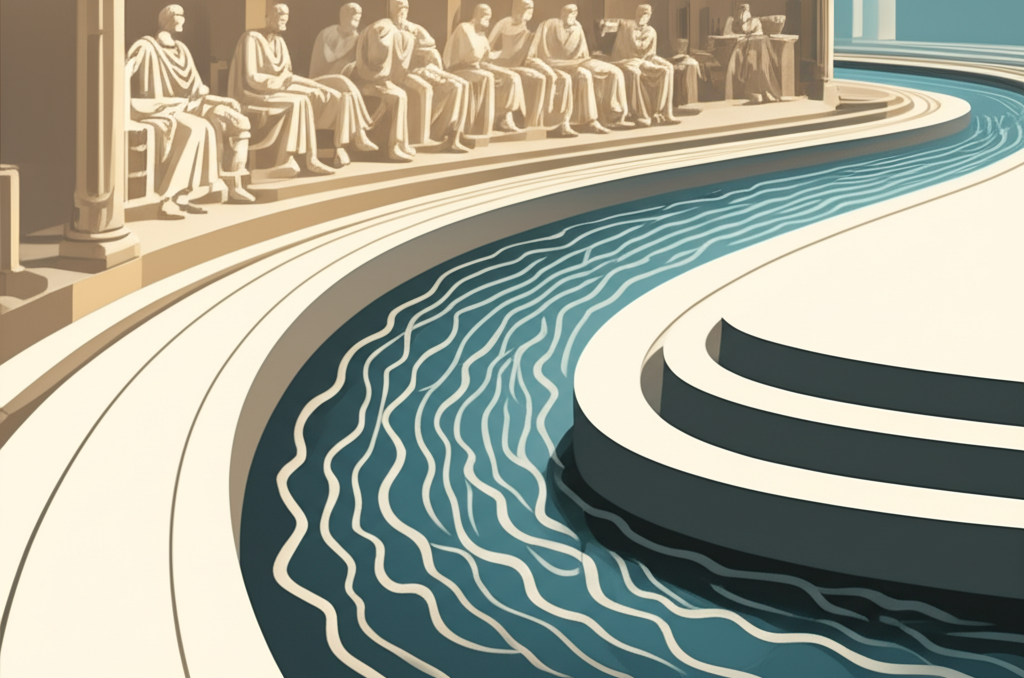 , while the other half is a dynamic, impressionistic swirl of water, constantly shifting and indistinct (representing Heraclitus's flux). In the background, faint, translucent silhouettes of ancient philosophers debate on the riverbank.)
Contemporary Reflections and Enduring Questions
Even today, the philosophical problem of change continues to fuel debate in metaphysics, philosophy of mind, and even physics.
- Process Philosophy: Thinkers like Alfred North Whitehead developed "process philosophy," where process and change are considered more fundamental than static substances. Reality is seen as a series of events, not enduring things.
- Identity Over Time: Questions of identity persist in ethics (e.g., responsibility for past actions), personal identity (e.g., brain transplants, artificial intelligence), and the philosophy of science (e.g., what makes a species the "same" species over evolutionary time?).
The journey through the philosophical problem of change reveals not just a historical progression of ideas, but a continuous wrestling with the fundamental tension between permanence and flux. It reminds us that while the world around us is in constant transformation, our human quest to understand it remains an enduring, unchanging endeavor.
Further Exploration: Key Philosophical Approaches to Change
| Philosophical Tradition | Primary View on Change | Key Thinkers (Great Books) |
|---|---|---|
| Pre-Socratics | Fundamental Reality (Heraclitus) vs. Illusion (Parmenides) | Heraclitus, Parmenides |
| Classical Greek | Reconciled via Forms (Plato) or Potency/Act (Aristotle) | Plato, Aristotle |
| Empiricism | Perceptual Succession; Skepticism about Enduring Self/Substance | Locke, Hume |
| Transcendental Idealism | Apprehended through Categories of Mind (e.g., Time) | Kant |
| Process Philosophy | Fundamental reality is process, not substance | (Later developments, e.g., Whitehead) |
Recommended Viewing for Deeper Insights
📹 Related Video: What is Philosophy?
Video by: The School of Life
💡 Want different videos? Search YouTube for: ""Heraclitus vs Parmenides - Philosophy Tube""
📹 Related Video: ARISTOTLE ON: The Nicomachean Ethics
Video by: The School of Life
💡 Want different videos? Search YouTube for: ""Aristotle on Change: Potency and Actuality Explained""