

The Unfolding Riddle: Navigating the Philosophical Problem of Change
The philosophical problem of change grapples with a seemingly simple yet profoundly complex question: how can something undergo alteration while still remaining the same entity? This fundamental inquiry into the nature of becoming versus being has been a cornerstone of Western philosophy for millennia, challenging our perceptions of reality, identity, and the very fabric of time. From ancient Greek debates to contemporary metaphysics, understanding change is central to comprehending existence itself.
Introduction: The Enduring Paradox of Becoming
At the heart of the "Problem of Change" lies a deep conceptual tension. We observe change constantly in the world around us – a seed grows into a tree, a child ages into an adult, water freezes into ice. Yet, in each instance, we intuitively speak of the same seed, the same person, the same water. How can something be both in flux and stable? If something truly changes, does it not become something else, thereby losing its original identity? This paradox compels us to examine the very essence of existence and our understanding of time as the medium through which change occurs.
Ancient Echoes: The Dawn of the Problem
The earliest systematic attempts to grapple with change emerged in ancient Greece, laying the groundwork for much of subsequent Western thought. The pre-Socratic philosophers, in particular, offered starkly contrasting views that defined the poles of this enduring debate.
Heraclitus: The River of Constant Flux
For Heraclitus of Ephesus (c. 535–475 BCE), change was the fundamental reality. His famous dictum, "You cannot step into the same river twice," encapsulates his belief in panta rhei – "everything flows." He argued that the universe is in a state of perpetual flux, with change being the only constant. Identity, in this view, is fleeting, an illusion superimposed upon an ever-shifting reality. The very nature of things is to transform.
Parmenides: The Illusion of Motion
In stark opposition stood Parmenides of Elea (c. 515–450 BCE). For Parmenides, true reality is eternal, unchanging, and indivisible. He argued that "what is, is; and what is not, cannot be." Change, motion, and plurality were deemed logical impossibilities because they would require "non-being" to exist or for something to transition from "being" to "non-being" and vice-versa. Therefore, our sensory experience of change is a mere illusion. This radical view deeply challenged the common-sense understanding of the world.
Zeno's Paradoxes: Logic's Labyrinth
Parmenides' student, Zeno of Elea (c. 490–430 BCE), further defended his master's position by devising a series of ingenious paradoxes. These paradoxes aimed to demonstrate the logical inconsistencies inherent in the concept of motion and change.
Key Zeno's Paradoxes:
- The Dichotomy Paradox: To reach a destination, one must first traverse half the distance, then half of the remaining distance, and so on, infinitely. Thus, motion can never begin.
- Achilles and the Tortoise: The swift Achilles can never overtake the slow tortoise if the tortoise has a head start, because by the time Achilles reaches the tortoise's previous position, the tortoise will have moved a little further.
- The Arrow Paradox: At any given instant, an arrow in flight occupies a space equal to itself. If it occupies a space equal to itself, it must be at rest. Since time is composed of instants, the arrow is always at rest and thus never moves.
These paradoxes highlight the intellectual difficulty of reconciling our empirical experience of change with rigorous logical analysis, a challenge that continues to resonate in philosophy and physics.
Plato's Solution: The Realm of Eternal Forms
Plato (c. 428–348 BCE), deeply influenced by both Heraclitus and Parmenides, sought to reconcile their opposing views through his theory of Forms. He agreed with Heraclitus that the sensory world is in constant flux, but with Parmenides that true knowledge must be of something eternal and unchanging.
Plato posited a dualistic reality:
- The World of Appearances: The material world we perceive with our senses, characterized by change, impermanence, and imperfection.
- The World of Forms: A transcendent realm of perfect, eternal, and unchanging archetypes (Forms or Ideas) that are the true reality.
For Plato, a beautiful object in the material world is beautiful only insofar as it participates in, or imitates, the Form of Beauty. Thus, while individual instances of things change and perish, their underlying essence – their Form – remains constant. This provided a framework for understanding how something could be both changing (in its particular manifestation) and yet possess an enduring identity (by virtue of its Form).
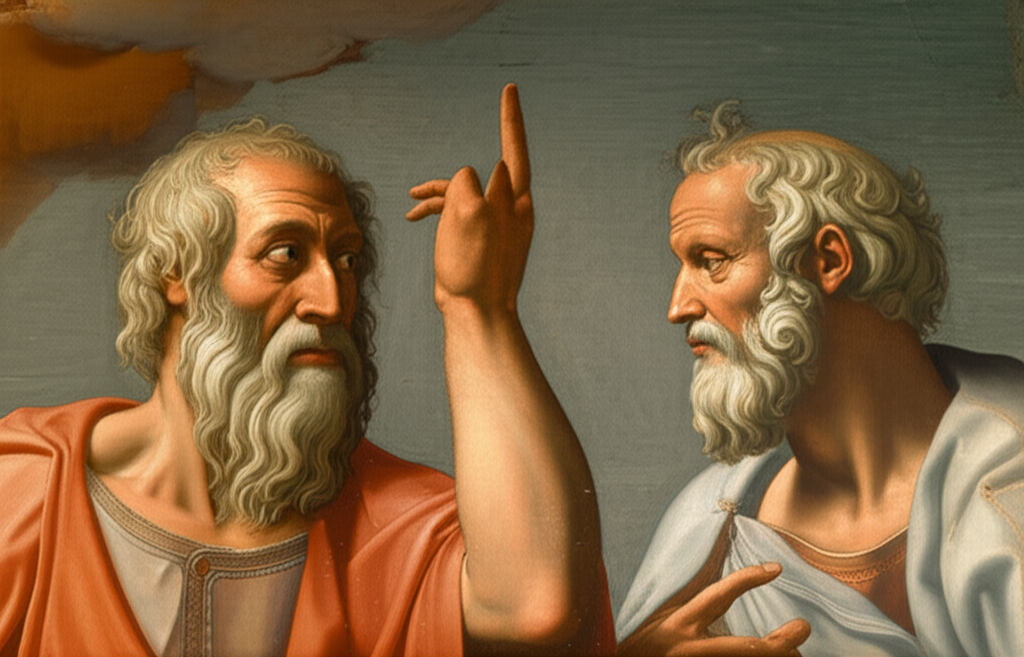
Aristotle's Synthesis: Potency, Act, and the Nature of Becoming
Aristotle (384–322 BCE), Plato's most famous student, offered a more immanent and empirically grounded solution to the problem of change. Rejecting Plato's separate realm of Forms, Aristotle argued that Forms (or essences) are inherent in the particulars themselves. He developed the concepts of potency (dynamis) and act (energeia) to explain how change is genuinely possible without lapsing into Parmenidean immobility or Heraclitean chaos.
- Potency: The capacity or potential for something to become something else. A seed has the potency to become a tree.
- Act: The actualized state of something. A tree is the act of a seed's potential.
Change, for Aristotle, is the actualization of a potential. The seed changes into a tree not by becoming an entirely different thing, but by actualizing its inherent potential to be a tree. The underlying substance (the matter) persists, while its form (its characteristics and organization) changes.
Understanding Change Through Four Causes
To further elucidate the nature of change, Aristotle identified four causes (or explanations) that contribute to understanding any given thing or process:
- Material Cause: What something is made of (e.g., bronze of a statue).
- Formal Cause: The form, essence, or structure of something (e.g., the shape of the statue).
- Efficient Cause: The agent or process that brings something about (e.g., the sculptor).
- Final Cause: The purpose or end for which something exists (e.g., to honor a god).
This comprehensive framework allowed Aristotle to explain change as an orderly, teleological process inherent in the nature of things, providing a robust alternative to both Heraclitean flux and Parmenidean stasis.
The Inextricable Link: Change and the Nature of Time
The problem of change is inherently bound up with our understanding of time. Is time a real, independent dimension through which events unfold, or is it merely a measure of change?
- If time is an illusion, as some Parmenidean interpretations might suggest, then change itself becomes problematic.
- If time is real, then how does it facilitate change? Does time flow, or is it a static dimension we traverse?
Philosophers like St. Augustine, in his Confessions, famously pondered the elusive nature of time, concluding that while he knew what time was when not asked, he struggled to define it. He saw time as a distension of the soul, intimately connected to memory (past), attention (present), and expectation (future), all of which are concepts predicated on the experience of change. The very concept of "before" and "after" relies on the occurrence of change.
Identity, Persistence, and the Human Condition
The philosophical problem of change has profound implications for our understanding of identity, particularly personal identity. How can we say that a person at eighty years old is the "same person" as the infant they once were, given the vast physical, mental, and experiential changes that have occurred?
This question has led to various theories:
- Psychological Continuity: Identity is maintained through a continuous stream of memories, beliefs, and experiences (e.g., Locke).
- Bodily Continuity: Identity is tied to the persistence of the physical body.
- Substance Dualism: The enduring self is an immaterial soul or mind, distinct from the changing body.
The problem of change compels us to confront the fluid nature of our own being and the criteria by which we define persistence amidst constant transformation.
Modern Reflections and Enduring Questions
While ancient philosophers laid the groundwork, the problem of change has continued to evolve within modern philosophy and science.
- Hume's Challenge to Causation: David Hume questioned whether we actually perceive causation or merely constant conjunction, impacting how we understand the mechanism of change.
- Process Philosophy: Thinkers like Alfred North Whitehead proposed that change and becoming are more fundamental than static being, seeing reality as a dynamic process rather than a collection of fixed substances.
- Physics and Relativity: Modern physics, particularly Einstein's theory of relativity, has fundamentally altered our understanding of time and space, presenting new challenges and perspectives on how change occurs within the cosmos. The concept of a "block universe" where all time exists simultaneously, for instance, reintroduces Parmenidean-like questions about the reality of change.
The problem remains a vibrant area of inquiry, impacting not only metaphysics but also ethics (e.g., moral responsibility over time), epistemology (how we gain knowledge of a changing world), and even aesthetics (the nature of artistic change).
Conclusion: The Unceasing Inquiry into Change
The philosophical problem of change is not merely an academic exercise; it is a fundamental inquiry into the very nature of reality. From the ancient debates between Heraclitus and Parmenides to the sophisticated models of modern physics and philosophy, the tension between permanence and flux continues to drive human thought. By grappling with how things change yet endure, we gain deeper insights into the nature of existence, identity, and the elusive flow of time. It is a testament to the enduring power of philosophy that such a seemingly simple observation can unravel into a tapestry of profound and interconnected questions that continue to shape our understanding of the world and ourselves.
YouTube Video Suggestions:
-
📹 Related Video: What is Philosophy?
Video by: The School of Life
💡 Want different videos? Search YouTube for: "Zeno's Paradoxes explained philosophy"
-
📹 Related Video: ARISTOTLE ON: The Nicomachean Ethics
Video by: The School of Life
💡 Want different videos? Search YouTube for: "Aristotle change potency act philosophy"