

The Enduring Riddle of Flux: Navigating the Philosophical Problem of Change and Becoming
Summary: The philosophical problem of change and becoming grapples with one of existence's most fundamental paradoxes: how can something be and yet change? From ancient Greek thinkers wrestling with the constant flux of the world to modern inquiries into the nature of reality, this core challenge in Philosophy asks how we reconcile the seemingly stable nature of Being with the undeniable reality of transformation over Time. It explores whether change is an illusion, a fundamental aspect of reality, or a complex interplay between permanence and impermanence that shapes our understanding of identity, existence, and the very fabric of the cosmos.
The Shifting Sands of Reality: An Introduction to a Timeless Dilemma
Few questions have haunted the halls of philosophy with such persistent intensity as the problem of change. It is, at its heart, an inquiry into the very nature of reality itself. Is reality fundamentally static, an immutable Being, or is it a ceaseless river of Change, ever-flowing and never the same? This ancient conundrum, central to the Great Books of the Western World, forces us to confront the intuitive experience of a world in constant motion against the logical demand for something stable to be.
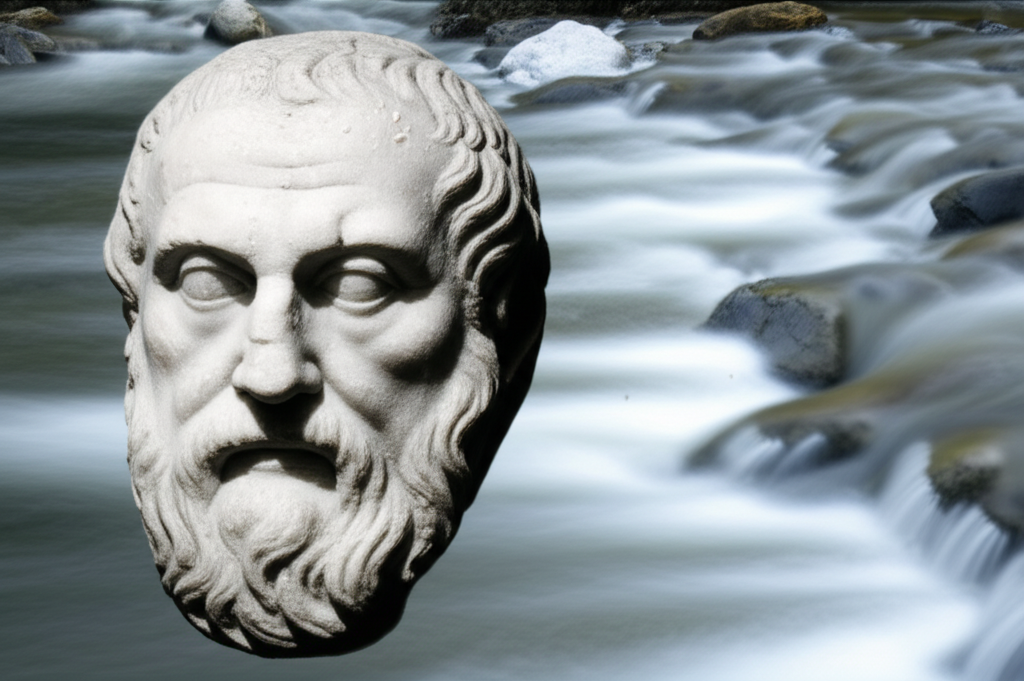
The Clash of Titans: Heraclitus vs. Parmenides
The earliest and most dramatic articulation of this problem emerged from the pre-Socratic philosophers.
-
Heraclitus of Ephesus (c. 535 – c. 475 BCE) famously declared, "No man ever steps in the same river twice, for it's not the same river and he's not the same man." For Heraclitus, Change was the only constant, the fundamental principle of the cosmos. Reality was an eternal becoming, a fiery flux where all things are in motion. Identity was not a fixed state but a dynamic process. Panta rhei – "everything flows."
-
Parmenides of Elea (late 6th or early 5th century BCE), in stark contrast, argued that Change is an illusion. For Parmenides, true Being must be eternal, ungenerated, indestructible, indivisible, and unchanging. If something changes, it must either come from non-being (which is impossible, as nothing can come from nothing) or become non-being (also impossible). Therefore, what truly is cannot change. Our senses, which perceive change, are deceptive; only reason can grasp the singular, undifferentiated, and unchanging nature of Being.
This fundamental disagreement laid the groundwork for millennia of philosophical debate. How could one reconcile the undeniable evidence of our senses with the seemingly irrefutable logic of Parmenides?
Plato's Dual Realms: Forms and the World of Appearance
Plato, deeply influenced by both Heraclitus and Parmenides, sought to bridge this chasm with his theory of Forms, a cornerstone of Western Philosophy.
Plato posited two distinct realms of existence:
- The World of Forms (Being): This is the realm of perfect, eternal, immutable, and non-physical Forms (e.g., the Form of Beauty, the Form of Justice, the Form of a Circle). These Forms are the true objects of knowledge, accessible only through intellect and reason. They embody Parmenides' conception of unchanging Being.
- The World of Sensible Particulars (Becoming): This is the world we inhabit, perceived through our senses. It is a realm of imperfect copies, shadows, and approximations of the Forms. Everything in this world is subject to Change, decay, and flux, much like Heraclitus's river.
For Plato, the objects of our experience participate in the Forms, giving them what limited reality they possess. A beautiful object is beautiful because it partakes in the Form of Beauty. Thus, Change occurs in the sensible world, but there is an unchanging foundation – the Forms – that gives meaning and structure to that change.
Aristotle's Potentiality and Actuality: A More Earthly Solution
Aristotle, Plato's most famous student, offered a different, more immanent solution to the problem of Change by focusing on the internal dynamics of substances. Rejecting Plato's separate realm of Forms, Aristotle argued that Forms (or essences) are inherent in the particular objects themselves.
To explain change, Aristotle introduced the concepts of potentiality and actuality:
| Concept | Description | Example |
|---|---|---|
| Potentiality | The capacity of something to become something else; its inherent possibilities. A state of not yet being what it could be. | An acorn has the potentiality to become an oak tree. A block of marble has the potentiality to become a statue. |
| Actuality | The state of being fully realized; the fulfillment of a potentiality. What something is at a given moment. | An oak tree is the actuality of an acorn. A finished statue is the actuality of a block of marble. |
| Change | The process by which something moves from a state of potentiality to a state of actuality, or from one actuality to another. It is the actualization of a potential. This takes place over Time. | The growth of the acorn into an oak tree is a process of change, actualizing its inherent potential over a period of time. |
For Aristotle, Change is not an illusion, nor does it require a separate realm. It is a real, intelligible process within the substance itself, a movement from what can be to what is. This framework allowed for both the persistence of Being (the underlying substance) and the reality of Change (the actualization of its potentials).
The Modern Echoes: Change, Being, and Time
The philosophical problem of Change and Becoming continues to resonate in contemporary thought. From the scientific understanding of an evolving universe to discussions about personal identity over Time, the core questions remain:
- How can something persist through change? What constitutes the identity of a person, a nation, or an object if all its constituent parts or properties are in constant flux?
- Is Time merely the measure of change, or does it have its own independent reality, enabling and structuring becoming?
- Does our understanding of reality bias us towards permanence (Parmenides) or flux (Heraclitus)?
Process philosophy, for instance, championed by thinkers like Alfred North Whitehead, suggests that processes and events, rather than static substances, are the fundamental building blocks of reality. Everything is fundamentally becoming, a continuous creative advance. This perspective, while modern, clearly draws a direct lineage back to Heraclitus.
The enduring relevance of this problem underscores its profundity. It is not merely an academic exercise but a foundational inquiry that shapes our worldview, our ethics, and our very self-conception. To understand change is, in a profound sense, to understand life itself.
YouTube Video Suggestions:
-
📹 Related Video: ARISTOTLE ON: The Nicomachean Ethics
Video by: The School of Life
💡 Want different videos? Search YouTube for: ""Heraclitus vs Parmenides: The Problem of Change Explained""
2. ## 📹 Related Video: PLATO ON: The Allegory of the Cave
Video by: The School of Life
💡 Want different videos? Search YouTube for: ""Plato's Theory of Forms and Aristotle's Four Causes Explained""