

The Sweat and the Soul: Unpacking the Philosophical Meaning of Labor
Labor, in its myriad forms, is more than just a means to an end; it's a fundamental aspect of the human condition, deeply intertwined with our identity, our values, and our very existence. From the ancient Greek disdain for manual work to modern theories of self-realization through craft, philosophy has long grappled with the profound implications of labor. This article delves into how thinkers across the ages, whose ideas are preserved within the venerable "Great Books of the Western World," have understood the act of working, revealing its connections to our understanding of Man, Life and Death, and the pursuit of meaning.
What is Labor, Philosophically Speaking?
At its core, labor is the exertion of physical or mental effort to achieve a purpose, to transform the world around us, or to sustain ourselves. But for philosophers, it’s rarely just about the sweat. It's about:
- Creation: Bringing something new into existence.
- Transformation: Changing existing materials or conditions.
- Sustenance: Providing for basic needs – food, shelter, security.
- Self-Expression: Imprinting one's will and creativity onto the world.
- Social Relation: Connecting individuals within a community through shared effort and production.
The philosophical inquiry into labor asks not just what we do, but why we do it, what it makes of us, and what it means for our place in the cosmos.
Ancient Roots: Labor, Freedom, and the Polis
In the classical world, particularly in ancient Greece, the concept of labor was often viewed through a lens distinct from modern perspectives. For thinkers like Plato and Aristotle, whose ideas permeate the "Great Books," physical labor was generally seen as a necessity, but one that could hinder true intellectual and political freedom.
- Aristotle's Politics distinguishes between the free citizen and those whose lives are consumed by manual tasks. The free man was one who had leisure (schole) to participate in the polis, to engage in contemplation and civic life. Labor, often performed by slaves or foreigners, was seen as ignoble because it tied one to the material world and the ceaseless cycle of production and consumption, diverting attention from the higher pursuits of reason and virtue.
- Plato's Republic also implicitly places intellectual and governing roles above manual ones, with a clear division of labor in his ideal state, where artisans and farmers serve the needs of the guardians and philosopher-kings.
This perspective highlights an early philosophical tension: Is labor a means to freedom, or an impediment to it? It also starkly connects labor to the very struggle for Life and Death – the necessity of work for survival, juxtaposed against the ideal of a life lived for higher purposes.
Medieval Reflections: Toil, Penance, and Virtue
With the rise of Christianity, the philosophical understanding of labor underwent a significant shift. The biblical narrative, particularly the expulsion from Eden, introduced the idea of toil as a penance for original sin. Yet, Christian thought also elevated labor in other ways:
- Monastic Orders: Manual labor became a form of ascetic discipline, a way to serve God, and a path to humility. The Benedictine motto, Ora et Labora (Pray and Work), encapsulates this ethos.
- Divine Calling: Work could be seen as a way to glorify God, transforming the world He created and contributing to the community.
- Virtue: Diligence, craftsmanship, and providing for one's family became virtues associated with honest labor.
This period, reflected in the writings of Thomas Aquinas, presents a more nuanced view where labor, while still a hardship, could also be a source of spiritual growth and moral good, shaping Man not just materially, but spiritually.
Modern Perspectives: Labor as Identity and Alienation
The Enlightenment and subsequent industrial revolutions dramatically reshaped the philosophical discourse on labor.
- John Locke's Two Treatises of Government posited that labor is the foundation of property. By mixing one's labor with natural resources, one acquires ownership, thereby transforming the common into the private. This idea profoundly influenced concepts of individual rights and economic freedom, suggesting that Man literally creates his world through his work.
- G.W.F. Hegel explored how labor transforms both nature and the laborer. Through work, Man externalizes himself, sees himself reflected in the objects he creates, and thus achieves self-consciousness and recognition. The master-slave dialectic in The Phenomenology of Spirit famously illustrates how the slave, through his labor, eventually achieves a deeper understanding of himself and the world than the master who merely consumes.
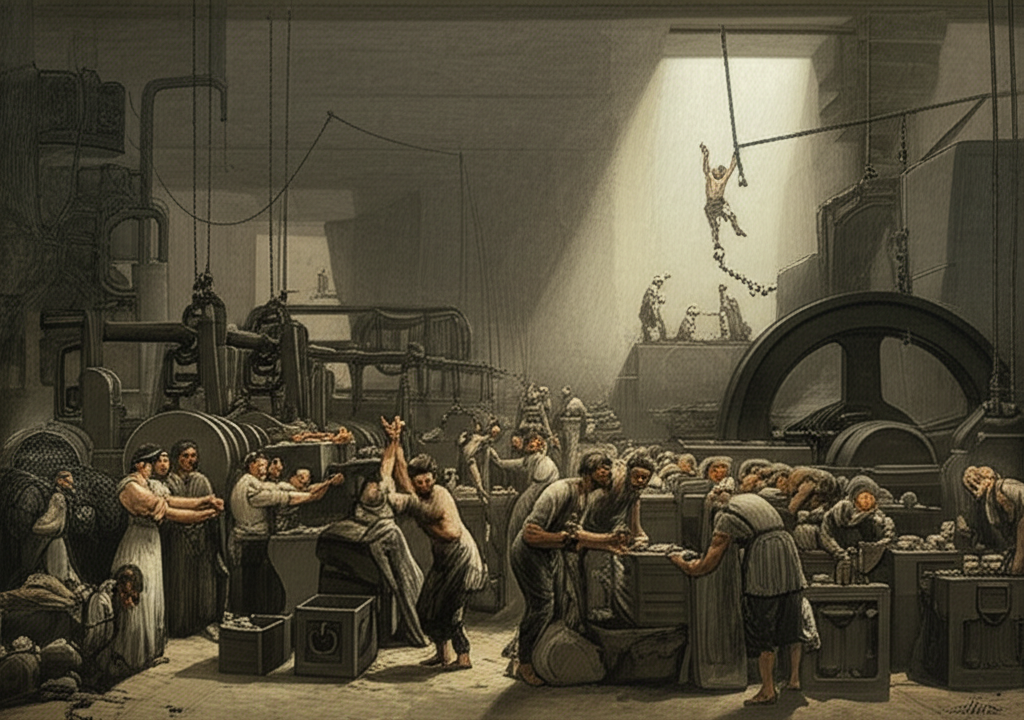
- Karl Marx, building on Hegel, radically critiqued labor under capitalism. In works like Das Kapital, he argued that while labor is humanity's essential activity – the means by which Man creates his world and expresses his species-being – capitalist modes of production lead to alienation. This alienation occurs when:
- From the product: Workers don't own what they produce.
- From the process: Work is repetitive, controlled, and lacks creativity.
- From species-being: Labor becomes a mere means of survival, not self-realization.
- From other men: Competition rather than cooperation.
Marx connected the struggle over labor directly to the quality of Life and Death for the working class, seeing it as a battle for dignity, freedom, and even survival in the face of exploitation.
Labor, Life, and Death: The Ultimate Stakes
Ultimately, the philosophical meaning of labor brings us face-to-face with the most profound questions of Life and Death.
- Survival: At its most basic, labor is about securing the necessities of life, fending off hunger, exposure, and the ever-present threat of non-existence.
- Meaning and Legacy: Beyond mere survival, our labor often becomes the vessel through which we express our purpose, contribute to society, and leave a mark on the world that outlives us. A craftsman's lasting creation, a scientist's discovery, a philosopher's written words – these are all forms of labor that defy the finality of death.
- Existential Struggle: For existentialist thinkers, labor can be seen as a way to confront the absurdity of existence, to create meaning in a world that offers none inherently. The act of creation through labor is an affirmation of life in the face of its inevitable end.
| Philosophical Era | Key Perspective on Labor | Connection to Man, Life & Death |
|---|---|---|
| Ancient Greece | Necessary but ignoble; impedes leisure for higher thought. | Essential for survival, but separates Man from true freedom and the contemplation of eternal truths. |
| Medieval | Penance, but also a path to virtue, spiritual growth, and service. | Shapes Man's soul, connects his earthly life to divine purpose, and prepares him for the afterlife (transcending death). |
| Modern (Locke) | Foundation of property, self-creation, and individual rights. | Defines Man's relationship to nature and society, crucial for securing life and liberty. |
| Modern (Hegel) | A means of self-consciousness, transformation, and recognition. | Through labor, Man externalizes himself, understands his place in the world, and achieves a form of self-realization in life. |
| Modern (Marx) | Humanity's essential activity, but often alienated under capitalism. | A struggle for dignity and freedom; determines the quality of life and is central to overcoming exploitation and premature death. |
The Enduring Question
The philosophical meaning of labor is not a static concept but a dynamic inquiry that continues to evolve with human society. From the fields of ancient Greece to the factories of the industrial age and the digital workspaces of today, Man has always sought to understand his relationship to his work. Is our labor a curse, a blessing, a path to freedom, or a source of alienation? How we answer this question fundamentally shapes our understanding of ourselves, our society, and the very purpose of our existence between Life and Death.
YouTube: "Philosophical Theories of Labor History"
YouTube: "Marx on Alienated Labor Explained"
📹 Related Video: What is Philosophy?
Video by: The School of Life
💡 Want different videos? Search YouTube for: "The Philosophical Meaning of Labor philosophy"