

The Enduring Enigma: Unpacking the Philosophical Idea of the Body and Soul
The philosophical Idea of the Body and Soul stands as one of humanity's most persistent and profound inquiries, reaching back to the dawn of systematic thought. At its core, this debate grapples with the fundamental nature of human existence: Are we merely complex biological machines, or is there an immaterial, conscious essence that transcends our physical form? This article explores the historical trajectory and enduring relevance of this Idea, drawing upon the foundational texts that have shaped Western Philosophy and continue to challenge our understanding of ourselves.
A Journey into Self: What Are We, Truly?
From ancient Greece to contemporary cognitive science, the question of the Body and Soul has captivated thinkers. It's an Idea that touches upon our understanding of consciousness, personal identity, morality, and even our place in the cosmos. Is the soul a vital principle, the seat of reason and emotion, or merely an archaic term for brain functions? Is the body a vessel, a prison, or an integral part of our being? The answers proposed by various philosophical traditions offer a rich tapestry of thought, each attempting to reconcile our subjective experience with our objective, material reality.
Ancient Foundations: Plato, Aristotle, and the Dawn of Dualism
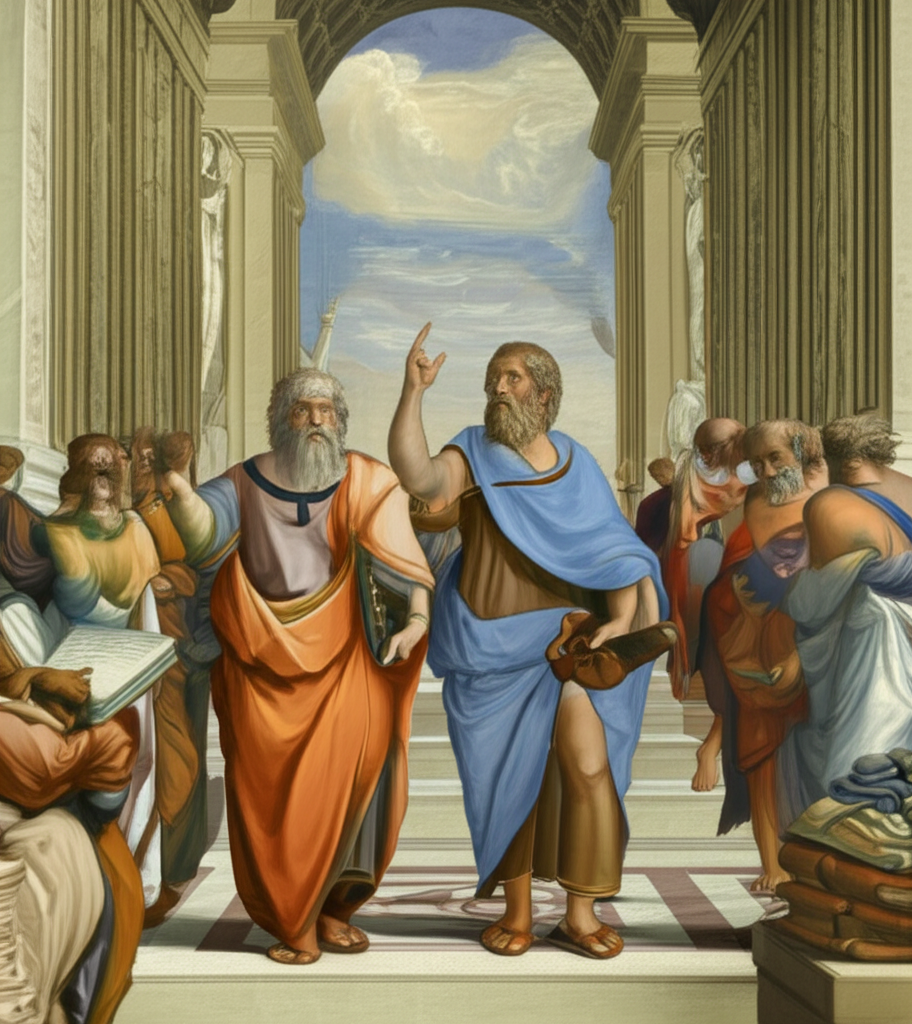
The earliest and arguably most influential articulations of the Body and Soul problem emerge from classical antiquity, particularly through the works of Plato and Aristotle, cornerstones of the Great Books of the Western World.
- Plato's Dualism: For Plato, the soul was distinct from and superior to the body. In dialogues like the Phaedo, he presents the body as a hindrance, a source of desires and distractions that impede the soul's pursuit of true knowledge. The soul, immortal and divine, pre-existed the body and would survive its death, belonging to the realm of perfect, unchanging Forms. Our body is temporary, perishable; our soul is eternal, the true essence of our identity.
- Aristotle's Hylomorphism: Plato's student, Aristotle, offered a more integrated perspective. In De Anima, he argued that the soul is not a separate entity imprisoned within the body, but rather the form of the body. Just as the shape of an axe defines what it is, the soul is the organizing principle and actualization of a living body. It is the body's capacity for life, sensation, and thought. While distinct conceptually, body and soul are inseparable in a living being, much like matter and form.
These early ideas laid the groundwork for centuries of debate, establishing the core tension between a purely material existence and one imbued with an immaterial spirit.
The Cartesian Revolution: Mind-Body Dualism Defined
Centuries later, René Descartes, another giant within the Great Books tradition, dramatically reshaped the discussion with his radical Idea of mind-body dualism. In his Meditations on First Philosophy, Descartes famously argued for two fundamentally distinct substances:
- Res Cogitans (Thinking Substance): The mind or soul, characterized by thought, consciousness, and non-extension. It is indivisible and immaterial.
- Res Extensa (Extended Substance): The body, characterized by extension in space, divisibility, and mechanical properties. It is purely material.
Descartes posited that these two substances interact, famously suggesting the pineal gland as the point of connection. This sharp distinction created what is now known as the "mind-body problem": how can two such disparate entities interact and influence each other? This problem has been a central preoccupation of Philosophy ever since.
Key Philosophical Stances on the Body and Soul
The Idea of the Body and Soul has spawned a spectrum of philosophical positions, each attempting to resolve the puzzles posed by our dual experience of being both physical and conscious.
| Philosophical Stance | Core Idea | Key Proponents/Variations |
|---|---|---|
| Dualism | Mind and body are distinct substances or properties. | Cartesian Dualism (substance), Property Dualism (properties emerge from body) |
| Monism | Only one fundamental substance exists. | |
| Materialism | Everything, including the mind, is ultimately physical. The soul is an illusion or a product of brain activity. | Identity Theory, Eliminative Materialism, Behaviorism |
| Idealism | Everything is ultimately mental or spiritual. The body is a manifestation of mind. | George Berkeley |
| Neutral Monism | Mind and body are two aspects of a single, neutral substance. | Baruch Spinoza, William James |
| Emergentism | Mental properties emerge from complex physical systems (like the brain) but are not reducible to them. | John Searle (Biological Naturalism) |
The Enduring Relevance in Modern Philosophy and Science
Despite advancements in neuroscience, the Idea of the Body and Soul remains profoundly relevant. Modern philosophy continues to grapple with questions of consciousness, free will, personal identity, and the nature of subjective experience. While many contemporary philosophers lean towards materialist explanations, the challenge of explaining how a purely physical brain gives rise to subjective qualia (the "what it's like" aspect of experience) or the sense of self remains a formidable hurdle.
The debate has evolved, but the fundamental Idea persists: what is the relationship between our physical body and our inner, conscious life? Is there an ultimate, non-physical soul, or is consciousness an emergent property of complex biological systems? These questions, honed by centuries of philosophical inquiry, continue to drive research in fields ranging from artificial intelligence to psychology, proving that the Idea of the Body and Soul is far from exhausted.
YouTube Video Suggestions:
- YouTube: "Plato's Theory of the Soul Explained"
- YouTube: "Descartes Mind Body Problem Explained"
📹 Related Video: What is Philosophy?
Video by: The School of Life
💡 Want different videos? Search YouTube for: "The Philosophical Idea of the Body and Soul philosophy"