

The Philosophical Definition of Truth: An Enduring Quest
Hello fellow explorers of thought! Emily Fletcher here, ready to dive into one of the most fundamental and fascinating questions that has captivated philosophers for millennia: What is truth? It sounds simple, doesn't it? Yet, the philosophical definition of truth is anything but. It's a concept so deeply woven into the fabric of our understanding and our pursuit of knowledge that its precise nature has been a subject of intense debate, shaping the very course of philosophy. From the ancient Greeks to contemporary thinkers, the quest to pin down truth reveals not just its complexity, but its profound importance to how we navigate the world and construct our realities.
The Elusive Nature of Truth in Philosophy
For many, truth feels intuitive. We say a statement is true if it corresponds to reality, or if it's a fact. But as soon as we scratch the surface, the philosophical questions begin to multiply. Is truth objective, existing independently of human minds, or is it subjective, dependent on our perspectives? Can we ever truly know the truth, or only believe in it? These aren't mere academic exercises; how we define truth impacts everything from scientific inquiry to ethical decisions, legal judgments, and even our personal relationships.
The Great Books of the Western World are replete with dialogues and treatises grappling with this very concept. Plato, through Socrates, famously explored the distinction between mere opinion and true knowledge, suggesting that truth resides in an eternal, unchanging realm of Forms. Aristotle, on the other hand, grounded truth more directly in observation and logic, emphasizing the correspondence between thought and reality.
Major Theories of Truth: A Philosophical Palette
Over centuries, various schools of thought have proposed distinct frameworks for understanding truth. Each offers a unique lens through which to examine what it means for something to be "true."
Here are some of the most influential theories:
-
Correspondence Theory:
- This is arguably the most intuitive and historically dominant theory. It posits that a statement or belief is true if, and only if, it corresponds to a fact or state of affairs in the world. Think of Aristotle's dictum: "To say of what is that it is not, or of what is not that it is, is false, while to say of what is that it is, and of what is not that it is not, is true."
- Key Idea: Truth is a relation between a proposition and the world.
- Proponents: Aristotle, Thomas Aquinas, Bertrand Russell.
- Example: The statement "The sky is blue" is true if, in reality, the sky is blue.
-
Coherence Theory:
- In contrast, the coherence theory suggests that a belief is true if it "fits" or is consistent with a larger system of beliefs. It's less about matching an external reality and more about internal consistency within a web of propositions.
- Key Idea: Truth is internal consistency within a system of beliefs.
- Proponents: Baruch Spinoza, G.W.F. Hegel, F.H. Bradley.
- Example: In a detective story, a proposed solution is true if it logically explains all the clues without contradiction.
-
Pragmatic Theory:
- Emerging in American philosophy, this theory defines truth by its practical utility and consequences. A belief is true if it "works" or is useful in guiding our actions and predictions. Truth, in this view, is not a static property but something that is made in the process of inquiry.
- Key Idea: Truth is what is useful, effective, or provides successful outcomes.
- Proponents: Charles Sanders Peirce, William James, John Dewey.
- Example: A scientific theory is true if it consistently allows us to make accurate predictions and develop effective technologies.
-
Consensus Theory:
- Often associated with modern discourse ethics, this theory suggests that truth is what would be agreed upon by all participants in an ideal speech situation, where arguments are based purely on reason and free from coercion.
- Key Idea: Truth is the outcome of rational, uncoerced agreement.
- Proponents: Jürgen Habermas.
- Example: A moral principle is true if it could be universally accepted through open, rational debate among all affected parties.
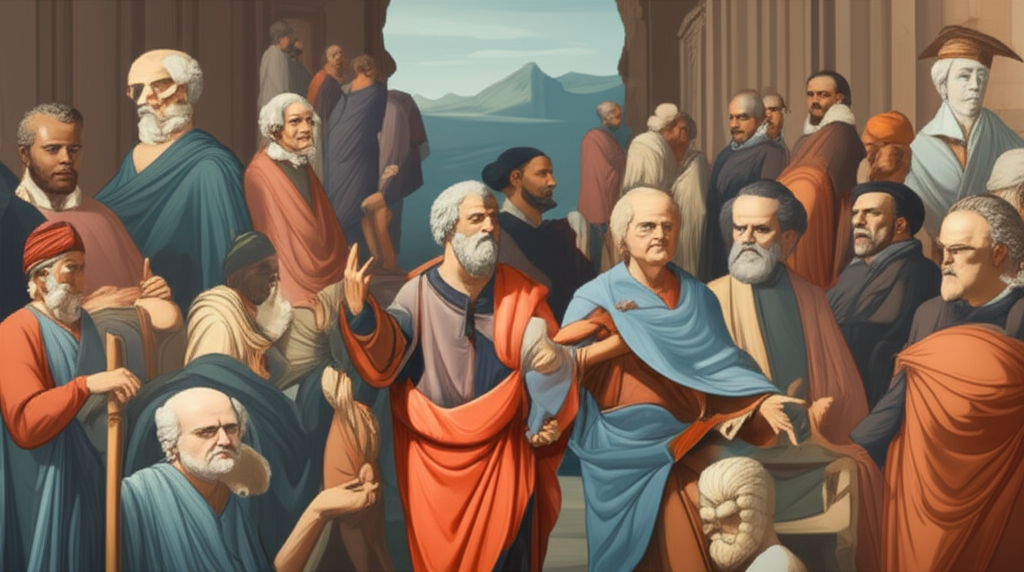 engaged in a vibrant, overlapping discussion, surrounded by floating question marks and light bulbs, symbolizing the ongoing pursuit of knowledge and the multifaceted nature of truth. The background is a parchment-like texture with faint Greek and Latin script.)
Truth and the Pursuit of Knowledge
The relationship between truth and knowledge is inextricably linked. Indeed, epistemology—the theory of knowledge—often defines knowledge as "justified true belief." This classic definition, though challenged and refined over time (notably by Edmund Gettier), highlights that for something to be considered knowledge, it must not only be believed and justified, but it must also be true.
Consider René Descartes, another giant from the Great Books. His radical doubt, famously encapsulated in "Cogito, ergo sum" (I think, therefore I am), was an attempt to find an indubitable foundation for knowledge, a truth so certain that it could not be questioned. This quest for certainty underscores philosophy's deep-seated need for a robust understanding of truth. If we cannot define truth, how can we possibly claim to possess knowledge?
Why Does This Philosophical Inquiry Matter?
You might wonder why we spend so much time debating the definition of truth. Isn't it just semantics? Far from it! Our understanding of truth profoundly impacts our lives:
- Science: Scientific progress relies on the belief that there is an objective truth about the natural world that can be discovered through empirical investigation and logical reasoning.
- Ethics: Moral truths guide our actions and define right and wrong. Are these truths universal, or culturally relative?
- Politics and Society: Debates about "fake news" and "alternative facts" reveal a societal crisis stemming from a fractured understanding of truth. A shared conception of truth is crucial for functioning democracies and informed public discourse.
- Personal Growth: Our personal search for meaning and authenticity often involves grappling with what is true for ourselves and about the world around us.
The Enduring Quest
The philosophical definition of truth remains a vibrant and active field of inquiry. There is no single, universally accepted answer, and perhaps that's the beauty of it. Each theory offers valuable insights, pushing us to think critically about our assumptions and the very foundations of our beliefs. As we continue to navigate an increasingly complex world, the ability to discern, question, and seek truth—in all its nuanced forms—is more vital than ever. It is the bedrock upon which all genuine knowledge and meaningful understanding are built.
📹 Related Video: What is Philosophy?
Video by: The School of Life
💡 Want different videos? Search YouTube for: ""Philosophical Theories of Truth Explained""
📹 Related Video: PLATO ON: The Allegory of the Cave
Video by: The School of Life
💡 Want different videos? Search YouTube for: ""Plato's Theory of Forms and the Allegory of the Cave""