

The Elusive Quest: Unpacking the Philosophical Definition of Truth
In the vast landscape of philosophy, few concepts are as fundamental, yet as stubbornly elusive, as the definition of truth. Far from a simple, self-evident notion, philosophers have, for millennia, grappled with what it truly means for something to be true. This inquiry is not merely an academic exercise; it underpins our very understanding of knowledge, reality, ethics, and indeed, our place in the cosmos. To explore the philosophical definition of truth is to embark on a journey through the very bedrock of Western thought, challenging our assumptions and revealing the profound complexity that lies beneath what we often take for granted.
What is Truth, Anyway? The Philosophical Imperative
For many, truth is simply "that which is real" or "that which corresponds to the facts." If I say, "the sky is blue," and it is indeed blue, then my statement is true. Simple, right? But philosophy demands a deeper look. What constitutes a "fact"? How do we verify correspondence? And what about statements concerning morality, aesthetics, or abstract concepts like justice? The philosophical imperative to define truth arises precisely because our everyday understanding, while practical, lacks the rigor needed to build a robust system of knowledge. Thinkers from Plato to Kant, whose works populate the Great Books of the Western World, have understood that our capacity to know anything reliably hinges on a clear understanding of what makes a belief or statement true.
A Tapestry of Theories: How Philosophers Define Truth
Over centuries, philosophers have developed various theories to explain the nature of truth. Each offers a distinct lens through which to view this foundational concept, highlighting different aspects of its definition.
The Correspondence Theory of Truth
Perhaps the most intuitive and widely accepted, the Correspondence Theory posits that a statement or belief is true if and only if it corresponds to, or accurately reflects, a state of affairs in the world. This is the common-sense view: a proposition is true if it matches reality.
- Key Idea: Truth is a relational property; it exists between a belief/statement and a fact.
- Proponents: Often traced back to Aristotle, later developed by St. Thomas Aquinas.
- Example: The statement "Socrates was a philosopher" is true because there was an individual named Socrates who indeed engaged in philosophy.
- Challenge: How do we access "reality" directly to verify this correspondence? What about abstract concepts?
The Coherence Theory of Truth
In contrast, the Coherence Theory suggests that a proposition is true if it coheres with, or is consistent with, other propositions that are already accepted as true within a given system of beliefs. Here, truth isn't about matching an external reality, but about internal consistency.
- Key Idea: Truth is a property of a system of propositions, not of individual propositions in isolation.
- Proponents: Found in the works of rationalists like Baruch Spinoza and idealists like G.W.F. Hegel.
- Example: In a mathematical system, a theorem is true if it can be logically derived from the axioms and other established theorems within that system.
- Challenge: A coherent system can still be entirely false if its initial premises are flawed (e.g., a perfectly coherent fictional novel is not "true" in the real world sense).
The Pragmatic Theory of Truth
The Pragmatic Theory offers a more practical definition of truth. It asserts that a belief or statement is true if it "works," is useful, or has successful practical consequences. For pragmatists, truth is not a static property but something that is made in the process of inquiry.
- Key Idea: Truth is dynamic and instrumental; it is what proves valuable in guiding our actions and predictions.
- Proponents: Charles Sanders Peirce, William James, and John Dewey.
- Example: A scientific theory is true if it consistently allows us to make accurate predictions and effectively manipulate the natural world.
- Challenge: Does "what works" always equate to truth? Can a useful lie be considered true?
Other Perspectives
While these three are foundational, other theories contribute to the philosophical definition of truth:
- Consensus Theory: Truth is what an ideal community of inquirers would agree upon.
- Deflationary Theories: These argue that the word "truth" doesn't describe a deep property at all, but merely serves a logical or linguistic function (e.g., saying "it is true that the sky is blue" is just another way of saying "the sky is blue").
Here's a quick comparison of the major theories:
| Theory | Core Idea | Focus | Primary Criterion for Truth |
|---|---|---|---|
| Correspondence | Agreement with external reality | Relation between statement and fact | Accuracy, Matching |
| Coherence | Consistency within a system of beliefs | Internal logical consistency | Non-contradiction |
| Pragmatic | Usefulness, practical consequences, what works | Utility, Efficacy | Success, Functionality |
Truth, Knowledge, and the Search for Justification
The philosophical quest for the definition of truth is inextricably linked to the pursuit of knowledge. Indeed, a widely accepted definition of knowledge in Western philosophy is "justified true belief." This means for us to truly know something, three conditions must be met:
- Belief: We must believe it.
- Truth: The belief must be true.
- Justification: We must have good reasons or evidence for believing it.
Without a clear understanding of what makes a belief true, the entire edifice of knowledge collapses. Thinkers like René Descartes, in his radical doubt, sought an indubitable foundation for knowledge, a truth so certain it could not be questioned. This highlights the profound anxiety philosophers feel when the definition of truth remains ambiguous. The challenge, then, is not only to define truth but also to establish reliable methods for identifying and justifying true beliefs, navigating the complexities of human perception, reason, and potential biases.
The Enduring Relevance of Defining Truth
The ongoing philosophical debate surrounding the definition of truth reminds us that this isn't a settled matter. It is a living, breathing question that continues to shape contemporary thought, from epistemology (the study of knowledge) to ethics and political philosophy. Understanding these different perspectives isn't about choosing a single "correct" definition, but about appreciating the multifaceted nature of truth itself and the profound ways in which philosophy challenges us to think critically about our most fundamental assumptions. The journey to define truth is, in essence, the journey to understand ourselves and the world we inhabit more deeply.
📹 Related Video: What is Philosophy?
Video by: The School of Life
💡 Want different videos? Search YouTube for: ""Theories of Truth Philosophy Explained""
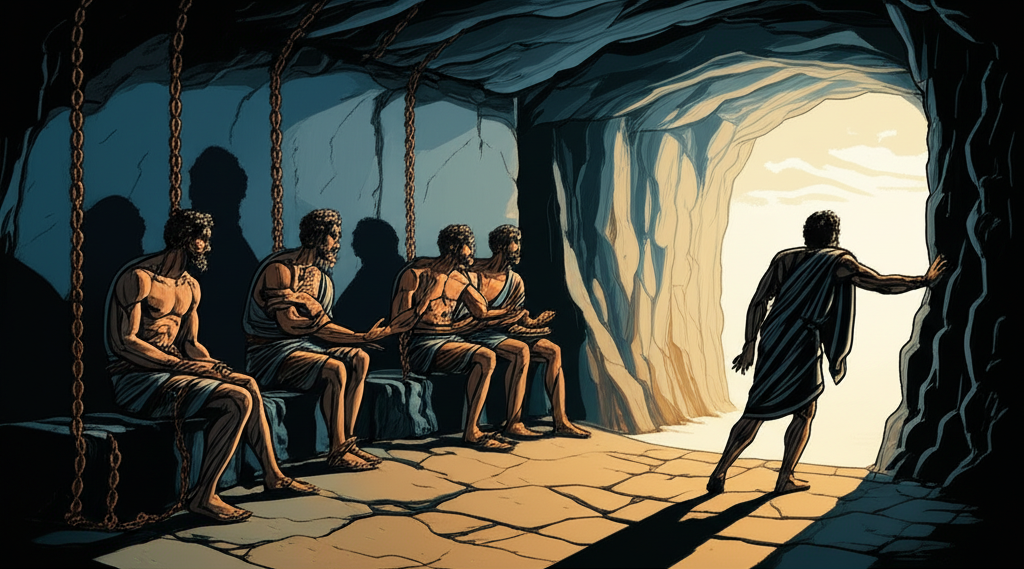
📹 Related Video: PLATO ON: The Allegory of the Cave
Video by: The School of Life
💡 Want different videos? Search YouTube for: ""Plato's Allegory of the Cave Explained""