

The Philosophical Concept of Progress: An Ever-Unfolding Inquiry
Summary: The philosophical concept of progress is not a simple linear march forward, but a deeply complex and contested idea, central to understanding human history and our aspirations. It compels us to question what constitutes improvement, whether it's inevitable, and how we measure it across diverse domains like science, ethics, and society. From ancient cyclical views to Enlightenment optimism and modern skepticism, the journey of this concept reflects humanity's ongoing struggle to define its own advancement.
The very notion of progress is one that profoundly shapes our understanding of history, our present actions, and our hopes for the future. As an inhabitant of the 21st century, it’s almost second nature to assume that humanity is, on the whole, moving forward. We see advancements in technology, medicine, and arguably, in certain social liberties. But is this assumption truly warranted? And what, precisely, do we mean when we speak of progress in a philosophical sense? This isn't just about faster computers or longer lifespans; it delves into the very core of what it means to improve, to evolve, and to perhaps even perfect our existence.
The Elusive Nature of Progress: A Historical Lens
The idea of progress isn't a timeless, universal truth; it's a concept with its own fascinating history. For many ancient civilizations, particularly those reflected in early Greek thought, time was often viewed cyclically. Empires rose and fell, societies flourished and decayed, only to begin anew. Thinkers like Plato, in works like The Republic, envisioned an ideal state, but even that often implied a return to an original perfection rather than an endless linear advancement. There was a sense of inevitable decline from a Golden Age, or simply a repetitive pattern.
- From Ancient Cycles to Enlightenment Ascendance
The shift towards a linear, forward-moving understanding of history began to gain traction with Judeo-Christian thought, where time had a distinct beginning and an ultimate end, implying a trajectory. However, it was truly the Enlightenment period, a cornerstone of Western philosophy, that firmly cemented the belief in human perfectibility and the steady march of reason and science. Philosophers like Immanuel Kant and Marquis de Condorcet championed the idea that human faculties, particularly reason, would inevitably lead to moral and intellectual betterment. This was a radical departure, suggesting that humanity could actively shape its destiny towards an ever-improving state.
Measuring the Unmeasurable: Criteria for Progress
If we accept the possibility of progress, then the next, perhaps more daunting, question arises: how do we measure it? What are the metrics for human advancement?
-
The March of Science and Reason
One of the clearest domains where progress seems undeniable is in science and technology. From understanding the atom to sequencing the human genome, the accumulation of knowledge and our ability to manipulate the physical world have grown exponentially. The Great Books of the Western World are replete with examples, from Aristotle's systematic biological observations to Galileo's astronomical discoveries and Newton's laws of motion. This intellectual and empirical progress often feels self-evident. We have more information, better tools, and a deeper understanding of the natural world than ever before. -
Moral and Social Evolution
However, when we turn to moral or social progress, the waters become murkier. Is humanity becoming better? Are our societies more just, compassionate, or equitable than those of the past? While we can point to the abolition of slavery, the expansion of human rights, and the growth of democratic ideals as indicators of progress, history also reminds us of genocides, perpetual conflicts, and persistent inequalities. Thinkers from Jean-Jacques Rousseau, who pondered the corrupting influence of society, to Karl Marx, who critiqued the inherent injustices of capitalism, offer profound challenges to any simplistic notion of moral or social progress. It forces us to confront the uncomfortable truth that advancements in one area might be accompanied by regressions or new forms of oppression in another.
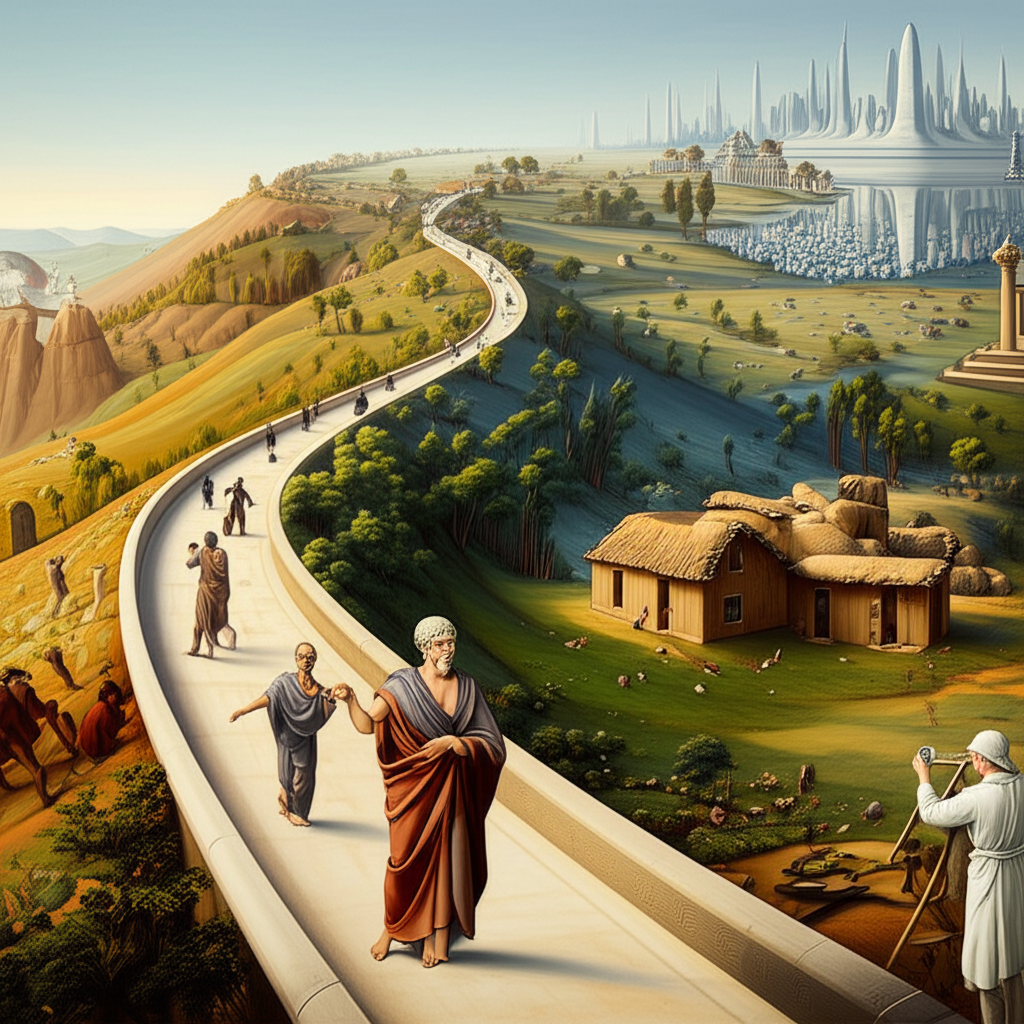 are shown, with some figures looking back in contemplation and others gazing forward with hope or apprehension. The sky above transitions from stormy clouds to clear, bright skies, symbolizing the changing perceptions of progress.)
The Skeptics and the Critics: Questioning the Narrative
Not all philosophers have been optimistic about progress. In fact, some of the most profound insights come from those who questioned its inevitability or even its desirability.
-
The Shadow Side of Advancement
The 20th century, with its world wars, totalitarian regimes, and environmental crises, profoundly challenged the Enlightenment's faith in linear progress. Philosophers like Theodor Adorno and Max Horkheimer, reflecting on the horrors of the Holocaust, questioned whether technological and rational advancement necessarily led to human liberation, suggesting instead that it could facilitate new forms of barbarism. Friedrich Nietzsche, earlier, had already cast a critical eye on the moral values underpinning Western civilization, suggesting that the "progress" towards certain ideals might actually weaken the human spirit. -
Is Progress Inevitable?
The question of whether progress is an inherent, teleological force in history or merely a contingent outcome of human effort and circumstance remains a lively debate. Is there a guiding hand, a cosmic plan, or are we simply fumbling our way forward, sometimes successfully, sometimes disastrously? This philosophical inquiry forces us to confront our agency and our responsibility in shaping the future.
Progress in the Great Books of the Western World
The Great Books of the Western World offer an unparalleled resource for exploring the multifaceted concept of progress. They don't just chronicle history; they reflect and shape our understanding of it.
- Plato's Republic: Envisions an ideal state, a form of societal progress towards justice, though perhaps more a blueprint for perfection than an expectation of historical evolution.
- Aristotle's Politics and Ethics: Explores the development of the polis and the cultivation of virtue, hinting at forms of social and individual betterment.
- Augustine's City of God: Presents a profound contrast between the earthly city, subject to decay, and the heavenly city, representing spiritual progress and ultimate salvation.
- Machiavelli's The Prince: Though not directly about progress, it marks a shift in political philosophy, focusing on practical power dynamics rather than moral ideals, arguably a "progress" in political realism.
- Hobbes's Leviathan: Proposes a social contract as a way to escape the "state of nature," a clear argument for societal progress through rational self-interest.
- Locke's Two Treatises of Government: Further develops ideas of natural rights and limited government, laying foundational stones for political and individual progress.
- Rousseau's Discourse on the Origin and Basis of Inequality Among Men: Offers a counter-narrative, suggesting that civilization and "progress" have, in many ways, corrupted humanity.
- Kant's Critique of Pure Reason and Idea for a Universal History with a Cosmopolitan Purpose: Articulates a strong belief in humanity's rational and moral progress towards a more peaceful and enlightened future.
- Hegel's Phenomenology of Spirit: Proposes a grand narrative of historical progress as the unfolding of Spirit towards absolute knowledge and freedom.
- Marx's Das Kapital: Interprets history as a progression through class struggles, culminating in a communist society, a specific vision of economic and social progress.
- Nietzsche's Thus Spoke Zarathustra: Challenges traditional notions of moral progress, advocating for the "overcoming" of man and the creation of new values.
In conclusion, the philosophical concept of progress is far from settled. It is a dynamic, evolving inquiry that demands constant critical engagement. As we continue to navigate the complexities of our rapidly changing world, understanding the historical debates and the various facets of this concept — its scientific triumphs, its moral dilemmas, and its inherent ambiguities — remains crucial. It forces us to ask not just if we are progressing, but what kind of progress we truly desire, and at what cost.
📹 Related Video: What is Philosophy?
Video by: The School of Life
💡 Want different videos? Search YouTube for: ""History of the Idea of Progress Philosophy""
📹 Related Video: PLATO ON: The Allegory of the Cave
Video by: The School of Life
💡 Want different videos? Search YouTube for: ""Is Moral Progress Real? Philosophical Debate""