

The Enduring Question of "How Many?": Unpacking the Philosophical Concept of Number (Quantity)
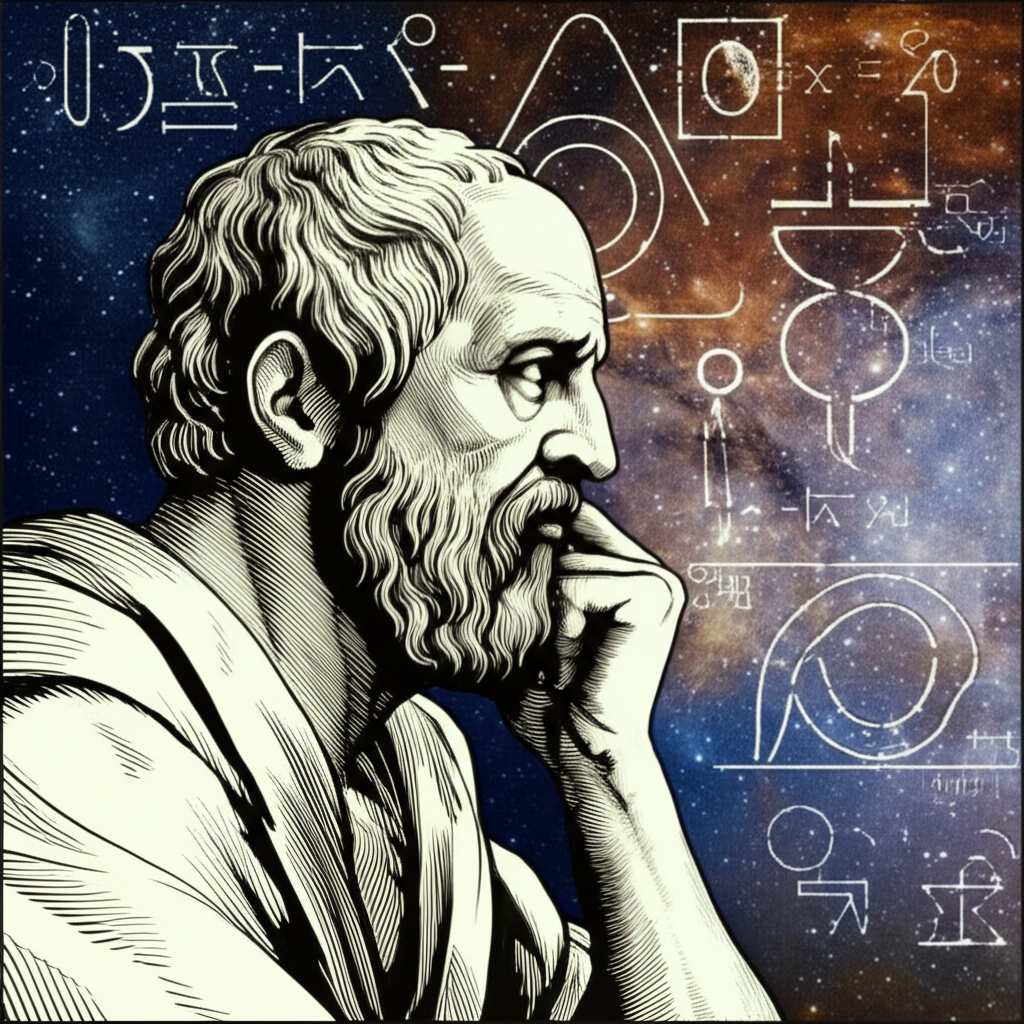
Have you ever stopped to truly consider what a number is? Beyond its utility in counting, measuring, or performing complex equations, the philosophical concept of number, or quantity, delves into its fundamental nature, its existence, and how we come to know it. This article explores the rich history of philosophical inquiry into quantity, moving beyond mere mathematics to ask: What is number, really? From ancient Greek metaphysics to modern logic, philosophers have wrestled with whether numbers are real entities, mental constructs, or simply tools for understanding the world.
Beyond the Tally Mark: What is Number, Philosophically Speaking?
While mathematics provides us with an incredibly powerful system for manipulating numbers, philosophy isn't content with just using them. It seeks to understand their essence. Are numbers abstract objects existing independently of our minds, like Plato's Forms? Are they properties of objects, like Aristotle suggested? Or are they purely human inventions, tools we've devised to make sense of the world? This fundamental inquiry into the concept of quantity is one of the oldest and most persistent in Western thought.
Ancient Roots: Quantity in the Great Books
The Great Books of the Western World offer a fascinating starting point for understanding the philosophical concept of number. Early thinkers grappled with its mysterious power and ubiquitous presence.
- Pythagoras and the Cosmic Harmony: For the Pythagoreans, number wasn't just a tool; it was the very essence of reality. They believed the universe was ordered by numerical ratios, and that understanding these ratios was the key to understanding the cosmos itself. Music, astronomy, and geometry were all seen as manifestations of numerical harmony.
- Plato's Ideal Forms: In Plato's philosophy, numbers exist as independent, eternal, and unchanging Forms, residing in a realm accessible only through intellect, not the senses. When we count two apples, we are not seeing "twoness" itself, but rather participating in the Form of Two. This view posits numbers as objective realities, prior to and independent of physical objects or human minds.
- Aristotle's Categories of Being: Aristotle, ever the empiricist, classified quantity as one of the fundamental categories of being. Unlike Plato, he saw quantity not as a separate entity, but as a property inherent in things. A table has a certain size (continuous quantity) and a certain number of legs (discrete quantity). He distinguished between:
- Discrete Quantity: That which is composed of indivisible units, like numbers (e.g., 5 apples, 3 people). You can't have half a person.
- Continuous Quantity: That which is infinitely divisible, like lines, surfaces, volumes, time, and space (e.g., a length of rope, a duration of time). You can always divide a line into smaller segments.
Modern Perspectives: Debating the Nature of Number
The philosophical debate over the concept of number continued to evolve, giving rise to various schools of thought, each offering a different answer to the fundamental question of its nature.
- Logicism (Frege, Russell): This school, prominent in the late 19th and early 20th centuries, attempted to reduce mathematics to logic. Philosophers like Gottlob Frege and Bertrand Russell argued that numbers could be defined purely in terms of logical concepts, suggesting that mathematics is ultimately a branch of logic. For them, numbers are abstract objects, but their existence is guaranteed by logical principles.
- Formalism (Hilbert): David Hilbert and his followers viewed mathematics as a formal game played with symbols according to strict rules. Numbers, in this view, are essentially meaningless symbols within a formal system. The focus is on the consistency and completeness of the system, not on the "reality" of the numbers themselves.
- Intuitionism (Brouwer): L.E.J. Brouwer proposed that mathematics is fundamentally a construction of the human mind. Numbers and mathematical objects do not exist independently but are created through mental processes. This view emphasizes the role of human intuition and constructive proof.
- Structuralism: More contemporary approaches, like structuralism, suggest that numbers are not objects in themselves but rather positions in a structure. For instance, the number "2" isn't a specific entity, but rather the second element in the sequence of natural numbers. What matters are the relationships between numbers within a given mathematical structure.
The Significance of the "How Many?": Why This Philosophical Inquiry Matters
Why spend so much time pondering the concept of number? Because our understanding of quantity profoundly impacts our understanding of reality, knowledge, and even ourselves.
- Understanding Reality: If numbers are Platonic Forms, then reality has a deeply abstract, unchanging layer. If they are mental constructs, then our minds play a more active role in shaping our perceived reality.
- The Nature of Knowledge: How do we acquire mathematical knowledge? Is it discovered, like exploring a pre-existing landscape, or invented, like building a new tool? This question ties directly into broader epistemological debates about rationalism vs. empiricism.
- The Power of Mathematics: The incredible effectiveness of mathematics in describing the physical world (often called "the unreasonable effectiveness of mathematics") is itself a philosophical puzzle. Is it because the universe is fundamentally mathematical, or because our mathematical systems are perfectly adapted to describe it?
An Enduring Enigma
The philosophical concept of number, or quantity, remains a vibrant and contested field within philosophy. There is no single, universally accepted answer to what a number truly is. However, the journey through these different perspectives—from ancient metaphysics to modern logic—enriches our appreciation for the complexity of what seems like a simple, everyday tool. It reminds us that even the most fundamental aspects of our world can hide profound philosophical depths, inviting us to question, explore, and wonder.
📹 Related Video: What is Philosophy?
Video by: The School of Life
💡 Want different videos? Search YouTube for: ""Philosophy of Mathematics introduction""
📹 Related Video: PLATO ON: The Allegory of the Cave
Video by: The School of Life
💡 Want different videos? Search YouTube for: ""Plato Aristotle on Numbers""