

The Philosophical Concept of Number: Unpacking Quantity's Enduring Mystery
The concept of number, often taken for granted in our daily lives and the bedrock of mathematics, is a profound wellspring of philosophical inquiry. Far from being a mere tool for counting or calculation, the very nature of quantity – what it is, how it exists, and how we come to know it – has challenged thinkers for millennia. This article delves into the rich philosophy surrounding number, exploring its evolution from ancient mysticism to modern foundational debates, and inviting us to reconsider one of the most fundamental concepts shaping our understanding of reality.
Ancient Origins: Plato, Aristotle, and the Essence of Number
The earliest philosophical investigations into number, prominently featured in the Great Books of the Western World, reveal a deep fascination with its ontological status.
Plato's Ideal Numbers
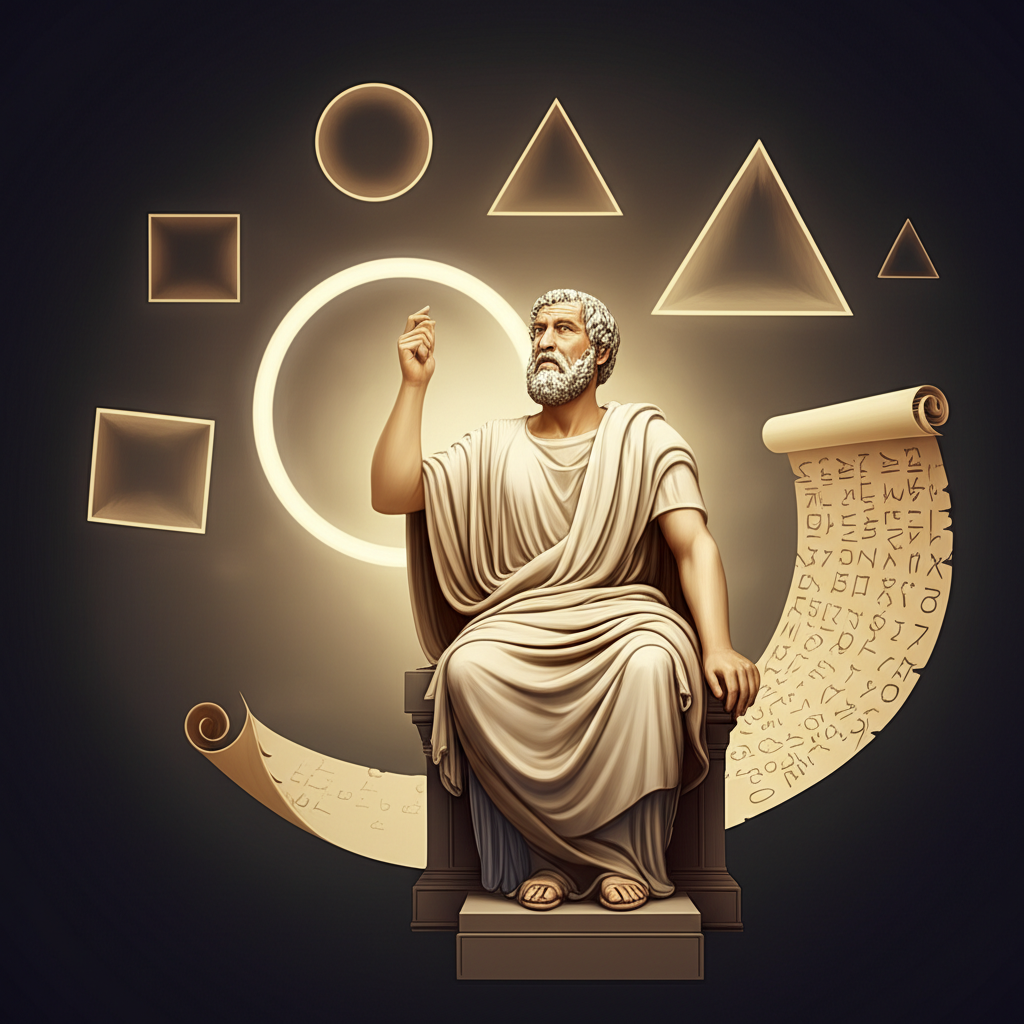
For Plato, numbers were not mere abstractions derived from counting objects; they were Forms, eternal and immutable entities existing independently of the physical world. In his view, the number "two" is not just a property shared by two apples or two people, but an ideal, perfect "Twoness" residing in the realm of Forms. Our physical world, with its imperfect instances of quantity, merely participates in or imitates these perfect numerical Forms. This perspective grants numbers a profound reality, suggesting they are discovered, not invented, and are essential to the structure of the cosmos.
Aristotle's Empiricism
Aristotle, while acknowledging the importance of number, diverged from his teacher. He viewed numbers not as separate entities but as attributes of existing things. For Aristotle, a number like "three" is only intelligible in relation to three specific objects. It is a quantity that describes a collection of actual things, not an independent substance. This more empirical approach grounds number firmly in the observable world, seeing it as a concept derived from our experience of grouping and measuring. His work, particularly in categories, laid the groundwork for understanding quantity as one of the fundamental ways we describe reality.
Medieval Meditations: Divine Order and Human Intellect
During the medieval period, the concept of number often intertwined with theological considerations. Thinkers like Augustine of Hippo saw numbers as reflections of divine order and truth, existing in the mind of God before creation. The regularity and predictability of numerical relationships were evidence of a rational, ordered cosmos. Later, Thomas Aquinas integrated Aristotelian thought, viewing numbers as intellectual abstractions derived from our sensory experience of multiple objects, yet still pointing towards a transcendent order. The philosophy of number during this era grappled with how human quantity perception harmonized with divine creation.
The Modern Turn: Rationalism, Empiricism, and the Mathematical Universe
The scientific revolution brought a renewed focus on mathematics as the language of nature.
- René Descartes emphasized the clarity and distinctness of mathematical ideas, seeing them as innate truths foundational to knowledge. For rationalists, numbers were concepts grasped by pure reason.
- Gottfried Leibniz proposed a universe governed by mathematical principles, where logic and quantity were inextricably linked. He envisioned a universal characteristic, a logical language that could resolve all disputes, built upon numerical and logical foundations.
This period saw a shift towards understanding quantity not just as a descriptor, but as an active principle underlying the universe's mechanics.
Foundations of Mathematics: Frege, Russell, and the Logicist Project
The 19th and 20th centuries witnessed an intense philosophical scrutiny of the foundations of mathematics itself. This era questioned the very definition of number and the nature of mathematical truth.
The Logicist Program
Philosophers like Gottlob Frege and later Bertrand Russell and Alfred North Whitehead (in their monumental Principia Mathematica, a cornerstone of Great Books level inquiry) spearheaded the "logicist" program. Their ambitious goal was to reduce mathematics to logic, arguing that numbers could be defined purely in terms of logical concepts. For them, the concept of "number two" could be defined as "the class of all pairs," where a "pair" is a class containing exactly two members. This aimed to provide a rigorous, non-metaphysical foundation for quantity.
Other Foundational Schools
While logicism was influential, other schools of thought emerged:
- Intuitionism (L.E.J. Brouwer): Argued that mathematical objects, including numbers, are mental constructions. They do not exist independently of the human mind, challenging the platonic and logicist views.
- Formalism (David Hilbert): Viewed mathematics as a formal system of symbols and rules, where the "meaning" of numbers was less important than their consistent manipulation within the system.
These debates highlight the profound philosophical disagreement on whether numbers are discovered (existing independently), invented (mental constructs), or merely formal symbols.
What Is Quantity? A Persistent Philosophical Question
The ongoing philosophical inquiry into number ultimately circles back to the fundamental question: What is quantity?
Table: Perspectives on Quantity's Nature
| Philosophical Viewpoint | Description | Implication for Number |
|---|---|---|
| Platonism | Quantity is an objective, transcendent property of ideal Forms. | Numbers are discovered. |
| Aristotelianism | Quantity is an inherent attribute of physical objects, abstracted by the mind. | Numbers are derived. |
| Empiricism | Quantity is a concept derived solely from sensory experience and observation of the world. | Numbers are invented. |
| Rationalism | Quantity is a clear and distinct idea, graspable by reason, possibly innate or reflecting the rational structure of the universe. | Numbers are innate. |
| Logicism | Quantity (number) can be reduced to fundamental logical concepts and definitions. | Numbers are logical. |
| Intuitionism | Quantity (number) is a mental construction, existing only insofar as it can be constructively proven or understood by the human mind. | Numbers are constructed. |
The concept of quantity forces us to confront fundamental questions about reality itself:
- Are numbers "out there" in the world, waiting to be observed?
- Are they purely mental constructs, tools we use to organize our experience?
- Or are they something else entirely – a unique category of being that bridges the gap between thought and reality?
The enduring mystery of quantity underscores the profound connection between philosophy and mathematics, reminding us that even the simplest concept can harbor infinite depths of inquiry. From ancient Greek philosophers pondering the eternal Forms to modern logicians dissecting the very fabric of mathematical truth, the philosophical journey through number continues to illuminate the nature of knowledge, reality, and the human mind.
📹 Related Video: PLATO ON: The Allegory of the Cave
Video by: The School of Life
💡 Want different videos? Search YouTube for: ""Philosophy of Mathematics: Platonism vs. Formalism""
📹 Related Video: PLATO ON: The Allegory of the Cave
Video by: The School of Life
💡 Want different videos? Search YouTube for: ""What is a Number? Frege's Definition Explained""