

Unpacking the Abstract: The Philosophical Concept of Number (Quantity)
The concept of number, seemingly so fundamental and straightforward in our daily lives, has been a source of profound philosophical inquiry for millennia. Far from being a mere tool for counting or calculation, number—and its inherent connection to quantity—stands at the very intersection of philosophy, mathematics, and our understanding of reality itself. This article delves into the rich history and complex debates surrounding what numbers truly are, how we come to know them, and their place in the fabric of existence.
A Direct Look at Number's Philosophical Core
At its heart, the philosophical concept of number questions the nature and ontology of numbers. Are numbers real entities existing independently of human thought? Are they mental constructs, properties of objects, or perhaps linguistic conventions? This inquiry into quantity moves beyond the practical application of mathematics to explore its foundational principles, revealing how deeply our understanding of the world is intertwined with these abstract notions. From ancient Greek contemplation of perfect forms to modern logical formalisms, the journey through the philosophy of number challenges our intuitions and illuminates the very limits of human knowledge.
I. The Ancient Roots: Plato, Aristotle, and the Dawn of Quantity
The Western philosophical tradition, as chronicled in the Great Books of the Western World, offers early and profound insights into the nature of number.
-
Plato's Ideal Forms: For Plato, as explored in works like The Republic and Parmenides, numbers were not merely abstractions but eternal, unchanging Forms existing independently in a realm accessible only to the intellect. The number 'Two', for instance, was a perfect, ideal entity, of which any two objects in the sensible world were mere imperfect copies. This perspective posits a mathematical Platonism, where numbers possess an objective reality beyond human experience. Their existence is discovered, not invented.
-
Aristotle's Immanent Properties: Aristotle, Plato's student, offered a contrasting view. In his Metaphysics and Categories, he largely rejected the separate realm of Forms. For Aristotle, numbers were not independent entities but rather properties or aspects of things. Quantity was one of his fundamental categories of being, describing how much or how many of a substance there was. A number, therefore, was always the number of something—two apples, three virtues. This view grounds number firmly in the empirical world, making it a feature of existence rather than a transcendent one.
-
Euclid's Geometric Foundations: While primarily a mathematician, Euclid's Elements (another cornerstone of the Great Books) implicitly shaped philosophical thinking about number by grounding it in geometry. His axiomatic approach demonstrated how complex mathematical truths could be derived from basic definitions and postulates, influencing later philosophers like Descartes and Kant in their quest for certainty.
II. The Enlightenment and Beyond: From Descartes to Kant
The modern era brought new perspectives, particularly as mathematics itself underwent revolutionary changes.
-
Descartes and Analytic Geometry: René Descartes, in his Discourse on Method and Meditations, bridged algebra and geometry, showing how spatial figures could be represented by numerical equations. This unification suggested a deep underlying unity between different aspects of quantity and space, reinforcing the idea that mathematics provided a universal language for understanding reality. His method emphasized clear and distinct ideas, laying groundwork for later attempts to found mathematics on logical principles.
-
Kant's Synthetic A Priori: Immanuel Kant, in his Critique of Pure Reason, argued that our knowledge of numbers and quantity is not solely empirical (derived from experience) nor purely analytic (derived from definitions). Instead, he proposed that mathematical truths are synthetic a priori—they are necessarily true, universally valid, and originate from the very structure of our minds, not from external objects alone. For Kant, counting and arithmetic are products of our faculty of intuition (specifically, time) and understanding, allowing us to organize and make sense of the world. Numbers, therefore, are fundamental to our way of experiencing and knowing.
III. Key Philosophical Debates in the Concept of Number
The historical journey reveals recurring tensions that continue to define the philosophy of number.
-
Realism vs. Anti-Realism:
- Platonism/Realism: Numbers exist objectively and independently of human minds. We discover them. (e.g., Plato, Frege, Gödel)
- Anti-Realism: Numbers are mental constructs, linguistic tools, or properties of objects. They do not exist independently. (e.g., Aristotle, Mill, Formalists, Intuitionists)
-
The Nature of Quantity: Discrete vs. Continuous:
- Is quantity fundamentally discrete (countable units, like integers) or continuous (infinitely divisible, like the real number line, often associated with space and time)? This distinction impacts how we model the physical world and understand paradoxes like Zeno's.
-
Logicism, Intuitionism, and Formalism: These 20th-century schools of thought grapple with the foundations of mathematics:
- Logicism: (Frege, Russell, Whitehead in Principia Mathematica) Argues that mathematics can be reduced to logic, making numbers logical constructs.
- Intuitionism: (Brouwer) Posits that mathematical objects are mental constructions, and only those that can be constructively proven truly exist. Rejects classical logic principles (like the law of excluded middle) for infinite sets.
- Formalism: (Hilbert) Views mathematics as a formal system of symbols and rules, without necessarily referring to any inherent meaning or external reality. The focus is on consistency and completeness.
Image: 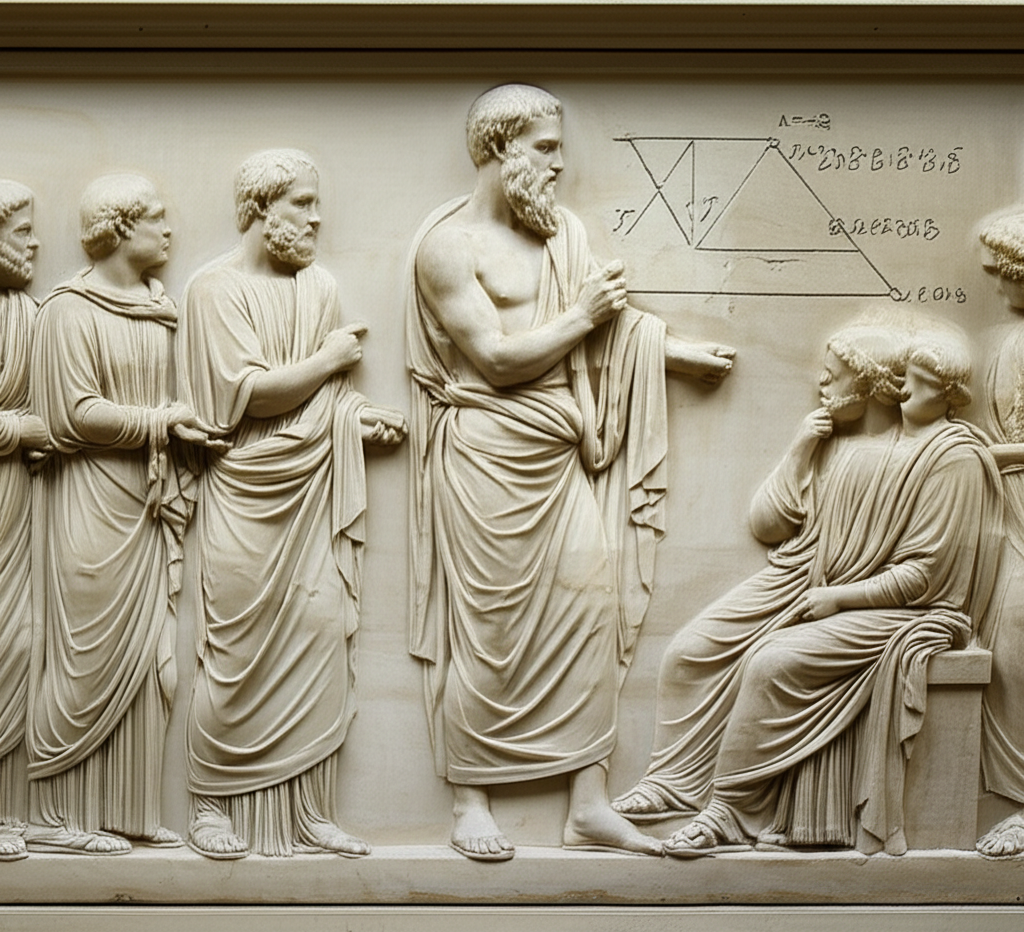
IV. Number, Quantity, and Modern Mathematics
Contemporary philosophy of mathematics continues to explore these themes, often integrating insights from set theory, logic, and cognitive science.
Core Questions Persist:
- How do we acquire knowledge of numbers? Is it innate, empirical, or a product of language and culture?
- What is the relationship between abstract numbers and the physical world? How do numbers "apply" to reality, and why is mathematics so effective in describing the universe?
- Are mathematical truths discovered or invented? This question echoes the ancient realist vs. anti-realist debate.
- What constitutes a quantity? Is it merely magnitude, or does it encompass order, ratio, and other relational properties?
The shift towards set theory in the 20th century provided a new foundational language for mathematics, defining numbers in terms of sets. For example, the number 'zero' can be defined as the empty set {}, 'one' as the set containing the empty set {{}}, and so on. This approach, while powerful, still invites philosophical questions about the nature of sets themselves.
V. Conclusion: The Enduring Mystery of Number
The philosophical concept of number, with its deep roots in the Great Books of the Western World and its pervasive influence on mathematics and our understanding of quantity, remains a vibrant field of inquiry. From Plato's perfect Forms to Kant's synthetic a priori intuitions and the formal systems of the 20th century, philosophers have grappled with the elusive nature of these abstract entities.
Numbers are not just tools; they are fundamental to how we perceive, measure, and articulate the world. Their existence, their properties, and our ability to comprehend them continue to challenge our assumptions about reality, knowledge, and the very structure of thought. The journey into the philosophy of number is a journey into the heart of what it means to reason and understand.
YouTube Video Suggestions:
-
📹 Related Video: What is Philosophy?
Video by: The School of Life
💡 Want different videos? Search YouTube for: ""philosophy of mathematics realism anti-realism""
2. ## 📹 Related Video: PLATO ON: The Allegory of the Cave
Video by: The School of Life
💡 Want different videos? Search YouTube for: ""Plato Aristotle philosophy of number quantity""