

The Endless Enigma: A Philosophical Journey Through Infinity
Ah, infinity – a concept that has both tantalized and tormented the greatest minds throughout history. It's not merely a gargantuan number; it's a profound philosophical puzzle, a boundary-pushing concept that challenges our very understanding of existence, time, space, and the divine. From ancient paradoxes to modern mathematics, the idea of the boundless has forced us to confront the limits of human reason and the vastness of the cosmos. This article delves into the rich tapestry of how philosophers, drawing often from the wellsprings of the Great Books of the Western World, have grappled with this elusive notion, transforming it from a mere numerical curiosity into a cornerstone of metaphysical inquiry.
The Ancient Roots: Zeno's Paradoxes and Aristotle's Distinctions
Our journey into the philosophical concept of infinity often begins in ancient Greece, where thinkers first wrestled with the implications of endlessness.
- Zeno of Elea (c. 490–430 BCE): Zeno's famous paradoxes, such as Achilles and the Tortoise or the Dichotomy, brilliantly illustrated the perplexing nature of infinity when applied to motion and space. By dividing distances into an infinite series of smaller segments, Zeno argued that motion was impossible, forcing philosophers to consider whether infinity could truly exist in the physical world or if it was merely a conceptual tool. His work, though often seen as a challenge to common sense, served as a powerful catalyst for deeper inquiry into the nature of continuity and discreteness.
- Aristotle (384–322 BCE): One of the most influential figures in the Great Books, Aristotle provided a crucial distinction that shaped centuries of thought: that between potential infinity and actual infinity.
- Potential Infinity: This refers to a process that can be continued indefinitely, such as counting numbers (you can always add one more) or dividing a line segment (you can always divide it further). It is never completed; it exists only in the possibility of extension. Aristotle believed this was the only kind of infinity that could truly exist in the natural world.
- Actual Infinity: This refers to a completed, existing whole that is infinite. For Aristotle, an actual infinite magnitude, number, or duration was impossible in reality, leading to logical contradictions. His arguments profoundly influenced Western thought, asserting that the universe, though vast, was not actually infinite in extent or duration.
This foundational distinction provided a framework for subsequent generations to debate whether a truly infinite entity could exist, especially in relation to a divine being.
Medieval Meditations: Infinity and the Divine
With the rise of monotheistic religions, the concept of infinity became inextricably linked with the nature of God.
- St. Augustine of Hippo (354–430 CE): In his Confessions, Augustine grappled with the infinity of God, particularly in relation to time. He posited that God exists outside of time, in an eternal present, implying a divine infinity that transcends human temporal understanding. The creation of the world, for Augustine, was not an event within an infinite past, but the beginning of time itself.
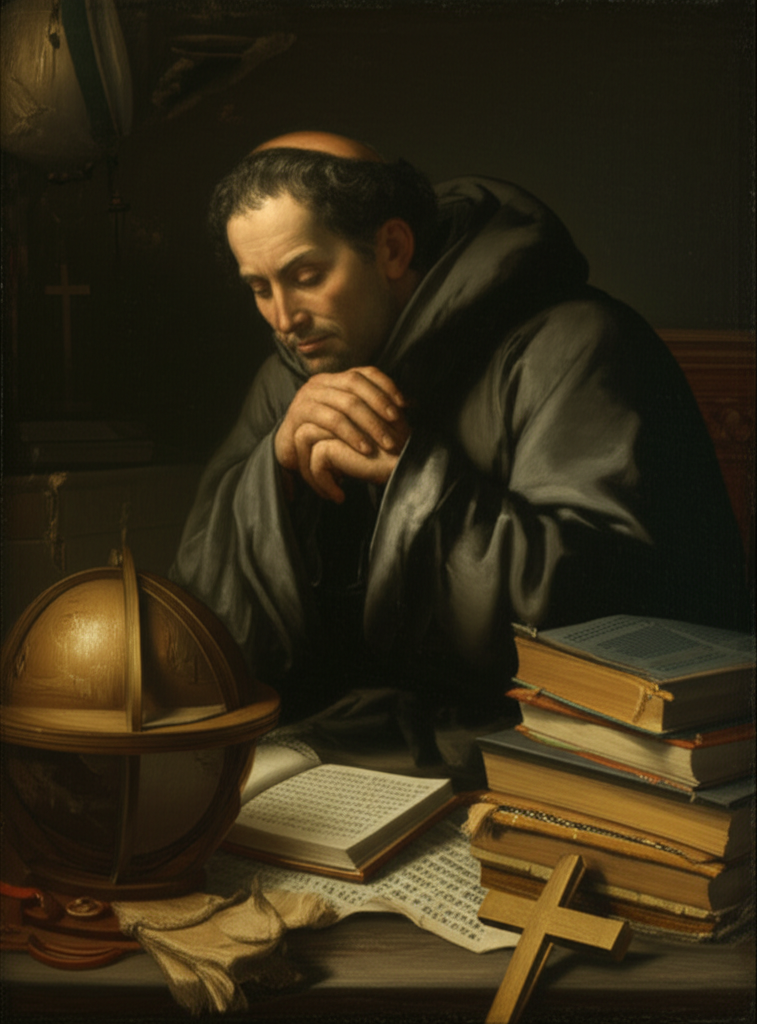
- St. Thomas Aquinas (1225–1274 CE): Drawing heavily on Aristotle, Aquinas, in his Summa Theologica, affirmed the absolute infinity of God. God, as pure act and perfect being, is infinite in power, goodness, and knowledge. However, Aquinas maintained Aristotle's view regarding the impossibility of an actual infinite in creation. While God is infinite, the created world, being contingent and limited, cannot possess actual infinity. This theological perspective highlighted the qualitative difference between divine and created existence.
Early Modern Explorations: From Substance to Space
The Enlightenment brought new perspectives, challenging scholastic views and re-evaluating the role of infinity in metaphysics and the natural world.
- René Descartes (1596–1650 CE): Descartes, in his Meditations, uses the concept of infinity as a proof for God's existence. He argues that the idea of an infinite and perfect being cannot originate from a finite, imperfect mind unless it was placed there by an actually infinite and perfect being – God. He also considered the spatial infinity of the universe, suggesting that God's omnipotence implies the possibility of boundless extension.
- Baruch Spinoza (1632–1677 CE): Spinoza's monistic philosophy, presented in his Ethics, famously posits a single, infinite substance – God or Nature – which possesses infinite attributes. For Spinoza, everything that exists is a mode of this one infinite substance. This radical view asserts the actual infinity of reality itself, a stark contrast to Aristotle's and Aquinas's limitations.
- Gottfried Wilhelm Leibniz (1646–1716 CE): Leibniz, while a co-inventor of calculus (which inherently deals with infinitesimals and infinite series), philosophically grappled with the concept through his theory of monads. He believed in a universe composed of infinitely many simple, indivisible substances (monads), each reflecting the entire universe from its unique perspective. He also explored the idea of an infinite number of possible worlds, only one of which God chose to actualize.
Modern & Contemporary Views: Challenging Intuition with Mathematics
The 19th and 20th centuries witnessed revolutionary developments, particularly in mathematics, which profoundly impacted the philosophical concept of infinity.
- Immanuel Kant (1724–1804 CE): In his Critique of Pure Reason, Kant presented the "Antinomies of Pure Reason," where he demonstrated that equally compelling arguments could be made for both the finitude and infinity of the universe (e.g., whether the world has a beginning in time and is limited in space, or is infinite in both). Kant concluded that infinity, as a noumenal concept, lies beyond the grasp of human experience and understanding, serving as a regulative ideal for reason rather than a knowable reality.
- Georg Cantor (1845–1918 CE): Cantor's groundbreaking work in set theory fundamentally changed how we understand infinity, especially its relationship with mathematics. He demonstrated that there are different sizes of infinity – transfinite numbers.
- The infinity of natural numbers (countably infinite).
- The infinity of real numbers (uncountably infinite, a "larger" infinity).
Cantor's work, initially met with resistance, showed that actual infinity could be rigorously defined and manipulated in mathematics, opening new avenues for philosophical inquiry into the nature of mathematical existence and reality.
- David Hilbert (1862–1943 CE): Hilbert's famous "Hilbert's Hotel" thought experiment brilliantly illustrates the counter-intuitive properties of actual infinity. An infinitely large hotel can always accommodate new guests, even if all its rooms are full, simply by shifting existing guests. This paradox highlights the stark difference between finite and infinite systems and continues to be a powerful tool for exploring the concept.
The Enduring Paradoxes and Puzzles
Despite centuries of inquiry, the philosophical concept of infinity continues to generate paradoxes and deep questions.
- The Problem of the Continuum: How do discrete points form a continuous line? This harks back to Zeno and remains a challenge in both philosophy and mathematics.
- The Nature of Mathematical Objects: Do infinite sets truly exist in some Platonic realm, or are they merely useful fictions of the human mind?
- Cosmological Implications: Is the universe spatially or temporally infinite? And if so, what are the implications for our existence and purpose?
| Era | Key Figures | Core Ideas on Infinity |
|---|---|---|
| Ancient | Zeno, Aristotle | Paradoxes of motion; Distinction between potential and actual infinity (Aristotle: actual infinity impossible). |
| Medieval | Augustine, Aquinas | God's absolute infinity; Creation is finite; Time created with the world. |
| Early Modern | Descartes, Spinoza, Leibniz | Infinity as proof for God; God as infinite substance; Infinitesimals, infinite monads, infinite possible worlds. |
| Modern | Kant, Cantor, Hilbert | Antinomies of reason; Different "sizes" of actual infinity (transfinite numbers); Paradoxes of infinite sets (Hilbert's Hotel). |
The journey through the philosophical concept of infinity is far from over. It remains a vibrant area of discussion, continually pushing the boundaries of our understanding, reminding us that some of the most profound questions lie beyond the grasp of simple answers. It is a testament to the enduring power of philosophy to grapple with the truly boundless.
**## 📹 Related Video: What is Philosophy?
Video by: The School of Life
💡 Want different videos? Search YouTube for: ""Zeno's Paradoxes explained philosophy" or "Cantor's transfinite numbers philosophical implications""**