

The Philosophical Basis of Liberty: A Timeless Pursuit of Freedom
Summary: The concept of Liberty stands as a cornerstone of human civilization, a perpetual subject of philosophical inquiry that has shaped societies and individual lives. From ancient Greek city-states to modern democracies, philosophers have grappled with the nature of freedom, its relationship to Law, and its implications for the very essence of Man. This article delves into the rich intellectual history of Liberty, tracing its evolution through the lens of Western thought, revealing how diverse thinkers from the Great Books of the Western World tradition have sought to define, defend, and understand this fundamental human aspiration.
The Enduring Question: What is Liberty?
To speak of Liberty is to touch upon one of the most profound and persistent themes in the history of Philosophy. It is not merely the absence of constraint, but a complex tapestry woven with threads of individual autonomy, civic participation, moral agency, and the very structure of society. For millennia, thinkers have wrestled with defining what it means for Man to be truly free, and how this freedom can coexist, or indeed thrive, within the framework of Law. This journey through the annals of thought reveals that Liberty is not a static ideal, but a dynamic concept continually re-evaluated and re-imagined.
Ancient Echoes: Freedom within the Polis
Our philosophical journey begins in the classical world, where the very notion of Liberty was inextricably linked to citizenship and the communal life of the polis. For the ancient Greeks, particularly as reflected in the works compiled in the Great Books, true freedom was often understood not as boundless individualism, but as the ability to participate fully in the life of the city-state.
- Plato and Aristotle, while differing in their ideal states, both emphasized the role of Law in cultivating virtue and enabling citizens to live a good life. For them, Liberty was tied to rational self-governance and adherence to laws that promoted the common good. A man was free when he lived according to reason, aligning his actions with the dictates of a just society.
- Socrates' willingness to accept his death sentence, rather than defy the laws of Athens, stands as a powerful testament to this early understanding of civic Liberty – freedom found within the bounds of a just legal system, even when that system appeared to err.
The Medieval Interlude: Divine Law and Human Freedom
With the advent of Christianity, the philosophical understanding of Liberty took on new dimensions, integrating divine will and eternal Law. Thinkers like St. Augustine and St. Thomas Aquinas, drawing heavily on classical philosophy but reinterpreting it through a theological lens, explored freedom in relation to God's plan.
- St. Augustine grappled with free will and predestination, ultimately asserting Man's capacity for choice, even amidst divine providence. True Liberty, for Augustine, was liberation from sin, found through grace, and adherence to God's eternal Law.
- St. Thomas Aquinas further elaborated on natural Law – principles discoverable by human reason that reflect divine Law. For Aquinas, human Law derived its legitimacy from natural Law, and Man's Liberty was actualized when he acted in accordance with these rational and divinely inspired principles. Freedom was not mere license, but the ordered pursuit of good.
The Enlightenment's Dawn: Social Contracts and Natural Rights
The Enlightenment period marked a profound shift, placing the individual and their inherent rights at the center of the debate on Liberty. This era, rich with foundational texts in the Great Books collection, saw the emergence of social contract theories that fundamentally reshaped our understanding of the relationship between Man, Law, and government.
| Philosopher | Core Concept of Liberty | Relationship to Law |
|---|---|---|
| Thomas Hobbes | Liberty as the absence of external impediments; security. | Law (Leviathan's rule) necessary to prevent chaos and ensure peace, even at the cost of extensive individual freedom. |
| John Locke | Natural rights to life, Liberty, and property; freedom from arbitrary power. | Law (government) exists to protect these inherent natural rights; legitimate Law derives from the consent of the governed. |
| Jean-Jacques Rousseau | Civic Liberty through the "General Will"; freedom by obeying laws one prescribes for oneself. | Law (General Will) is the expression of the collective moral freedom of the people; legitimate Law ensures true freedom. |
| Baron de Montesquieu | Political Liberty found in the separation of powers and the rule of Law. | Law must be designed to prevent tyranny and protect individual rights through checks and balances. |
John Locke's ideas were particularly revolutionary, asserting that Man possesses inherent natural rights, including the right to Liberty, which predate government. For Locke, the purpose of Law and government is not to grant Liberty, but to protect it. When a government fails to uphold these rights, the people retain the right to resist. This articulation laid the groundwork for modern liberal democracies.
Jean-Jacques Rousseau, while also a social contract theorist, offered a more communal vision of Liberty. He argued that true freedom is found not in individualistic pursuit but in collective self-governance, where individuals obey laws they have collectively made for themselves—the "General Will." Here, Law becomes the very embodiment of Liberty.
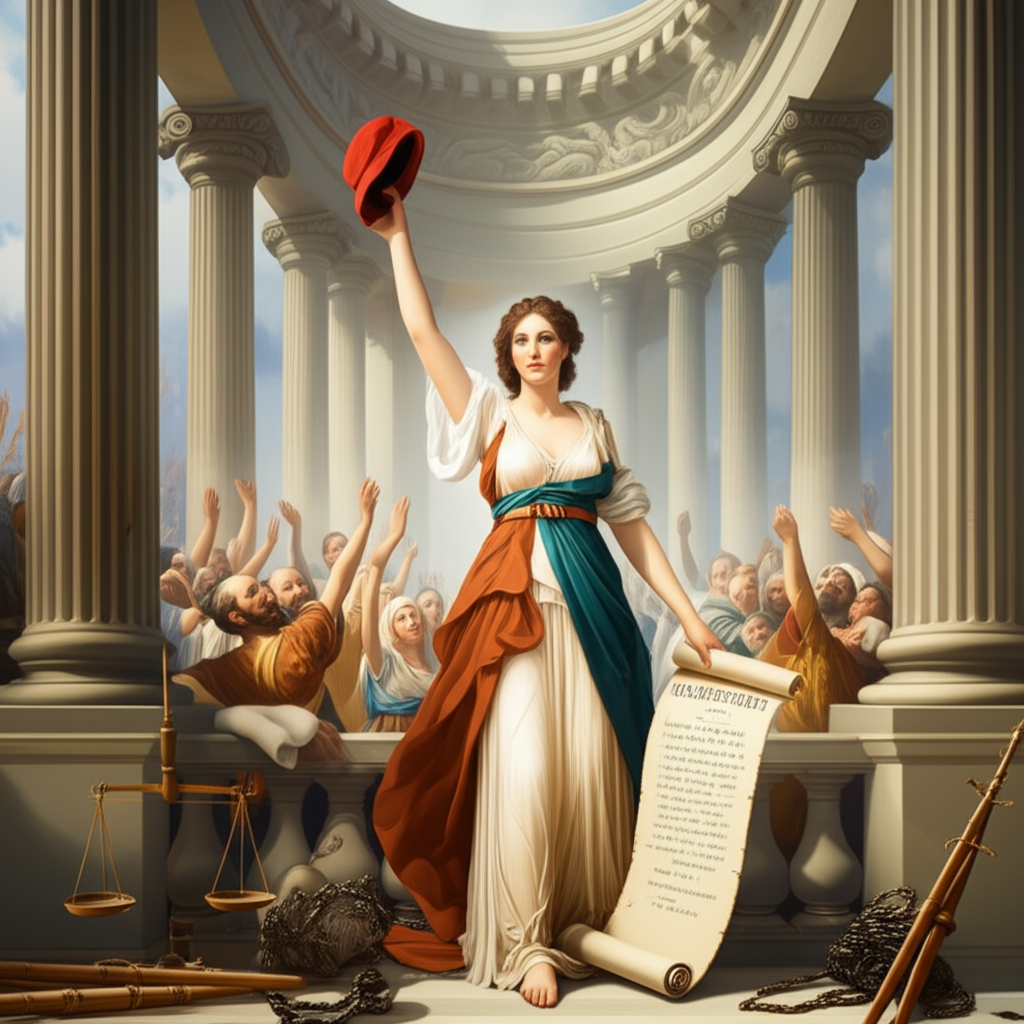
The Modern Era: Expanding the Scope of Liberty
The 19th and 20th centuries saw further nuanced explorations of Liberty, expanding beyond purely political freedom to encompass individual expression, social justice, and economic considerations.
- John Stuart Mill, in his seminal work On Liberty, championed individual freedom against the tyranny of the majority and the state. His "harm principle" posits that the only legitimate reason for society to interfere with Man's Liberty is to prevent harm to others. For Mill, freedom of thought, discussion, and lifestyle choices are paramount to human flourishing and societal progress, emphasizing that robust Law must safeguard these freedoms.
- Isaiah Berlin introduced the influential distinction between "negative Liberty" (freedom from interference) and "positive Liberty" (freedom to achieve one's potential or self-mastery). This distinction highlights the ongoing philosophical tension between non-interference and the active role a society or state might play in enabling Man's freedom.
Liberty, Law, and the Nature of Man: A Synthesis
The Philosophy of Liberty is a dynamic and evolving dialogue, constantly seeking to understand the intricate relationship between Man's innate desire for freedom and the societal necessity of Law. From the ancient focus on civic virtue to the Enlightenment's emphasis on natural rights, and through modern considerations of individual autonomy and social justice, the question remains: How can Man be truly free while living within a structured society governed by Law?
This enduring philosophical quest reveals that Liberty is not a simple concept but a continuous negotiation. It requires a commitment to critical thought, a willingness to challenge existing norms, and a profound respect for the dignity of every Man. The great texts of Western thought do not offer a single, definitive answer, but rather a rich tapestry of perspectives that continue to inform our contemporary understanding of freedom.
The Perpetual Dialogue
The philosophical basis of Liberty remains a vibrant field of inquiry. As societies evolve, new challenges emerge that demand a re-examination of our understanding of freedom. Whether confronting issues of digital privacy, global governance, or social inequality, the foundational questions posed by the giants of Philosophy continue to provide the framework for our debates. The pursuit of Liberty, guided by thoughtful inquiry into the nature of Man and the role of Law, is an unending journey—a testament to humanity's enduring aspiration for a life lived in freedom and dignity.
📹 Related Video: What is Philosophy?
Video by: The School of Life
💡 Want different videos? Search YouTube for: ""John Locke natural rights philosophy explained""
📹 Related Video: PLATO ON: The Allegory of the Cave
Video by: The School of Life
💡 Want different videos? Search YouTube for: ""Isaiah Berlin Two Concepts of Liberty animated""