

The Philosophical Basis of Liberty: A Journey Through Thought
Summary: Liberty, a concept often taken for granted in modern discourse, possesses a profound and intricate philosophical lineage. This article delves into the historical and intellectual foundations of liberty, tracing its evolution from ancient Greek city-states to the Enlightenment's revolutionary ideals. We explore how thinkers, grappling with the nature of Man, society, and Law, meticulously constructed the frameworks that define our understanding of freedom today, drawing heavily from the enduring wisdom found within the Great Books of the Western World.
Unveiling the Essence of Freedom
What does it truly mean to be free? Is it merely the absence of external constraint, or does it encompass a deeper, more profound capacity for self-determination and moral agency? These are questions that have occupied the greatest minds in Philosophy for millennia, shaping civilizations and inspiring revolutions. To understand Liberty is to understand the very essence of human aspiration, and its philosophical basis is a tapestry woven from the threads of reason, ethics, and political theory.
The journey to comprehend liberty is not a simple linear progression but a complex dialogue across centuries. From the earliest inquiries into justice and governance to the intricate social contracts of modernity, each era has added its unique perspective, refining our collective understanding of what it means for Man to live freely under Law.
Ancient Echoes: The Seeds of Self-Governance
Our exploration begins in the cradles of Western thought, where the initial sparks of liberty were ignited. In ancient Greece, particularly Athens, the idea of the polis fostered a unique environment for political participation.
-
Plato and Aristotle: While their views on ideal governance differed, both philosophers grappled with the role of the individual within the state. Plato, in his Republic, explored the concept of internal freedom – the liberation of the soul from base desires through reason. Aristotle, in Politics, examined the conditions for a good life, emphasizing the importance of active citizenship and the rule of
Lawfor a flourishing society. For them, true freedom forManwas often tied to living virtuously within a well-ordered community. -
The Roman Republic: The Romans introduced concepts of civitas (citizenship) and lex (law) that provided a more structured framework for individual rights, albeit primarily for citizens. The Stoics, like Seneca and Marcus Aurelius, further developed the idea of inner
Liberty– freedom from emotional disturbance and external circumstances through rational self-control. This internal fortitude was seen as accessible to everyMan, regardless of his social standing.
Key Ancient Concepts of Liberty:
| Concept | Description | Primary Focus |
|---|---|---|
| Political Freedom | Participation in governance, freedom to speak and act within the polis. | External (civic) |
| Moral Freedom | Liberation from passions, self-mastery through reason. | Internal (individual Man) |
| Legal Freedom | Rights and protections afforded by the Law within a structured society. |
External (societal, applicable to citizens) |
The Medieval Interlude: Divine Order and Natural Law
The medieval period, often characterized by its theological focus, saw Liberty frequently framed within a divine order. Yet, even here, crucial philosophical developments occurred. Thinkers like Thomas Aquinas, synthesizing Aristotelian Philosophy with Christian theology in his Summa Theologica, articulated the concept of Natural Law. This posited that a universal moral Law, discoverable by human reason, precedes and informs all human Law.
This idea was revolutionary because it suggested that even rulers were bound by a higher standard. If human Law contradicted Natural Law, it lost its legitimacy, laying a foundational stone for future arguments about resistance to tyranny and the inherent rights of Man.
The Enlightenment's Grand Unveiling: Reason, Rights, and Revolution
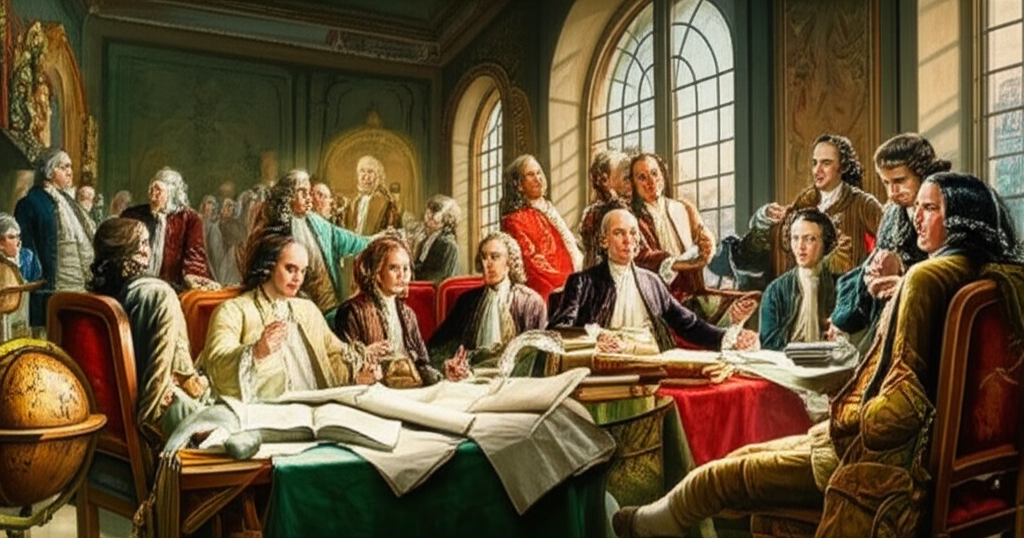
The Enlightenment marked a pivotal shift, placing Man and his reason at the center of the universe. This era, richly documented in the Great Books, fundamentally reshaped the Philosophy of Liberty.
-
John Locke: In his Two Treatises of Government, Locke argued that
Manpossesses inherent natural rights – to life,Liberty, and property – which precede government. He proposed that government derives its legitimacy from the consent of the governed and exists primarily to protect these rights. If a government fails in this duty, the people have a right to revolution. Locke's ideas were a direct challenge to absolute monarchy and provided the philosophical bedrock for modern liberal democracies. -
Jean-Jacques Rousseau: While complex and sometimes contradictory, Rousseau's The Social Contract explored the idea of
Libertythrough the concept of the "general will." For Rousseau, true freedom forManwas not merely individualistic but lay in participating in a community where one obeysLawthat one has helped create, thus obeying oneself. This concept of collective self-governance deeply influenced republican thought. -
Montesquieu: In The Spirit of the Laws, Montesquieu emphasized the importance of the separation of powers (executive, legislative, judicial) as a crucial safeguard for
Liberty. He argued that concentrating power in a single entity inevitably leads to tyranny, and only by dividing and balancing governmental authority can the freedom ofManbe preserved.
These thinkers, among others, moved Liberty from a privilege granted by rulers or a state of inner virtue to an inalienable right inherent in every Man, demanding institutional protection through Law and constitutional design.
Modern Interpretations and Enduring Debates
The philosophical journey of Liberty did not end with the Enlightenment. Subsequent thinkers have continued to refine, challenge, and expand upon these foundational ideas.
- Negative vs. Positive Liberty: Isaiah Berlin famously distinguished between negative liberty (freedom from interference by others, often associated with individual rights) and positive liberty (freedom to achieve one's potential, often requiring societal provisions or collective action). This distinction highlights ongoing debates about the role of the state in ensuring or limiting freedom.
- Economic Liberty: Philosophers like Adam Smith, in The Wealth of Nations, explored the concept of economic
Liberty, arguing that freedom in trade and enterprise leads to greater prosperity and individual well-being. - Social Justice and Group Liberty: More contemporary
Philosophyoften examinesLibertythrough the lens of social justice, questioning whether true freedom can exist for allManif systemic inequalities persist. This includes discussions on group rights and liberation movements.
The tension between individual autonomy and collective well-being, between absolute freedom and necessary Law, remains a vibrant and crucial area of philosophical inquiry. The pursuit of Liberty is a dynamic, ongoing process, continually informed by our evolving understanding of human nature and society.
Conclusion: The Unending Quest for Freedom
The philosophical basis of Liberty is not a static doctrine but a living tradition, a continuous conversation spanning millennia. From the ancient Greek concern with virtuous citizenship to the Enlightenment's emphasis on inalienable rights, and into contemporary debates about justice and autonomy, Philosophy has consistently sought to define, defend, and expand the horizons of human freedom.
By engaging with the profound insights contained within the Great Books of the Western World, we are reminded that Liberty is not merely a political slogan but a deeply considered ideal, painstakingly constructed through rigorous thought about Man, Law, and the very purpose of human existence. To cherish Liberty is to understand its roots, to participate in its ongoing definition, and to recognize its perpetual fragility and profound importance.
YouTube Video Suggestions:
-
📹 Related Video: What is Philosophy?
Video by: The School of Life
💡 Want different videos? Search YouTube for: "John Locke Natural Rights Philosophy"
2. ## 📹 Related Video: KANT ON: What is Enlightenment?
Video by: The School of Life
💡 Want different videos? Search YouTube for: "Isaiah Berlin Two Concepts of Liberty Explained"