

The Philosophical Basis of Liberty: An Enduring Quest for Freedom
Liberty, a concept deeply ingrained in the human spirit, is far from a simple or monolithic idea. Its philosophical underpinnings are complex, evolving across millennia of thought, and inextricably linked to our understanding of Man, Law, and the very essence of Philosophy. This article delves into the rich tapestry of philosophical discourse that has shaped our comprehension of liberty, examining how thinkers from the Great Books of the Western World have grappled with its definition, its limits, and its indispensable role in human flourishing. We will explore how different eras and intellectual traditions have conceived of freedom, from ancient civic participation to modern individual rights, always navigating the delicate balance between individual autonomy and societal order.
Unpacking Liberty: From Ancient Polis to Modern Autonomy
The concept of liberty, at its core, refers to the ability of Man to act, speak, and think without undue external restraint. However, the exact nature of these restraints, and what constitutes "undue," has been the subject of intense philosophical debate. From the earliest Greek city-states to the Enlightenment salons, philosophers have sought to define the conditions under which Man can truly be free, and what role Law plays in both enabling and limiting that freedom.
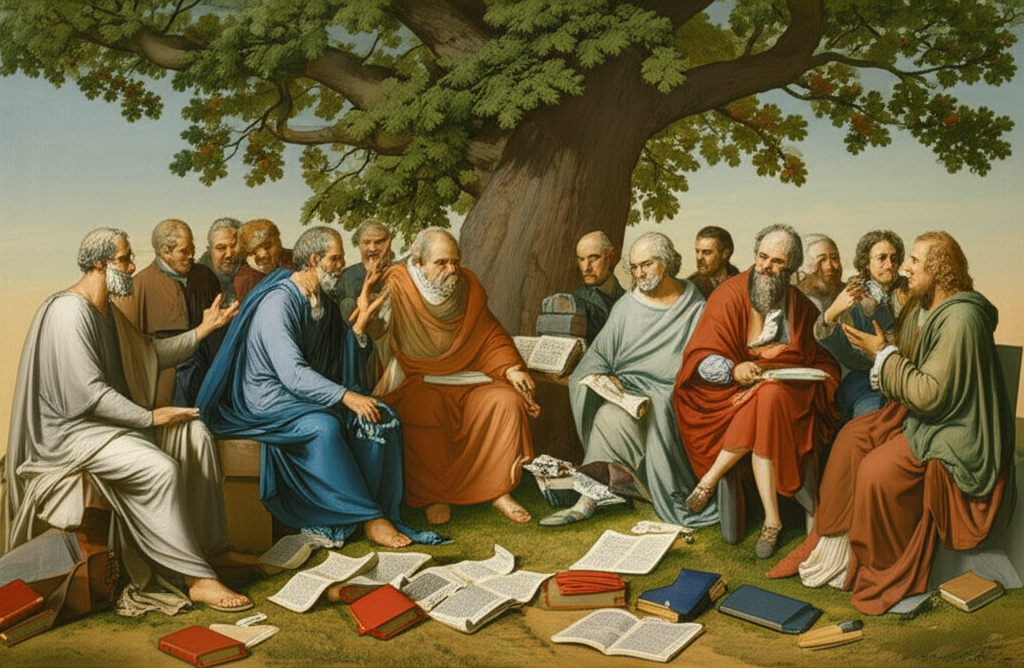
Ancient Roots: Civic Freedom and the Good Life
In the ancient world, particularly among the Greeks, liberty was often understood in a civic context. For thinkers like Plato and Aristotle, found in works such as The Republic and Politics, freedom was less about individual autonomy in the modern sense and more about the ability to participate in the political life of the polis. A free Man was a citizen, not a slave, capable of contributing to the common good and living according to the virtues prescribed by the community.
- Plato's Republic: While often seen as advocating for a highly structured society, Plato's ideal state aimed to free its citizens from the tyranny of their own appetites, leading to a higher form of internal liberty through reason.
- Aristotle's Politics: Aristotle emphasized the idea that Man is a "political animal," and true freedom involved participation in self-governance, living under just Law, and striving for the "good life" within a well-ordered community. The Law was seen as a necessary framework for achieving this collective flourishing, not merely a restriction.
The Enlightenment and the Birth of Individual Rights
The Enlightenment period marked a profound shift in the philosophical understanding of liberty, moving towards a greater emphasis on individual rights and freedoms inherent to Man. This era, heavily represented in the Great Books, saw philosophers grapple with the state of nature, the social contract, and the legitimate scope of governmental power.
John Locke: Natural Rights and Limited Government
John Locke's Two Treatises of Government laid the groundwork for modern liberal thought, asserting that Man possesses natural rights to life, liberty, and property even before the formation of government. For Locke:
- Natural Liberty: Man in the state of nature is free to order his actions and dispose of his possessions as he sees fit, within the bounds of the Law of Nature.
- Social Contract: People enter into society and form governments to better protect these natural rights.
- Limited Government: The purpose of government is to uphold these rights, and its authority is derived from the consent of the governed. If a government oversteps its bounds, the people have a right to resist. Here, Law is not a curtailment of liberty but its protector and enabler.
Jean-Jacques Rousseau: The General Will and Moral Liberty
Jean-Jacques Rousseau, in his Social Contract, presented a more complex view of liberty. He argued that Man is born free but everywhere is in chains. For Rousseau, true liberty is not merely freedom from external constraint but freedom to act according to a self-imposed Law derived from the "general will" of the community.
- Moral Liberty: By entering into a social contract, individuals surrender their natural liberty to gain moral liberty, becoming truly free by obeying laws they have collectively prescribed for themselves.
- General Will: This is not merely the sum of individual wills but the common interest, which aims at the good of the whole. Obedience to the general will makes Man truly free. This concept ties individual liberty intimately to the collective and the Law that embodies its will.
John Stuart Mill: The Harm Principle and Individual Sovereignty
In the 19th century, John Stuart Mill's On Liberty offered a powerful defense of individual freedom against the tyranny of both government and majority opinion. Mill's central argument is the "harm principle":
- Harm Principle: The only purpose for which power can be rightfully exercised over any member of a civilized community, against his will, is to prevent harm to others.
- Sovereignty of the Individual: Over himself, over his own body and mind, the individual is sovereign. This robust defense of individual liberty, freedom of thought, and expression remains a cornerstone of liberal democratic thought. For Mill, Law should be minimal, intervening only when necessary to prevent harm, thus maximizing the sphere of individual liberty for Man.
The Interplay of Man, Liberty, and Law
The journey through these philosophical perspectives reveals a persistent tension and interplay between Man, Liberty, and Law.
- Man's Nature: Is Man inherently good, requiring minimal Law to achieve liberty (Rousseau's initial premise), or prone to conflict, necessitating strong Law to prevent chaos and ensure security (Hobbes's Leviathan)? The answer profoundly shapes the conception of liberty.
- Law as Enabler vs. Restrictor: For Locke and Mill, just Law is the framework that protects liberty, defining its boundaries to prevent infringement upon others. For Hobbes, Law primarily restricts liberty to ensure peace. For Rousseau, Law is liberty when it emanates from the general will.
- Freedom From vs. Freedom To: This distinction, often explored in later philosophy, highlights whether liberty is primarily about the absence of external obstacles (negative liberty) or the presence of genuine opportunities and capabilities to act (positive liberty). Philosophers like Aristotle and Rousseau leaned towards a form of positive liberty, where freedom meant achieving a certain state or capacity within a just society.
Key Aspects of the Relationship:
| Aspect of Liberty | Philosophical Perspective | Role of Law |
|---|---|---|
| Natural Liberty | Locke: Freedom from government in the state of nature, governed by the Law of Nature. Mill: Individual sovereignty over one's own being. | Law of Nature (Locke) provides moral guidance. Minimal Law (Mill) to prevent harm. to the government to protect their rights. |
📹 Related Video: What is Philosophy?
Video by: The School of Life
💡 Want different videos? Search YouTube for: "The Philosophical Basis of Liberty philosophy"