

The Philosophical Basis of Democracy: A Journey Through Western Thought
Democracy, as a form of government, is far more than a mere system of voting; it is a profound philosophical construct, deeply rooted in centuries of Western thought. Its basis lies in fundamental ideas about human nature, justice, liberty, and the legitimate exercise of power. From the ancient Greek polis to the Enlightenment's grand treatises, the philosophy underpinning democracy has been debated, refined, and challenged, shaping the very fabric of our modern political landscape. This article delves into the core intellectual heritage that provides democracy its enduring philosophical foundation, drawing insights from the Great Books of the Western World.
Ancient Roots: The Greek Polis and Early Democratic Thought
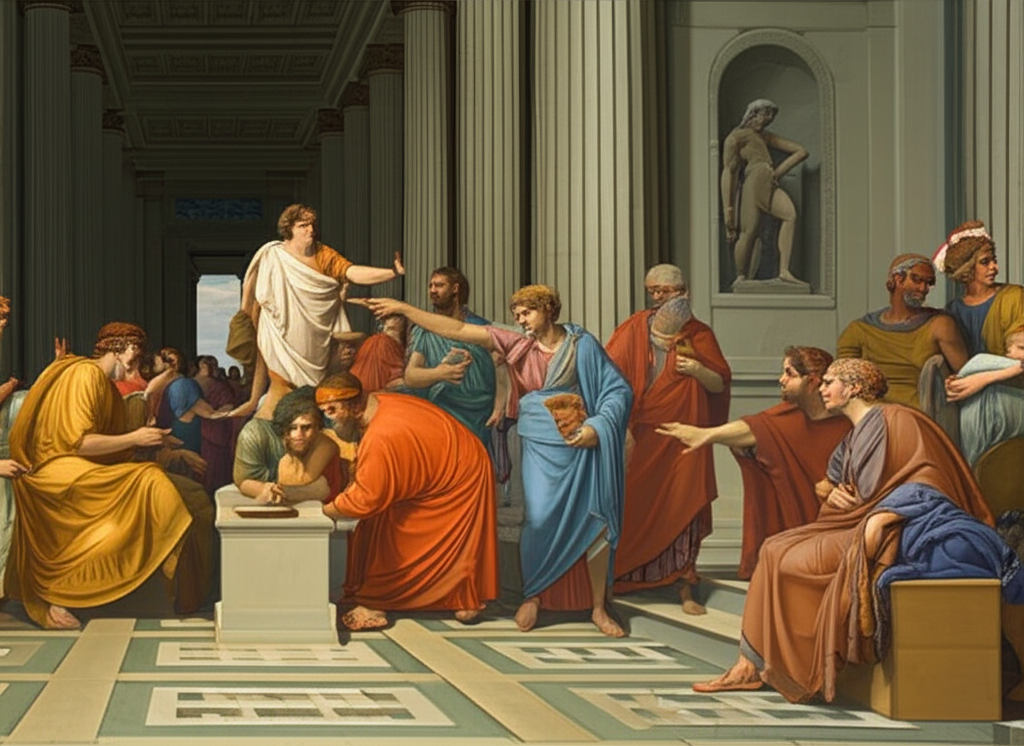
The earliest explicit philosophical engagement with democracy emerged in ancient Greece, particularly in Athens. While Athenian democracy was distinct from modern forms – excluding women, slaves, and foreigners – it laid crucial groundwork for thinking about self-governance.
Plato's Critique and the Search for Justice
In his seminal work, The Republic, Plato offers a scathing critique of democracy, viewing it as a degenerate form of government prone to chaos, mob rule, and the ascendancy of unqualified individuals. For Plato, the ideal state is an aristocracy ruled by philosopher-kings, individuals guided by reason and wisdom, not popular opinion or fleeting desires. His concern was primarily with justice – a concept he believed could only be realized when each part of society performed its proper function, led by those with the intellect and training to discern the Good.
- Key Idea: Plato's critique highlights the enduring tension between the pursuit of collective wisdom and the potential pitfalls of unbridled popular rule.
Aristotle's Classification and the "Polity"
Aristotle, Plato's student, took a more empirical approach in Politics. He systematically classified different forms of government based on the number of rulers and whether they governed in the common interest or their own. While he acknowledged democracy (rule by the many) as a legitimate form, he feared its degeneration into ochlocracy (mob rule). Aristotle championed the "polity" – a mixed constitution that blends elements of oligarchy (rule by the wealthy) and democracy. This "middle way" aimed to balance the virtues of different systems, leveraging the wisdom of the few with the broad participation of the many, thereby creating a stable and just government.
- Key Idea: Aristotle's advocacy for a mixed constitution underscores the pragmatic recognition that no single form of government is perfect, and stability often arises from balancing competing interests.
The Enlightenment and Social Contract Theory: Forging Modern Democratic Principles
Centuries later, the Enlightenment brought a revolutionary shift in philosophy, placing individual rights and reason at the forefront. Social contract theorists reimagined the basis of government, asserting that its legitimacy derived from the consent of the governed.
Thomas Hobbes: Order and the Sovereign
In Leviathan, Thomas Hobbes presented a stark vision of humanity in a "state of nature" – a "war of all against all." To escape this brutal existence, individuals rationally agree to surrender some freedoms to an absolute sovereign, creating a powerful government capable of enforcing order. While Hobbes advocated for an absolute monarchy, his philosophy laid crucial groundwork by establishing the idea that government legitimacy stems from a contract, however implicitly, made by the people for their own security.
- Key Idea: Hobbes introduced the social contract concept, emphasizing the primary role of government in maintaining peace and order, even at the cost of extensive individual liberty.
John Locke: Natural Rights and Consent of the Governed
John Locke, in his Two Treatises of Government, provided a direct philosophical counterpoint to Hobbes and became a cornerstone of modern democratic thought. Locke argued that individuals possess inherent, inalienable natural rights to life, liberty, and property, which pre-exist any government. The purpose of government, therefore, is not to suppress these rights but to protect them. Legitimacy flows from the consent of the governed, and if a government breaches this trust by infringing upon natural rights, the people have a right – even a duty – to resist and establish a new government.
- Key Idea: Locke's philosophy cemented the basis for limited government, individual rights, and the principle that political authority ultimately rests with the people.
Jean-Jacques Rousseau: The General Will and Popular Sovereignty
Rousseau, in The Social Contract, pushed the idea of popular sovereignty further. He argued that true freedom is found not in individualistic pursuit but in obedience to the "general will" – the collective good as discerned by the citizenry. Each individual, by entering into the social contract, contributes to and is bound by this general will, making the people themselves the ultimate sovereign. This philosophy underpins direct democracy and the idea that laws are legitimate only when they reflect the collective will of the people, rather than the sum of individual private interests.
- Key Idea: Rousseau's concept of the general will emphasizes the collective nature of democratic decision-making and the idea of government as an expression of popular sovereignty.
The Evolution of Democratic Thought: Liberty and Representation
The 19th century saw further refinement of democratic philosophy, grappling with the practicalities of large-scale government and the protection of individual liberties within a democratic framework.
John Stuart Mill: Liberty and Representative Government
John Stuart Mill, a staunch advocate for individual liberty, explored the challenges of democracy in works like On Liberty and Considerations on Representative Government. He warned against the "tyranny of the majority," where the collective might suppress dissenting opinions or individual freedoms. Mill argued that a robust democracy requires not only the right to vote but also the active protection of minority rights, freedom of thought and expression, and an educated citizenry capable of rational deliberation. He championed representative government as a practical means to achieve broad participation while ensuring thoughtful decision-making.
- Key Idea: Mill's philosophy highlights the crucial balance between majority rule and the protection of individual and minority rights, stressing the importance of deliberation and intellectual freedom in a healthy democracy.
Core Philosophical Pillars of Democracy
The diverse historical perspectives coalesce into several fundamental philosophical pillars that form the basis of modern democracy:
| Philosophical Pillar | Description | Key Proponents |
|---|---|---|
| Individual Liberty | The belief that individuals possess inherent rights and freedoms that government cannot arbitrarily infringe upon. | Locke, Mill |
| Equality | The principle that all citizens are equal before the law and possess equal political rights, regardless of birth, wealth, or status. | Rousseau, (implicitly) Aristotle's concept of citizens |
| Rule of Law | The idea that government and citizens alike are bound by established laws, not by the arbitrary will of rulers, ensuring predictability and fairness. | Aristotle, Locke |
| Consent of the Governed | The legitimacy of government derives from the agreement of the people it governs, expressed through elections and ongoing participation. | Locke, Rousseau |
| Deliberation and Reason | The belief that political decisions should arise from rational discussion, debate, and the free exchange of ideas, rather than emotion or coercion. | Plato (in his ideal state), Mill, Aristotle (in polity) |
| Popular Sovereignty | The ultimate political authority resides in the people, who are the source of all legitimate government power. | Rousseau, Locke |
📹 Related Video: ARISTOTLE ON: The Nicomachean Ethics
Video by: The School of Life
💡 Want different videos? Search YouTube for: ""John Locke Social Contract Theory Explained", "Aristotle Politics Summary""
Challenges and Enduring Questions
Even with these strong foundations, the philosophy of democracy continues to evolve. Contemporary challenges – such as the rise of populism, the influence of digital media, and the struggle for genuine equality – force us to revisit the foundational questions posed by Plato, Locke, and Mill. How do we balance individual liberty with collective good in an increasingly complex world? How do we foster rational deliberation in an age of instant information and echo chambers? These are not merely practical political questions but profound philosophical dilemmas that demand ongoing engagement with democracy's intellectual heritage.
Conclusion
The philosophical basis of democracy is a rich tapestry woven from the threads of ancient wisdom and Enlightenment ideals. It is a testament to humanity's enduring quest for justice, freedom, and a legitimate form of government. From Plato's critiques to Locke's defense of natural rights and Mill's arguments for liberty, the journey through the Great Books of the Western World reveals that democracy is not a static blueprint but a dynamic, ever-evolving project. Understanding its deep philosophical roots is essential not only for appreciating its strengths but also for navigating its inherent complexities and ensuring its continued vitality in the face of new challenges.