

The Enduring Philosophical Basis of Democracy
Democracy, far from being a mere procedural government system, is deeply rooted in a rich tapestry of philosophy that has evolved over millennia. From the ancient Greek city-states to the Enlightenment salons and beyond, thinkers have grappled with fundamental questions about human nature, justice, liberty, and the ideal form of collective governance. This article explores the intellectual lineage that provides the basis for democratic ideals, demonstrating how our modern understanding of self-rule rests upon centuries of rigorous philosophical inquiry.
Democracy's enduring appeal and challenges can only be fully appreciated by understanding its philosophical underpinnings. It is a system built not just on votes, but on core ideas about individual rights, the social contract, the pursuit of justice, and the very purpose of political association. Without these philosophical foundations, democracy would lack its moral authority and intellectual coherence, reducing it to mere mob rule or arbitrary power.
Ancient Seeds: Plato's Critiques and Aristotle's Classifications
The earliest significant philosophical engagements with democracy emerged in ancient Greece, where the term itself was coined. While Athens practiced a direct form of democracy, philosophers like Plato and Aristotle offered profound, often critical, analyses that shaped subsequent thought.
- Plato's Republic: In his seminal work, The Republic, Plato famously expressed skepticism about democracy. He argued that it was prone to instability, demagoguery, and the tyranny of the majority, as it prioritised freedom above wisdom and expertise. For Plato, the ideal government was an aristocracy ruled by philosopher-kings, individuals trained in reason and justice. His critique, though anti-democratic in its conclusion, forced later thinkers to consider the potential pitfalls and necessary safeguards for popular rule.
- Aristotle's Politics: Aristotle, Plato's student, took a more empirical approach in Politics. He classified different forms of government based on who rules (one, few, or many) and whether they rule in the common interest or their own. He identified democracy as a "deviant" form of politeia (constitutional government) when the many rule in their own self-interest (the poor), rather than for the good of all citizens. However, he also recognized the collective wisdom of the many and the importance of a broad middle class for stability. His work laid the basis for comparative political analysis and highlighted the importance of constitutional structures.
These ancient thinkers provided the initial philosophical framework for debating the merits and demerits of popular government, setting the stage for future developments.
The Enlightenment's Blueprint: Rights, Consent, and the Social Contract
The modern basis of democracy was fundamentally shaped by Enlightenment philosophy, particularly the concepts of natural rights, the social contract, and the separation of powers. These ideas provided the intellectual ammunition for revolutions and the formation of new republics.
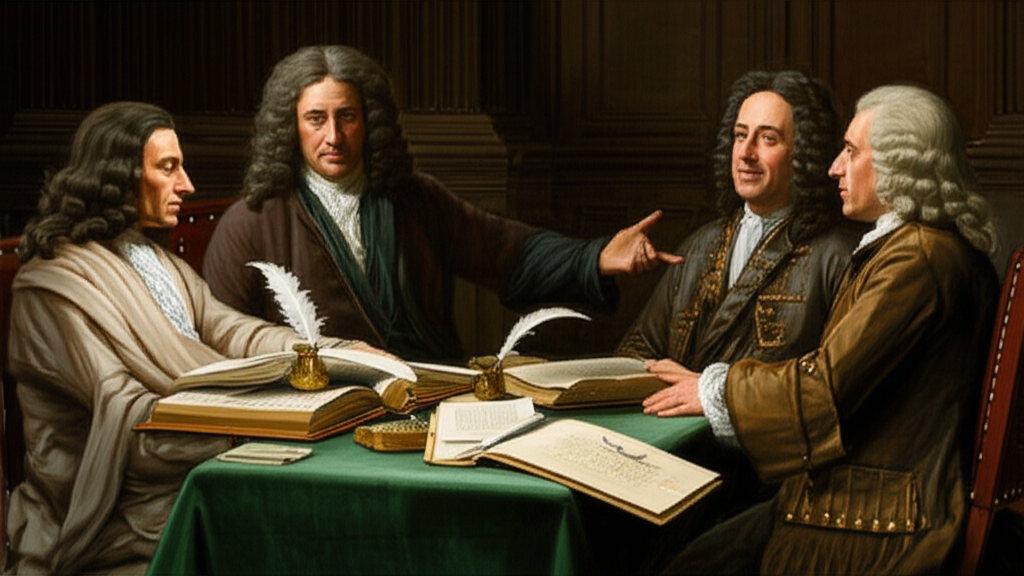
- John Locke (Two Treatises of Government): Locke is arguably the most influential philosopher for modern democracy. He posited that individuals possess inherent natural rights to life, liberty, and property, which pre-exist government. The purpose of government, therefore, is to protect these rights. He introduced the concept of the "social contract," where individuals consent to be governed, and if the government fails to uphold its end of the contract (i.e., protect rights), the people have the right to revolt. This idea forms the bedrock of popular sovereignty and limited government.
- Jean-Jacques Rousseau (The Social Contract): Rousseau further developed the social contract theory, introducing the concept of the "general will." He argued that true freedom lies in obeying laws that one has prescribed for oneself. In a legitimate government, individuals surrender their individual wills to the collective "general will," which always aims at the common good. While his ideas have been interpreted in various ways, they provide a powerful basis for direct participation and the notion that sovereignty ultimately resides with the people.
- Baron de Montesquieu (The Spirit of the Laws): Montesquieu's contribution was crucial for the practical implementation of democratic government. He advocated for the "separation of powers" into legislative, executive, and judicial branches, each checking and balancing the others. This philosophical framework was designed to prevent the concentration of power and safeguard individual liberties, becoming a fundamental principle in constitutional democracies worldwide.
These Enlightenment thinkers provided the theoretical basis for moving from monarchical or aristocratic rule to forms of government grounded in popular consent and the protection of individual liberties.
Core Philosophical Tenets Undergirding Democracy
The ongoing philosophical examination of democracy continues to refine our understanding. Key tenets derived from these historical discussions include:
- Individual Liberty and Rights: The belief that each person possesses inherent freedoms and rights that government must respect and protect. This is fundamental to democratic participation and expression.
- Popular Sovereignty: The principle that political authority ultimately resides in the people, who delegate power to their representatives.
- Rule of Law: The idea that all, including those in government, are subject to established, fair, and publicly known laws, preventing arbitrary rule.
- Equality: The notion that all citizens are equal before the law and possess equal political rights, regardless of background.
- Deliberation and Reason: The importance of public discourse, debate, and rational persuasion in shaping collective decisions and policy.
- Accountability: The requirement that those in power are answerable to the people and can be removed through established processes.
These principles form the ethical and practical basis upon which successful democracies are constructed and sustained.
Conclusion: An Evolving Philosophical Pursuit
The philosophical basis of democracy is not a static doctrine but an ongoing conversation. From Plato's warnings about demagoguery to Locke's defense of natural rights and Mill's arguments for individual liberty and representative government, the intellectual journey has been one of continuous critical reflection and adaptation. Understanding these profound philosophical roots is essential for appreciating the strengths, recognizing the vulnerabilities, and actively participating in the ongoing evolution of democratic government. It reminds us that democracy is more than a system; it is a commitment to a set of ideas about human dignity, collective flourishing, and the responsible exercise of power.
**## 📹 Related Video: ARISTOTLE ON: The Nicomachean Ethics
Video by: The School of Life
💡 Want different videos? Search YouTube for: ""John Locke Social Contract Theory Explained""**
**## 📹 Related Video: PLATO ON: The Allegory of the Cave
Video by: The School of Life
💡 Want different videos? Search YouTube for: ""Plato's Critique of Democracy | Republic Book VIII""**