

The Eternal Tug-of-War: Exploring the Opposition of Virtue and Vice
The human condition is perpetually framed by a fundamental tension: the opposition of virtue and vice. This isn't merely an academic debate; it's the very crucible in which character is forged, societies are shaped, and individual lives find meaning or despair. From the ancient Greeks pondering the summum bonum to modern ethicists grappling with moral dilemmas, philosophers across the Great Books of the Western World have consistently returned to this core duality. Understanding this intrinsic conflict between what is right and what is wrong, between excellence and corruption, is not just intellectually stimulating—it is essential for navigating the complexities of existence and fulfilling our inherent duty to strive for the good.
Defining the Poles: What Are Virtue and Vice?
To truly grasp their opposition, we must first understand virtue and vice in their own right. They are not simply abstract concepts but deeply ingrained patterns of thought, feeling, and action that shape our very being.
Virtue: The Path to Human Excellence
Virtue (from the Latin virtus, meaning excellence or manliness) signifies a moral excellence, a disposition to act in a morally good way. It is often understood as a habitual and firm disposition to do good, allowing the person not only to perform good acts but to give the best of themselves. As Aristotle posited, virtues are often a "mean" between two extremes of excess and deficiency. For instance, courage is the mean between recklessness and cowardice.
Key Characteristics of Virtue:
- Habitual Disposition: Virtues are developed through practice and repetition.
- Moral Excellence: They represent the highest moral standards of human conduct.
- Flourishing (Eudaimonia): Many traditions link virtue directly to human well-being and a flourishing life.
- Alignment with Reason: Virtuous actions are often guided by sound reason and wisdom.
Vice: The Deviation from the Good
Vice, conversely, represents a moral fault or failing, a habit of acting in a morally bad way. It is a disposition that disposes us to evil, acting contrary to reason and the proper end of human life. Where virtue elevates, vice diminishes. It represents a corruption of character, a deviation from the path of human excellence.
Key Characteristics of Vice:
- Habitual Disposition: Vices are also formed through repeated negative choices.
- Moral Corruption: They represent a degradation of character and moral integrity.
- Impediment to Flourishing: Vices actively hinder human well-being and lead to suffering.
- Contrary to Reason: Vicious actions often stem from irrational passions or ignorance.
The Intrinsic Opposition: Good and Evil Embodied
The opposition between virtue and vice is not merely a difference in degree but a fundamental antithesis, mirroring the larger cosmic struggle between Good and Evil. Virtue aims towards the good, towards what perfects human nature and contributes to the well-being of the community. Vice, by its very nature, deviates from this good, often causing harm to oneself and others.
This opposition is dynamic and ever-present, manifesting in several crucial ways:
- Direction of Will: Virtue directs the will towards what is objectively right and beneficial; vice directs it towards what is morally wrong and harmful.
- Internal Conflict: Every individual faces an internal battle, a choice between acting virtuously or succumbing to vice. This is the arena where character is truly tested.
- Societal Impact: A society rich in virtue tends towards justice, peace, and prosperity. A society riddled with vice tends towards corruption, conflict, and decay.
- Nature of Being: Virtue perfects our nature, bringing us closer to our ideal selves. Vice distorts and degrades our nature, moving us further from our true potential.
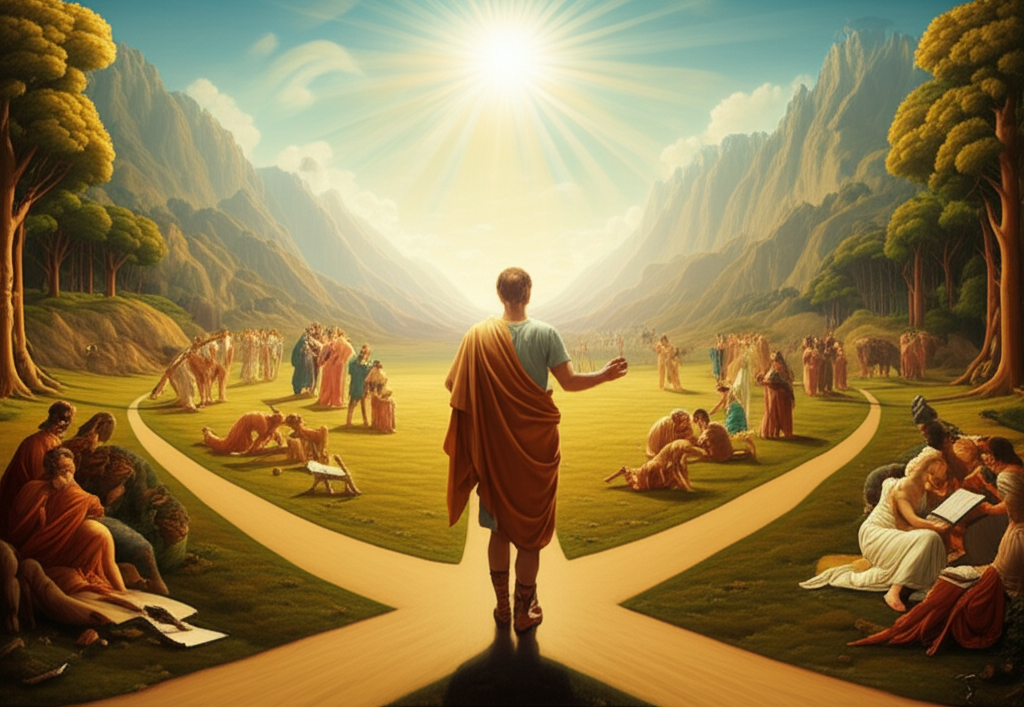 , and the other path descending into a shadowy, chaotic scene filled with figures demonstrating greed, envy, and sloth (representing Vice). The central figure appears to be in thoughtful contemplation, weighing the two divergent paths.)
The Role of Choice, Reason, and Duty
Given this profound opposition, how do we navigate it? This is where the concepts of choice, reason, and duty become paramount.
- Choice: Philosophers from Augustine to Sartre have emphasized human freedom and the burden of choice. We are not predetermined to be virtuous or vicious; rather, our ongoing choices define us. Every decision, no matter how small, contributes to the cultivation of either a virtuous or a vicious character.
- Reason: Reason is our primary tool for discerning the good. It allows us to analyze situations, understand consequences, and identify the virtuous path. The Socratic dictum that "virtue is knowledge" highlights the belief that true understanding naturally leads to right action, while vice often stems from ignorance or clouded judgment.
- Duty: For thinkers like Immanuel Kant, moral action is not just about inclination but about duty. Acting virtuously is not merely preferable; it is a moral imperative, an obligation dictated by universal moral law. Our duty is to act in accordance with principles that could be universalized, thereby upholding the moral order and respecting the inherent dignity of all rational beings. This sense of duty often provides the strength to choose virtue even when it is difficult or unpopular.
Philosophical Perspectives on the Virtue-Vice Dynamic
The Great Books offer a rich tapestry of perspectives on this fundamental opposition. While the language and emphasis may differ, the core recognition of virtue as essential for a good life and vice as destructive remains constant.
| Philosophical Tradition | View on Virtue | View on Vice | Role of Choice/Duty |
|---|---|---|---|
| Aristotelian Ethics | A "golden mean" between extremes; leads to eudaimonia (flourishing). | Extremes of excess or deficiency; hinders flourishing. | Cultivated through habit and practical wisdom (phronesis). |
| Stoicism | Living in accordance with nature and reason; inner tranquility. | Passions and irrational impulses; disturbs peace. | Duty to control what is within our power (thoughts, actions). |
| Kantian Deontology | Acting from duty according to universal moral law; good will. | Acting from inclination or self-interest, violating moral law. | Moral duty is paramount, regardless of outcome; categorical imperative. |
| Christian Ethics | Theological virtues (faith, hope, charity) and cardinal virtues; imitation of Christ. | Sin, alienation from God; seven deadly sins. | Obedience to divine law, grace, and free will. |
Conclusion: The Enduring Significance
The opposition of virtue and vice is not a relic of ancient thought but a living tension that defines our moral landscape. It challenges us to reflect, to choose, and to act. By understanding the nature of virtue as a striving for excellence and the insidious pull of vice, we are better equipped to cultivate character, fulfill our duty, and contribute to a world that leans towards good rather than evil. This profound philosophical insight, echoed throughout the Great Books of the Western World, serves as a timeless guide for personal integrity and societal flourishing.
YouTube Video Suggestions:
-
📹 Related Video: ARISTOTLE ON: The Nicomachean Ethics
Video by: The School of Life
💡 Want different videos? Search YouTube for: "Aristotle Virtue Ethics Explained"
2. ## 📹 Related Video: ARISTOTLE ON: The Nicomachean Ethics
Video by: The School of Life
💡 Want different videos? Search YouTube for: "Kantian Ethics Duty Morality Explained"