

The Enduring Dichotomy: Navigating Virtue and Vice
The human experience is perpetually framed by choices, and at the heart of these choices lies the profound opposition between virtue and vice. This article delves into this fundamental philosophical tension, exploring how thinkers across the ages, from the foundational texts within the Great Books of the Western World, have grappled with the nature of Good and Evil, the imperatives of Duty, and the very essence of human character. We will examine how this dichotomy shapes our understanding of morality, ethics, and the pursuit of a meaningful life, offering a concise yet comprehensive overview of a debate that continues to resonate today.
Ancient Wisdom: Virtue as Excellence and the Shadow of Vice
From the earliest philosophical inquiries, the concept of virtue was inextricably linked to human excellence and flourishing. The ancient Greeks, whose works form a cornerstone of the Great Books, viewed virtue (aretē) not merely as moral goodness, but as the optimal functioning or inherent excellence of a thing. For a human, this meant living well, rationally, and in accordance with one's highest potential.
- Plato's Ideal Forms: In works like The Republic, Plato posits that true virtue is an imitation of the Forms of the Good, an ultimate, unchanging reality. Vice, then, is a deviation from this ideal, a corruption of the soul's natural harmony. The cardinal virtues—wisdom, courage, temperance, and justice—are essential for a well-ordered individual and state.
- Aristotle's Golden Mean: Aristotle, in his Nicomachean Ethics, offers a more practical, character-based approach. He defines virtue as a disposition to behave in the right manner, existing as a "golden mean" between two extremes of vice—excess and deficiency. For example, courage is the mean between the vice of cowardice (deficiency) and rashness (excess). Vice, for Aristotle, is a failure to hit this mean, a defect in character that hinders eudaimonia (human flourishing).
This perspective establishes a clear opposition: virtue leads to flourishing and a good life, while vice leads to discord, suffering, and a life lived below its potential. The Good and Evil here are not just abstract concepts but lived realities, manifest in the character and actions of individuals.
The Moral Imperative: Duty, Conscience, and the Struggle Against Evil
As philosophical thought evolved, particularly with the rise of Abrahamic religions and later Enlightenment philosophy, the understanding of virtue and vice shifted to incorporate concepts of divine command, natural law, and universal moral duty.
- Augustine and the Will: St. Augustine, a towering figure in the Great Books, grappled with the problem of evil, seeing vice as a privation of good, a turning away from God. His emphasis on free will highlights the individual's choice in the opposition between virtuous adherence to divine will and vicious rebellion.
- Kant and Categorical Imperatives: Immanuel Kant radically redefined the landscape of morality. For Kant, true virtue isn't about achieving happiness or a good outcome, but about acting from duty out of respect for the moral law. An action is virtuous only if it is done because it is right, not because of any desired consequence or inclination.
- Virtue: Acting purely from a sense of moral duty, following universalizable maxims (Categorical Imperatives).
- Vice: Acting from inclination, self-interest, or any motive other than pure duty, or performing actions that cannot be universalized without contradiction.
This perspective sharpens the opposition between virtue and vice into a stark, internal struggle of the will. Good and Evil are determined by the purity of one's intentions and adherence to rational moral principles, rather than solely by character traits or outcomes.
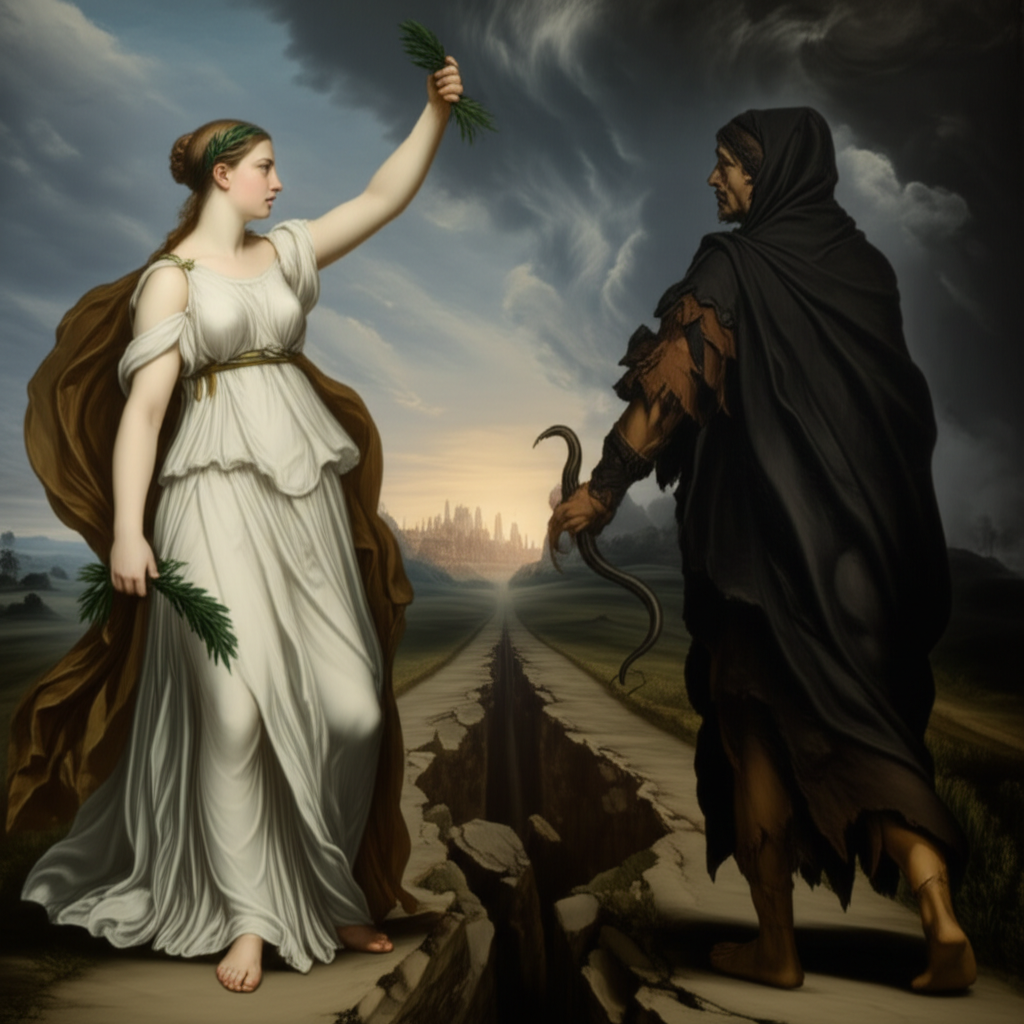
The Spectrum or the Chasm? Understanding the Nature of Opposition
The discussion of virtue and vice often prompts a deeper question: Is the opposition between them an absolute, unbridgeable chasm, or a continuous spectrum where individuals can slide back and forth?
| Aspect | Virtue | Vice |
|---|---|---|
| Nature | Excellence, flourishing, moral rectitude | Deficiency, excess, moral corruption |
| Motivation | Reason, duty, love of good | Inclination, self-interest, ignorance, malice |
| Impact | Harmony, well-being (individual & collective) | Discord, suffering, societal breakdown |
| Goal | Eudaimonia, salvation, moral perfection | Self-destruction, damnation, moral decay |
| Relationship | Path to the Good | Deviation from the Good |
While some philosophies, particularly those with a strong theological bent, might view Good and Evil as distinct and absolute categories, others, like Aristotle's, suggest a more nuanced scale. An individual is not simply virtuous or vicious but possesses varying degrees of each, influenced by habits and choices. The opposition is thus a dynamic tension within each person, a constant call to align one's actions and character with the highest ideals.
Conclusion: The Perennial Challenge
The opposition of virtue and vice remains one of philosophy's most enduring and vital themes. From the ancient Greek pursuit of excellence to Kant's rigorous adherence to duty, the Great Books of the Western World consistently challenge us to define, cultivate, and uphold virtue in the face of vice. This fundamental dichotomy compels us to reflect on our choices, the formation of our character, and our responsibility in the ongoing struggle to discern and enact what is truly Good and Evil. Understanding this profound tension is not merely an academic exercise; it is an essential step towards crafting a life of integrity, purpose, and genuine human flourishing.
📹 Related Video: PLATO ON: The Allegory of the Cave
Video by: The School of Life
💡 Want different videos? Search YouTube for: ""Plato's Ethics: The Good Life and the Virtues""
📹 Related Video: KANT ON: What is Enlightenment?
Video by: The School of Life
💡 Want different videos? Search YouTube for: ""Kant's Categorical Imperative Explained""