

The Eternal Dance: Exploring the Opposition of Virtue and Vice
The very fabric of human experience is woven with choices, decisions that invariably pull us towards one pole or another: the noble or the ignoble, the commendable or the reprehensible. This fundamental tension, the Opposition of Virtue and Vice, stands as a cornerstone of ethical philosophy, an enduring subject explored with profound depth across the Great Books of the Western World. From ancient Greek dialogues to Enlightenment treatises, thinkers have grappled with defining these opposing forces, understanding their origins, and charting their influence on individual lives and societies. At its heart, this opposition is not merely an intellectual exercise but a mirror reflecting our perpetual struggle to navigate the moral landscape, distinguish Good and Evil, and ultimately understand our Duty to ourselves and to others.
The Inescapable Duality: Defining Virtue and Vice
To speak of virtue is to inevitably invoke its opposite, vice. These concepts are inextricably linked, each defining the other through contrast.
- Virtue (from Latin virtus, meaning "excellence" or "manliness") generally refers to moral excellence, a disposition to act in a morally good way, embodying commendable qualities and character traits. It is often seen as a habituated state of character that allows one to flourish.
- Vice (from Latin vitium, meaning "fault" or "defect") represents a moral flaw, a habit or disposition that leads to morally wrong actions or a corrupt character. It is the antithesis of virtue, hindering human flourishing.
The Opposition between them is not simply a matter of presence or absence, but often a direct contradiction. Where one finds courage, one might also find cowardice or recklessness. Where justice resides, injustice lurks. This inherent duality forms the basis for much ethical inquiry into what constitutes Good and Evil, and how individuals are compelled to choose between them.
Historical Echoes in the Great Books
The exploration of virtue and vice is a recurring theme throughout the Western philosophical tradition, each era offering unique insights.
Ancient Perspectives: Shaping the Moral Compass
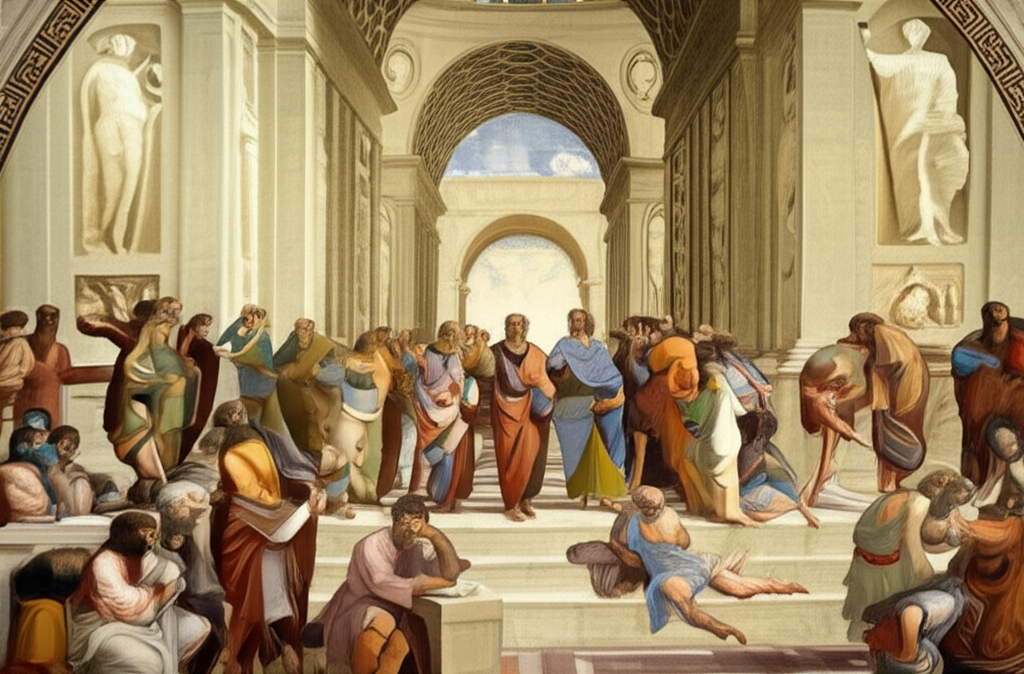
The Greeks laid much of the groundwork for understanding virtue.
- Plato, in works like The Republic, posited a tripartite soul (reason, spirit, appetite), with justice being the harmonious balance of these parts, each exhibiting its own virtue (wisdom, courage, temperance). Vice, for Plato, arises from disharmony and the dominance of the lower parts of the soul.
- Aristotle, in his Nicomachean Ethics, offered a meticulous examination of virtues, defining them as a "golden mean" between two extremes of vice—one of excess and one of deficiency. For instance, courage is the mean between the vice of cowardice (deficiency) and the vice of rashness (excess). Aristotle emphasized that virtue is not innate but developed through habituation and rational choice, highlighting the active role of the individual in cultivating their character.
Medieval Insights: Divine Will and Human Struggle
The Christian tradition brought new dimensions to the Opposition of Virtue and Vice, often linking them to divine law and the human condition.
- Augustine of Hippo, in Confessions and The City of God, explored the nature of the will, original sin, and the profound human struggle between earthly desires and the pursuit of divine grace. Vices stemmed from disordered love, while virtues were reoriented towards God.
- Thomas Aquinas, synthesizing Aristotelian philosophy with Christian theology, expanded on the cardinal virtues (prudence, justice, fortitude, temperance) and introduced the theological virtues (faith, hope, charity). He viewed vice as a deviation from reason and natural law, a failure to achieve humanity's proper end.
Enlightenment and Beyond: Reason, Duty, and Autonomy
The Enlightenment shifted focus towards reason and individual autonomy.
- Immanuel Kant, a towering figure of Enlightenment thought, radically reoriented the discussion in works like Groundwork of the Metaphysics of Morals. For Kant, morality is not about consequences or character traits, but about Duty—acting purely from a good will, in accordance with universal moral laws (the categorical imperative). Virtue, in this framework, is the strength of will to act from duty, while vice is the failure to do so, often driven by inclinations contrary to reason.
The Spectrum of Moral Choice: From Apathy to Action
The journey through virtue and vice is rarely a straightforward path. Individuals constantly face choices that test their moral fiber, influenced by internal dispositions and external pressures. The concept of Duty often serves as a guide or a demand, compelling us towards what is right, even when it is difficult.
Consider the Aristotelian framework for understanding specific virtues and their opposing vices:
| Virtue (Golden Mean) | Vice of Deficiency | Vice of Excess |
|---|---|---|
| Courage | Cowardice | Rashness |
| Temperance | Insensibility | Self-indulgence |
| Generosity | Stinginess | Prodigality |
| Magnanimity | Pusillanimity | Vanity |
| Justice | Unjustness | Unjustness |
This table illustrates how virtues are balanced states, requiring rational discernment to avoid the pitfalls on either side. The moral agent's duty is to find and uphold this mean, a task that demands constant practice and reflection.
Beyond Simple Dichotomies: Nuance and Complexity
While the Opposition of Virtue and Vice provides a powerful framework, it's crucial to acknowledge the nuances. Moral dilemmas often present scenarios where choices are not clearly black and white. Context, intent, and unforeseen consequences can complicate the assessment of an action as virtuous or vicious. A seemingly virtuous act performed with malicious intent might be deemed vicious, and vice versa.
Philosophers continue to debate the objective nature of virtues, their cultural relativity, and the extent to which human beings can truly achieve a virtuous state. Yet, the enduring discussion highlights our inherent drive to define, understand, and strive for the good, constantly wrestling with the shadows cast by evil.
Conclusion
The Opposition of Virtue and Vice remains an indispensable concept for understanding human morality, character, and the ethical life. From the classical pursuit of eudaimonia (human flourishing) to the Kantian emphasis on Duty and the good will, the Great Books reveal a persistent philosophical engagement with these fundamental forces. By exploring their definitions, historical interpretations, and practical implications, we gain deeper insights into the choices that shape us, and the continuous journey towards cultivating a life worthy of the highest human ideals, always navigating the eternal dance between Good and Evil.
YouTube Video Suggestions:
-
📹 Related Video: ARISTOTLE ON: The Nicomachean Ethics
Video by: The School of Life
💡 Want different videos? Search YouTube for: "Aristotle Nicomachean Ethics Virtue Explained"
2. ## 📹 Related Video: ARISTOTLE ON: The Nicomachean Ethics
Video by: The School of Life
💡 Want different videos? Search YouTube for: "Kantian Ethics Duty Categorical Imperative Summary"