

The Enduring Dance: Exploring the Opposition of Good and Evil in the World
The opposition of good and evil is not merely a philosophical concept; it is a lived reality, a constant tension woven into the very fabric of our World and the essence of human Being. This article delves into the historical and philosophical underpinnings of this fundamental dichotomy, examining how thinkers throughout the ages, from the ancient Greeks to modern existentialists, have grappled with its definition, its nature, and its profound implications for individual morality and societal structure. We will explore various perspectives, from the idea of evil as a mere absence of good to its portrayal as an active, independent force, seeking to understand how this enduring struggle shapes our understanding of existence and our place within it.
A Fundamental Inquiry into Human Being
From the earliest myths to the most intricate philosophical treatises, humanity has sought to comprehend the forces that drive creation and destruction, benevolence and malevolence. This quest is deeply personal, impacting our choices, our relationships, and our understanding of justice. It is also universal, shaping laws, cultures, and the grand narratives that define civilizations. The exploration of good and evil is, at its core, an exploration of ourselves and the moral landscape we inhabit.
Defining the Battlefield: What Constitutes Good and Evil?
Before we can discuss their opposition, we must first attempt to define these elusive concepts. Philosophers have offered myriad interpretations, often influenced by their cultural context and metaphysical assumptions.
Ancient Insights: Virtue, Form, and Purpose
For many ancient Greek thinkers, particularly Plato and Aristotle, "good" was often tied to an ideal state, a telos, or a harmonious balance.
- Plato: Envisioned the Good as the highest Form, the ultimate source of all truth and beauty, illuminating all other Forms. Evil, then, could be seen as a deviation from this Form, a lack of participation in the Good.
- Aristotle: Focused on eudaimonia (flourishing) as the ultimate good, achieved through virtuous action and the exercise of reason. Evil might be understood as a failure to achieve one's potential or to act in accordance with virtue.
Theistic Frameworks: Sin, Redemption, and Divine Will
The Abrahamic traditions introduced a different dimension, often linking good and evil to divine command and human free will.
- Good: Often synonymous with God's will, righteousness, and adherence to moral laws.
- Evil: Defined as sin, rebellion against God, or the influence of malevolent spiritual forces. The concept of original sin and the Fall profoundly shaped the understanding of humanity's inherent struggle with evil.
Modern Interpretations: Subjectivity, Consequence, and Existential Choice
As philosophy moved into the Enlightenment and beyond, new perspectives emerged, often questioning traditional religious dogma.
- Utilitarianism (Bentham, Mill): Good is defined by its consequences – actions that produce the greatest happiness for the greatest number. Evil, conversely, causes suffering.
- Deontology (Kant): Good is found in acting from duty, according to universal moral laws, regardless of consequences. Evil is acting against these duties.
- Existentialism (Sartre, Camus): In a world without inherent meaning, individuals are condemned to be free, responsible for creating their own values. Good and evil become products of human choice and the authenticity of one's Being.
The Nature of the Opposition: Is It Absolute or Relative?
The core of our discussion lies in the nature of the opposition itself. Is it a fundamental, cosmic dualism, or something more nuanced?
Dualism vs. Privation: Two Core Perspectives
| Perspective | Description
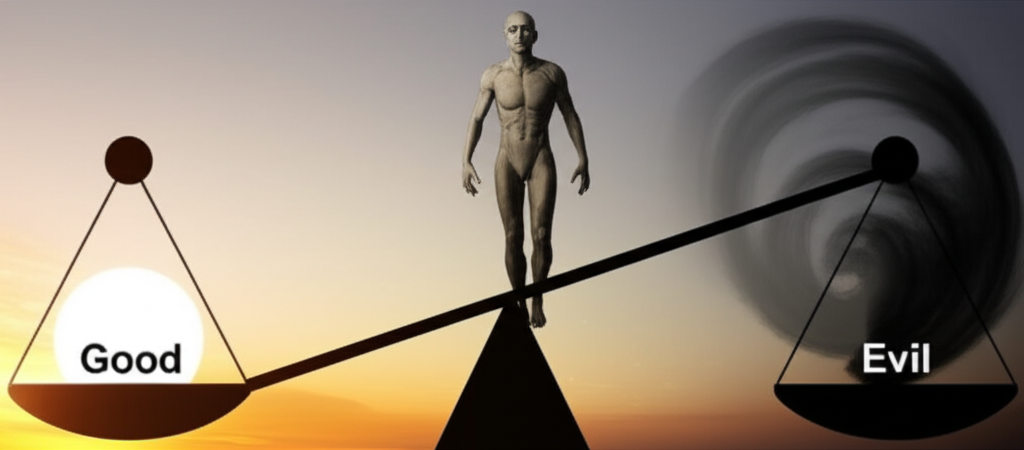
The Role of Free Will and Moral Agency
Regardless of whether good and evil are seen as fundamental forces or human constructs, the concept of free will emerges as crucial. If individuals possess the capacity to choose between right and wrong, then their moral agency becomes paramount.
- Responsibility: With choice comes responsibility for one's actions and their impact on the World.
- Conscience: The internal compass that guides individuals toward good or warns them away from evil, often debated as innate or socially conditioned.
Good and Evil in the Tapestry of the World
The opposition of good and evil is not confined to abstract thought; it manifests profoundly in our everyday lives and the grand narratives of history.
Individual Conscience and Everyday Decisions
Every day, individuals face choices that reflect this fundamental opposition.
- Acts of kindness: Helping a stranger, sharing resources, showing empathy.
- Acts of cruelty: Deception, betrayal, intentional harm.
These small choices, aggregated across billions of individuals, paint the moral landscape of humanity.
Societal Structures: Justice, Injustice, and Collective Morality
Societies grapple with good and evil through their institutions, laws, and cultural norms.
- Justice Systems: Designed to uphold what a society deems good and to punish what it deems evil.
- Social Movements: Often arise from a collective perception of injustice, striving to rectify systemic evils (e.g., slavery, discrimination).
- Ethical Frameworks: Guiding principles for professions, governance, and communal living, aiming to foster the good and mitigate harm.
Global Challenges: Conflict, Suffering, and the Human Condition
On a larger scale, the opposition plays out in international relations, conflicts, and humanitarian crises.
- War: Often framed as a clash between opposing goods (or the fight against a perceived evil).
- Poverty and Inequality: Seen by many as systemic evils that demand collective action.
- Environmental Degradation: The ethical challenge of humanity's impact on the planet, balancing short-term gain with long-term planetary well-Being.
Navigating the Moral Labyrinth: Philosophical Approaches
Philosophers continue to wrestle with the implications of good and evil, seeking frameworks to guide human action.
Seeking Objective Truth: Can Good Be Universally Defined?
The quest for a universal, objective definition of good remains a central theme.
- Is there a moral truth that transcends culture and individual opinion?
- How do we reconcile differing moral viewpoints in a globalized World?
- The role of reason, empathy, and shared human experience in forging common ethical ground.
The Problem of Evil: A Persistent Theological and Philosophical Puzzle
For those who believe in an omnipotent, omniscient, and benevolent God, the existence of evil presents a profound challenge.
- If God is all-good, why does evil exist?
- If God is all-powerful, why doesn't God prevent evil?
This "problem of evil" has spurred countless theological and philosophical arguments, attempting to reconcile divine attributes with the suffering and malevolence observed in the World.
The Continuous Quest: Shaping Our Being in the World
The opposition of good and evil is not a problem to be solved definitively but rather an ongoing condition of human Being. It is a dynamic tension that compels us to reflect, to choose, and to act. The Great Books of the Western World offer a rich tapestry of thought on this subject, providing not answers, but profound questions and diverse perspectives that continue to illuminate our understanding. As Grace Ellis, I believe that engaging with these timeless inquiries is essential for cultivating a thoughtful and morally aware existence in our complex World. The struggle between good and evil is, in essence, the struggle for what it means to be human.
YouTube Video Suggestions:
-
📹 Related Video: What is Philosophy?
Video by: The School of Life
💡 Want different videos? Search YouTube for: "The Problem of Evil Explained Philosophy"
-
📹 Related Video: PLATO ON: The Allegory of the Cave
Video by: The School of Life
💡 Want different videos? Search YouTube for: "Plato's Theory of Forms and the Good"