

The Perennial Struggle: Unpacking the Opposition Between Liberty and Tyranny
The history of political thought, beautifully chronicled within the Great Books of the Western World, reveals few conflicts as enduring and fundamentally human as the opposition between liberty and tyranny. This is not merely a political struggle, but a profound philosophical one, exploring the very nature of human flourishing, the legitimate scope of government, and the perilous ease with which power can corrupt. From ancient city-states to modern democracies, the constant tension between individual freedom and oppressive control has shaped societies, fueled revolutions, and demanded continuous re-evaluation of our most cherished values. Understanding this inherent opposition is crucial for any meaningful engagement with political philosophy.
Historical Roots of the Dichotomy
The seeds of this intellectual battle were sown early, long before the Enlightenment articulated modern concepts of rights. Ancient Greek thinkers, particularly Plato and Aristotle, grappled with the forms of government and their potential for either promoting the good life (eudaimonia) or descending into corruption. Plato, in The Republic, meticulously details the degeneration of ideal forms of government into increasingly tyrannical ones, culminating in the rule of the despot driven by insatiable desires. Aristotle, in Politics, distinguishes between just rule (monarchy, aristocracy, polity) and their perversions (tyranny, oligarchy, democracy in its extreme form), noting that tyranny is the antithesis of rule for the common good, instead serving the selfish interests of the ruler. These foundational texts establish a critical framework: the nature of power, its exercise, and its impact on the governed.
Defining Liberty: A Multi-Faceted Ideal
Liberty, in its essence, speaks to freedom from external constraint and the capacity for self-determination. However, its definition is far from monolithic, evolving through the ages:
- Negative Liberty: Often championed by thinkers like John Locke and John Stuart Mill, this refers to freedom from interference by others, particularly the government. It emphasizes a sphere of individual autonomy where one can act without obstruction.
- Positive Liberty: Explored by Rousseau and later idealists, this concerns freedom to achieve one's potential, often requiring certain conditions or enabling actions by the government (e.g., education, social welfare). It speaks to self-mastery and the capacity to pursue a rational life.
- Civil Liberty: The rights and freedoms granted to citizens by law, such as freedom of speech, assembly, and religion.
- Political Liberty: The right to participate in the political process, including voting and holding office.
The pursuit of liberty has consistently been a driving force in Western thought, viewed as essential for both individual dignity and societal progress.
The Shadow of Tyranny: Absolute Power Corrupts
In stark opposition to liberty stands tyranny. While often associated with a single, despotic ruler, tyranny can manifest in various forms:
- Classical Tyranny: As described by the Greeks, this is the arbitrary rule of one individual, not bound by law, who governs solely for their own benefit, often through fear and suppression.
- Oligarchic Tyranny: Rule by a small, self-serving elite.
- Tyranny of the Majority: A concept explored by Alexis de Tocqueville in Democracy in America, where the will of the majority can suppress the rights and opinions of minorities, even within a democratic framework.
The hallmarks of tyranny invariably include:
- Arbitrary power: Decisions made without reference to established law or justice.
- Suppression of dissent: Control over speech, thought, and assembly.
- Lack of accountability: Rulers are above the law.
- Fear as a tool of governance: Maintenance of power through intimidation.
- Erosion of individual rights: Disregard for the inherent dignity and freedoms of citizens.
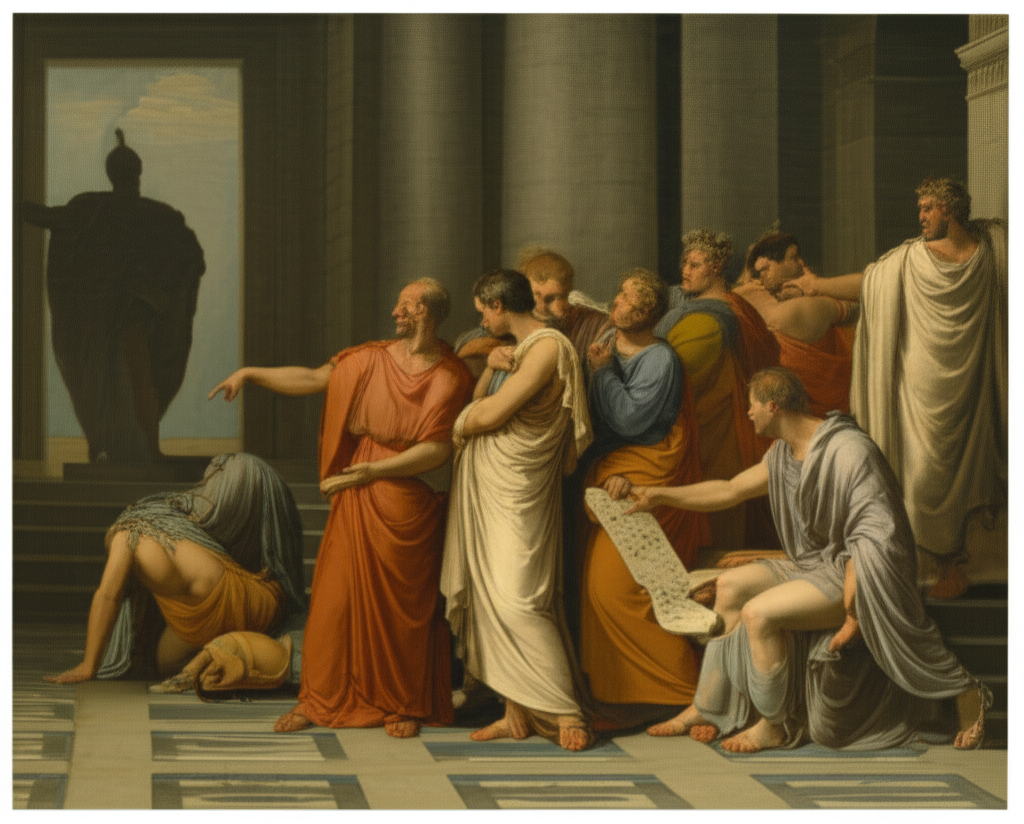
Government: Protector or Perpetrator?
The relationship between government and the opposition of liberty and tyranny is inherently paradoxical. On one hand, a well-structured government is indispensable for securing liberty. As Thomas Hobbes argued in Leviathan, without a sovereign power to enforce laws, life would be "solitary, poor, nasty, brutish, and short"—a state of nature devoid of true freedom. Locke, however, posited that the primary purpose of government is to protect natural rights (life, liberty, property), and if it fails to do so, or becomes tyrannical, the people have a right to resist.
This reveals the delicate balance:
- Government as a Safeguard of Liberty: Through the establishment of the rule of law, constitutional limits, separation of powers (Montesquieu), and protection of individual rights, government can create the conditions for liberty to flourish.
- Government as a Potential Source of Tyranny: Unchecked power, the absence of accountability, and the concentration of authority can easily transform a protective government into an oppressive one. The very mechanisms designed to maintain order can be perverted to enforce submission.
The continuous struggle to define and limit the power of government is therefore central to the philosophical discourse on liberty and tyranny.
Mechanisms to Counter Tyranny and Preserve Liberty
Throughout history, various mechanisms have been proposed and implemented to mitigate the threat of tyranny and secure liberty:
- Constitutionalism: Establishing fundamental laws that limit government power and define citizens' rights.
- Separation of Powers: Dividing governmental authority among legislative, executive, and judicial branches to prevent any single entity from becoming too powerful.
- Rule of Law: The principle that all, including rulers, are subject to and accountable under the law.
- Civil Society and Free Press: Independent institutions and media that can scrutinize government actions and provide a platform for dissent.
- Education: Fostering an informed and critical citizenry capable of recognizing and resisting oppressive tendencies.
The opposition between liberty and tyranny is not a battle won once and for all, but an ongoing vigilance required of every generation. It demands a perpetual re-examination of power, rights, and the role of the state in human affairs.
YouTube: "Plato's Republic Tyranny"
YouTube: "Locke Montesquieu Liberty Government"
📹 Related Video: What is Philosophy?
Video by: The School of Life
💡 Want different videos? Search YouTube for: "The Opposition Between Liberty and Tyranny philosophy"