

The Unbreakable Bond: Why Truth is Necessary for Knowledge
Summary: At the heart of philosophical inquiry into what we can truly know lies an indispensable requirement: truth. This article explores the profound and often understated necessity of truth for knowledge, arguing that without it, what we claim to know collapses into mere opinion, belief, or even coherent falsehood. Drawing on foundational principles from the history of philosophy, we assert that truth is not merely a desirable attribute of knowledge but an intrinsic, non-negotiable component, distinguishing genuine understanding from fortunate conjecture.
The Foundational Principle: Knowledge Demands Truth
To speak of "knowing" something immediately implies a commitment to its veracity. Can one genuinely know that the earth is flat, when in fact, it is spherical? Such a claim would be universally rejected as knowledge, precisely because its premise is untrue. This simple example highlights a principle that has guided epistemology for millennia: knowledge is, by its very definition, factive. It refers to a state of affairs that actually holds.
Philosophers, from Plato onwards, have grappled with the distinction between true belief and knowledge. While a true belief might be acquired through luck or faulty reasoning, knowledge demands something more robust – a justified connection to reality. This connection is precisely what truth provides. Without truth, our most elaborate systems of justification, our most profound insights, and our most confident assertions remain vulnerable to being nothing more than well-constructed fictions.
Distinguishing Necessity from Contingency in Epistemology
The concepts of necessity and contingency are crucial here. A contingent truth is one that happens to be true but could have been otherwise (e.g., "I am currently writing this article"). A necessary truth is one that must be true and could not possibly be otherwise (e.g., "2+2=4," or "all bachelors are unmarried").
When we speak of the necessity of truth for knowledge, we are referring to an epistemic necessity. It is not merely a contingent fact that knowledge happens to be true; rather, it is a necessary condition for something to qualify as knowledge.
Consider the following:
- A Fortuitous Guess: If I guess correctly that a coin flip will land on heads, and it does, I hold a true belief. But did I know it would land on heads? No, because my belief was based on chance, not a reliable connection to the outcome. The truth of the outcome was contingent, and my belief's truth was equally contingent.
- A Justified Falsehood: Imagine a medieval astronomer who, using the best instruments and mathematical models available at the time, rigorously concludes that the sun orbits the earth. His belief is highly justified by the prevailing scientific principles and observations of his era. Yet, we would not say he knew the sun orbited the earth, because that proposition is false. His justification, while robust for its time, led to an untrue conclusion.
These examples illustrate that justification, while vital, is insufficient without the grounding of truth. Knowledge requires not just that we believe something to be true, nor even that we have good reasons for believing it, but that what we believe actually is true.
The Pillars of Knowledge: Belief, Truth, and Justification
The classical definition of knowledge, often attributed to Plato (though debated), is Justified True Belief (JTB). While the Gettier problems famously challenged the sufficiency of JTB, they did not challenge the necessity of truth. Instead, they highlighted that merely having a justified true belief wasn't always enough; the way in which the belief was justified and true also mattered.
Let's break down these pillars:
- Belief: To know something, one must first believe it. It's nonsensical to say, "I know X, but I don't believe X."
- Truth: What is believed must correspond to reality. If the proposition is false, it cannot be known, regardless of how strongly it is believed or how well it is justified. This is the necessity of truth.
- Justification: The belief must be held for good reasons. It cannot be mere guesswork or blind faith. This ensures that the belief is reliably connected to the truth.
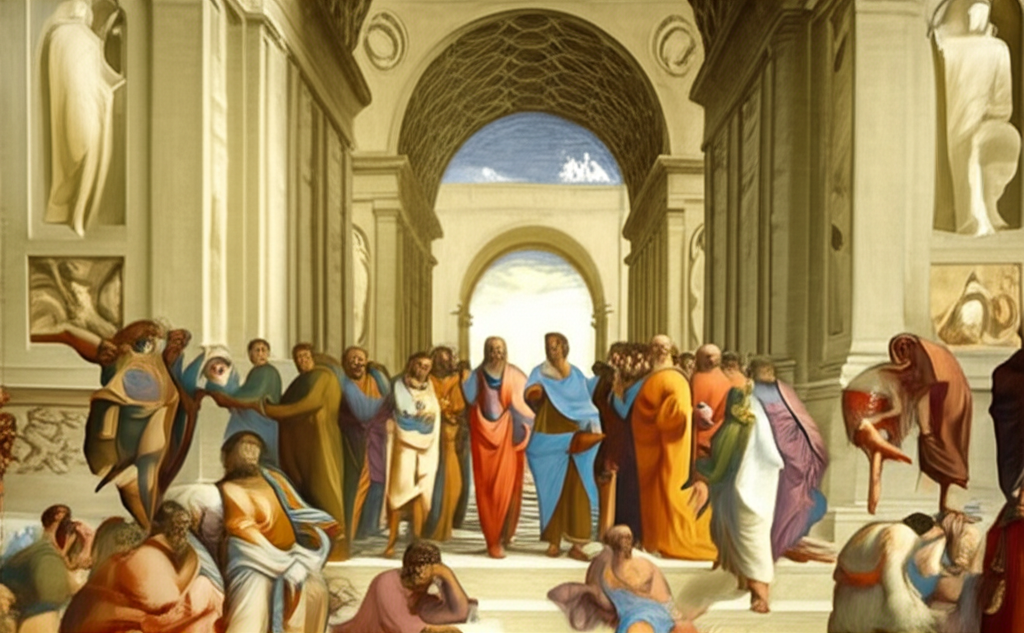 and Aristotle gesturing horizontally to the empirical world, symbolizing their differing approaches to knowledge and reality.)
The Peril of Relativism and the Pursuit of Truth
The very enterprise of philosophy, science, and indeed, any meaningful inquiry, presupposes a commitment to truth. If truth were merely subjective or entirely relative, the concept of knowledge itself would lose its coherence. Why seek to understand the world, to rigorously test hypotheses, or to engage in reasoned debate, if there is no objective state of affairs that our beliefs are attempting to capture?
The Great Books of the Western World are replete with thinkers who, in their diverse approaches, all wrestled with the pursuit of truth as the ultimate aim of intellectual endeavor. From the Socratic method's relentless questioning to Descartes' search for indubitable certainty, the underlying principle is the conviction that truth exists and is discoverable, and that its discovery is what constitutes genuine knowledge.
Conclusion: Truth as the Bedrock of Understanding
In closing, the necessity of truth for knowledge is not a mere philosophical nicety; it is the bedrock upon which all understanding is built. Without truth, our attempts to navigate the world, to make informed decisions, and to progress intellectually would be futile exercises in self-deception. Knowledge, as a concept, demands an unwavering commitment to what is. This intrinsic link ensures that our quest for understanding is always anchored to reality, distinguishing profound insight from mere illusion, and establishing truth as the indispensable principle guiding our intellectual journey.
YouTube Video Suggestions:
-
📹 Related Video: PLATO ON: The Allegory of the Cave
Video by: The School of Life
💡 Want different videos? Search YouTube for: ""Plato Meno Knowledge True Belief Explained""
2. ## 📹 Related Video: ARISTOTLE ON: The Nicomachean Ethics
Video by: The School of Life
💡 Want different videos? Search YouTube for: ""Epistemology Justified True Belief Gettier Problem Simplified""