

The Unshakeable Foundation: Why Labor is Indispensable to the State
The very fabric of any organized society, from ancient polities to modern nations, rests upon a singular, unyielding truth: the necessity of labor. This article posits that labor is not a contingent element that a state might choose to foster or neglect, but rather an absolute prerequisite for its genesis, sustenance, and prosperity. Without the ceaseless effort of its populace to transform raw materials into usable goods, to provide services, and to innovate, a state cannot accumulate wealth, defend its borders, administer justice, or even define its existence. From the most basic agricultural output to the most complex industrial production, human exertion is the bedrock upon which all political structures are erected.
The Primordial Link: Labor and Survival
At the most fundamental level, before any notion of a "state" can emerge, there is the individual and the community striving for survival. This struggle is inherently a struggle of labor.
- Food Production: Hunting, gathering, and agriculture demand physical and intellectual effort. Without this, starvation is inevitable.
- Shelter and Clothing: Constructing homes, weaving textiles, and crafting tools are all acts of labor designed to protect against the elements.
- Basic Services: Even in the simplest communities, tasks like water collection, fire tending, and childcare represent essential forms of labor.
As thinkers from Plato in his Republic to Aristotle in his Politics observed, the division of labor naturally arises from these basic needs. Specialization allows for greater efficiency and the production of a surplus, moving a community beyond mere subsistence. This surplus, however modest, is the nascent form of wealth, and its management and protection are among the earliest justifications for organized authority – the nascent State.
From Individual Effort to Collective Wealth: The State's Emergence
The transition from a collection of individuals to a coherent state is intimately tied to the organization and fruits of labor.
| Stage of Development | Role of Labor | Impact on State Formation |
|---|---|---|
| Subsistence | Direct production for immediate needs | Limited specialization, minimal surplus, small-scale groups |
| Specialization | Division of tasks, increased efficiency | Emergence of trades, interdependence |
| Surplus Production | Creation of goods beyond immediate consumption | Foundation of trade, accumulation of wealth |
| Exchange & Trade | Facilitation of goods and services flow | Need for rules, protection, currency – early state functions |
| Infrastructure | Construction of roads, markets, defenses | Requires organized labor, state coordination and funding |
This progression highlights the necessity and contingency at play. While the form of the state might be contingent (monarchy, republic, etc.), the underlying need for an entity to organize, protect, and distribute the products of labor is a fundamental necessity once a society moves beyond atomized existence. John Locke, in his Second Treatise of Government, famously rooted property rights in labor, asserting that by mixing one's labor with nature, one makes it one's own. This concept underscores how deeply labor is intertwined with the very notion of what a state seeks to protect.
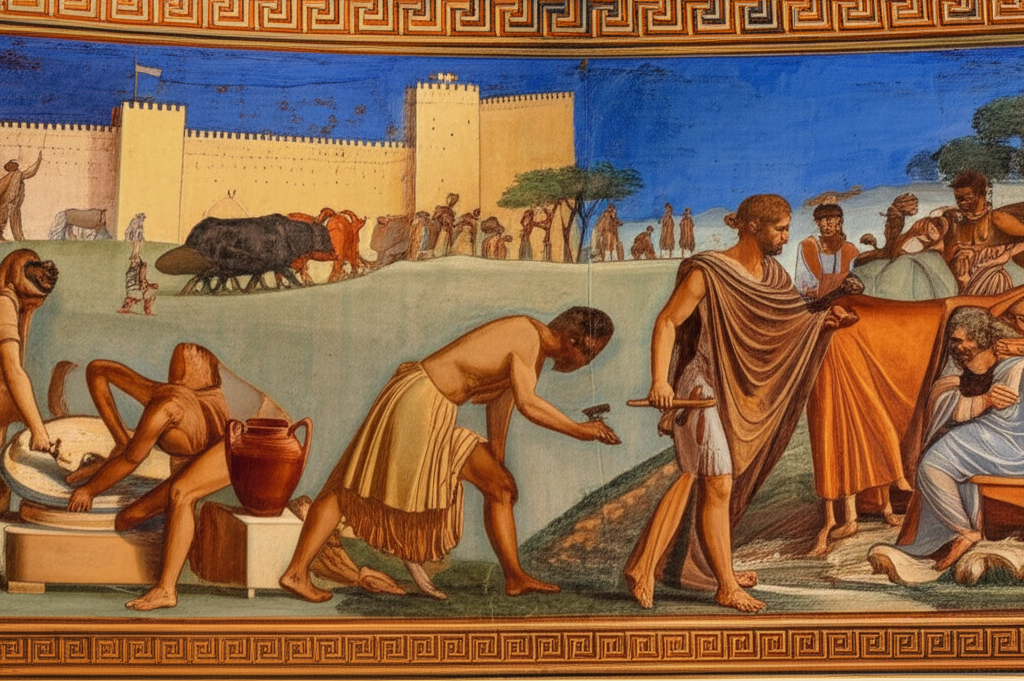
The State as a Consumer and Regulator of Labor
The relationship is not unidirectional; the state does not merely benefit from labor, it actively consumes it and relies upon its continuous flow.
- Public Works: The construction of roads, bridges, aqueducts, and public buildings requires vast amounts of human effort. These projects, often undertaken for the common good, are direct investments of labor.
- Defense and Security: Armies and police forces, essential for protecting the state and its citizens, are composed of individuals whose labor is dedicated to security.
- Administration and Governance: The bureaucrats, judges, and legislators who manage the state's affairs are performing a specialized form of labor – intellectual and organizational.
- Taxation: The state extracts a portion of the wealth generated by labor through taxation. This revenue is then reinvested into public services, infrastructure, and the maintenance of the state apparatus itself, creating a cyclical dependence. Adam Smith, in The Wealth of Nations, meticulously detailed how a nation's wealth, and thus its capacity to fund a state, is ultimately derived from the productivity of its labor.
Without the constant input of labor, a state's coffers would be empty, its infrastructure would crumble, its defenses would weaken, and its capacity to govern would vanish. The very existence of a stable political order is therefore a testament to the ongoing necessity of its citizens' productive efforts.
The Philosophical Weight of Labor's Indispensability
The philosophical implications of labor's centrality are profound. It moves beyond mere economic consideration to touch upon the very definition of human society and collective existence. The notion of necessity and contingency is crucial here: while the specific arrangements for labor (e.g., slave labor, feudal serfdom, free wage labor) are contingent products of historical development, the fundamental requirement for human effort to sustain life and build civilization remains a constant, an absolute necessity.
A state without labor is not merely impoverished; it is a contradiction in terms. It would lack the means to feed its people, to house them, to protect them, or to provide any services whatsoever. It would be a phantom entity, a theoretical construct without material basis. Thus, from the foundational provisions of survival to the complex machinery of modern governance, labor is the indispensable engine, the unshakeable foundation upon which the entire edifice of the State is built.
📹 Related Video: PLATO ON: The Allegory of the Cave
Video by: The School of Life
💡 Want different videos? Search YouTube for: ""Plato on the Division of Labor" or "Adam Smith Wealth of Nations Summary""