

The Indispensable Engine: Labor's Necessity for the State
The very existence and enduring stability of any political community, from the nascent city-state to the sprawling modern nation, is fundamentally predicated upon the necessity of labor. Without the sustained, organized effort of its populace, a state cannot secure its basic survival, generate wealth, or maintain the complex social structures that define it. This article explores how labor moves beyond mere individual sustenance to become the indispensable engine driving the formation, development, and perpetuation of the State, touching upon the philosophical interplay between necessity and contingency in human endeavor.
The Primal Link Between Toil and Polity
At its most elemental, human existence demands effort. Food must be gathered or grown, shelter constructed, and safety maintained. When individuals coalesce into a community, these efforts become collective, specialized, and interdependent. Philosophers from Plato to Locke have recognized this fundamental truth: the state arises not from abstract ideals alone, but from the practical necessity of cooperative labor to meet human needs.
In Plato’s Republic, the ideal city emerges from the recognition that no single person is self-sufficient. Different individuals possess different aptitudes, leading to a natural division of labor—farmers, builders, weavers, shoemakers—each contributing to the common good. This specialization, driven by practical necessity, forms the economic bedrock upon which the political structure is built. Aristotle, too, in his Politics, emphasizes the household as the primary economic unit, where different forms of labor (master, slave, husband, wife) contribute to the sustenance that allows for the higher pursuit of the polis.
Labor, Production, and the Accumulation of Wealth
Beyond mere subsistence, labor is the primary wellspring of wealth. It transforms raw materials into valuable goods and services, creating a surplus that can be invested, traded, and accumulated. This surplus is not only crucial for the comfort and advancement of a society but also for the very power and influence of the State itself.
John Locke, in his Second Treatise of Government, famously argued that labor is the foundation of property. By mixing one’s labor with nature, an individual takes something from the common state and makes it their own, thereby creating value. This concept is pivotal, as the recognition and protection of property—the product of labor—becomes a core function of the State, incentivizing further productive effort. Adam Smith, in The Wealth of Nations, further elucidated how the division of labor dramatically increases productivity, leading to an unprecedented accumulation of wealth that benefits all segments of society, provided the State creates a framework for free exchange and secure markets. The State, therefore, relies on this wealth to fund its institutions, defend its borders, and provide public services.
Necessity and Contingency: The Dual Nature of Human Endeavor
The concept of labor presents a fascinating philosophical intersection of necessity and contingency.
- Necessity: The necessity of labor itself is undeniable. Humans must work to survive and thrive; no state can exist without the productive efforts of its citizens. This is an ontological given of human existence.
- Contingency: However, the forms of labor, its organization, its social relations, and its distribution are profoundly contingent. They are not fixed or predetermined but are shaped by historical circumstances, technological advancements, cultural norms, and political decisions. For instance, the feudal system of serfdom differs vastly from the industrial wage labor system, or the modern knowledge economy. Each represents a contingent arrangement of labor within a specific historical State. Karl Marx, through his analysis of historical materialism, highlighted how these contingent "relations of production" fundamentally shape the entire superstructure of a society, including its political institutions.
The State, therefore, faces the constant challenge of managing these contingent forms of labor to meet the underlying necessity of production, often navigating tensions between individual freedom and collective good.
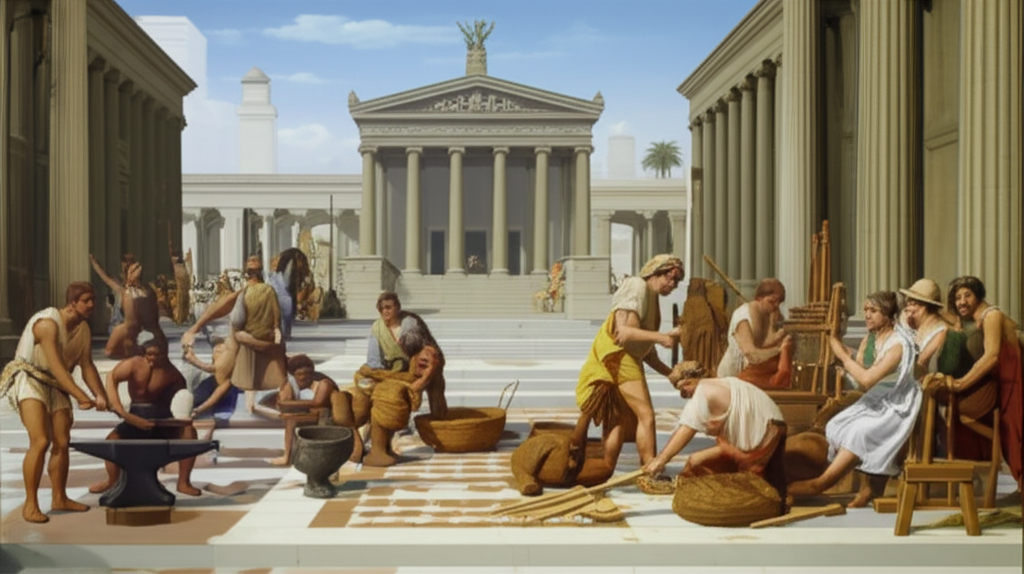
The State's Mandate: Organizing and Regulating Labor
Given labor's fundamental role, the State inevitably assumes a critical function in its organization and regulation. This is not merely about coercion, but about creating the conditions under which labor can be most productive and beneficial to the collective.
Historically, the State's involvement has manifested in various ways:
- Infrastructure Development: Building roads, ports, and communication networks to facilitate the movement of goods and workers.
- Legal Frameworks: Establishing laws regarding contracts, property rights, and working conditions to ensure fairness and stability.
- Education and Training: Investing in human capital to enhance the skills and productivity of the workforce.
- Resource Allocation: Directing resources (e.g., land, capital) towards productive enterprises.
- Social Welfare: Providing safety nets and public services (healthcare, unemployment benefits) to maintain a healthy and stable workforce.
- Defense and Security: Protecting the means of production and the laborers themselves from external threats and internal strife.
These interventions demonstrate the State's recognition that organized and effective labor is not a peripheral concern but central to its own viability and prosperity.
Philosophical Reflections on the Dignity and Burden of Toil
Across the Great Books, philosophers have grappled not only with the practical necessity of labor but also with its deeper human implications. Is labor a curse, a form of punishment for original sin, as suggested by some religious traditions? Or is it the very means by which humans realize their potential, transform the world, and express their freedom, as Hegel and Marx (in his earlier works) might argue?
The spectrum of views includes:
- Labor as a Burden/Curse: Often seen in ancient societies where manual labor was associated with lower status, relegated to slaves or the working classes, while leisure was for philosophical and political pursuits (e.g., Aristotle's view on schole).
- Labor as a Virtue/Duty: Protestant ethics, as explored by Max Weber, linked hard work, diligence, and frugality to religious calling and moral righteousness, contributing to the rise of capitalism.
- Labor as Self-Creation/Transformation: Thinkers like Hegel saw labor as the process through which consciousness externalizes itself, shaping the world and, in turn, shaping itself.
- Labor as Alienation: Marx critiqued capitalist labor as a process where workers become estranged from the product of their labor, the process of labor itself, their species-being, and other humans.
Regardless of these diverse interpretations, the underlying necessity of labor for the State remains undisputed. The philosophical debate shifts from whether we must labor to how we should labor, and what kind of society contingently emerges from our productive efforts.
Conclusion: The Enduring Imperative of Productive Effort
The necessity of labor for the State is an immutable truth of human civilization. From the fundamental requirements of survival to the generation of complex wealth and the maintenance of intricate social orders, productive effort forms the bedrock of political existence. While the contingent forms and philosophical interpretations of labor may evolve across history and culture, the imperative for humans to work—individually and collectively—to sustain and advance their political communities remains an enduring and indispensable condition for the very life of the State. Any society that fails to acknowledge, organize, and value its labor force does so at its peril, risking stagnation, decline, and ultimately, its dissolution.
📹 Related Video: PLATO ON: The Allegory of the Cave
Video by: The School of Life
💡 Want different videos? Search YouTube for: ""Plato's Republic division of labor philosophy""
📹 Related Video: KANT ON: What is Enlightenment?
Video by: The School of Life
💡 Want different videos? Search YouTube for: ""Adam Smith labor theory of value explained""