

The Unstoppable Current: Unpacking the Necessity of Change in History
History, far from being a static chronicle of past events, is an ever-unfolding narrative defined by ceaseless transformation. This article argues that Change is not merely an incidental feature of human experience, but a fundamental Necessity baked into the very fabric of our World and its historical progression. We will explore the interplay of Necessity and Contingency, drawing on philosophical insights from the Great Books of the Western World, to understand why the past, present, and future are always in flux.
The Unavoidable Current of Time: History as Dynamic Flux
From the smallest ripple to the grandest revolution, the World around us is in constant motion. To speak of History is to speak of Change. Civilizations rise and fall, ideas evolve, technologies emerge, and social structures are perpetually reshaped. This isn't a phenomenon unique to certain periods; it is the very essence of historical existence. As Heraclitus, one of the earliest voices in the Great Books of the Western World, famously posited, "Panta rhei" – everything flows, nothing stands still. To deny Change is to deny History itself.
Necessity and Contingency: The Dance of What Must Be and What Could Be
Philosophically, the concept of Change brings us face-to-face with the profound distinction between Necessity and Contingency.
- Necessity refers to that which must be, that which cannot be otherwise.
- Contingency refers to that which might or might not be, that which depends on circumstances.
While specific events within History are often contingent – a particular battle's outcome, the rise of a specific leader, the invention of a certain technology – the fact of historical Change itself appears to be a Necessity.
Consider the following:
- The Necessity of Evolution: Biological and cultural evolution are not optional; they are inherent processes driven by adaptation, resource competition, and the constant interplay of forces. Societies, like species, either adapt or perish.
- The Necessity of Idea Transformation: Philosophical and scientific paradigms are never final. New discoveries, ethical considerations, and logical critiques inevitably lead to the revision or outright replacement of old ideas. Think of the Copernican revolution challenging Ptolemaic cosmology, or Enlightenment thought questioning divine right.
- The Necessity of Social Flux: Social structures, from family units to political systems, are always under pressure from internal dynamics (e.g., class struggle, demographic shifts) and external forces (e.g., climate change, inter-societal contact). As Hegel articulated in his dialectical view of History, progress often arises from the conflict and synthesis of opposing forces, a necessary engine of Change.
Even if we cannot predict the exact form of future Change, the Necessity of its occurrence remains. To freeze History would be to halt life itself.
Historical Change as a Philosophical Imperative
Many philosophers, from ancient Greece to the modern era, have grappled with the imperative of Change.
Perspectives on Historical Dynamics
| Philosopher/Concept | Key Idea Regarding Change | Source Material Connection |
|---|---|---|
| Heraclitus | Constant flux; "You cannot step into the same river twice." | Great Books of the Western World (Early Greek Philosophy) |
| Plato | The material World is subject to Change and decay, contrasting with eternal Forms. | Republic, Timaeus |
| Aristotle | Potentiality and Actuality; Change as the actualization of potential. | Metaphysics, Physics |
| Machiavelli | Rulers must adapt to changing fortunes and circumstances ("fortuna"). | The Prince |
| Hegel | History as a dialectical process of thesis, antithesis, and synthesis, driving progress. | Phenomenology of Spirit, Lectures on the Philosophy of History |
| Marx | Historical materialism; economic Change and class struggle as the engine of History. | Das Kapital, The Communist Manifesto |
These thinkers, each in their own way, underscore that Change is not an accidental feature but a driving force, sometimes even a Necessity, for the unfolding of human civilization and thought. To resist it entirely is often to invite greater, more disruptive Change.
The Dialectic of Progress and Decay
It's crucial to understand that the Necessity of Change does not inherently imply "progress" in a linear, always-improving sense. Change can lead to decay, to the loss of valuable traditions, or to periods of intense suffering. However, even decay is a form of Change that often clears the ground for new formations.
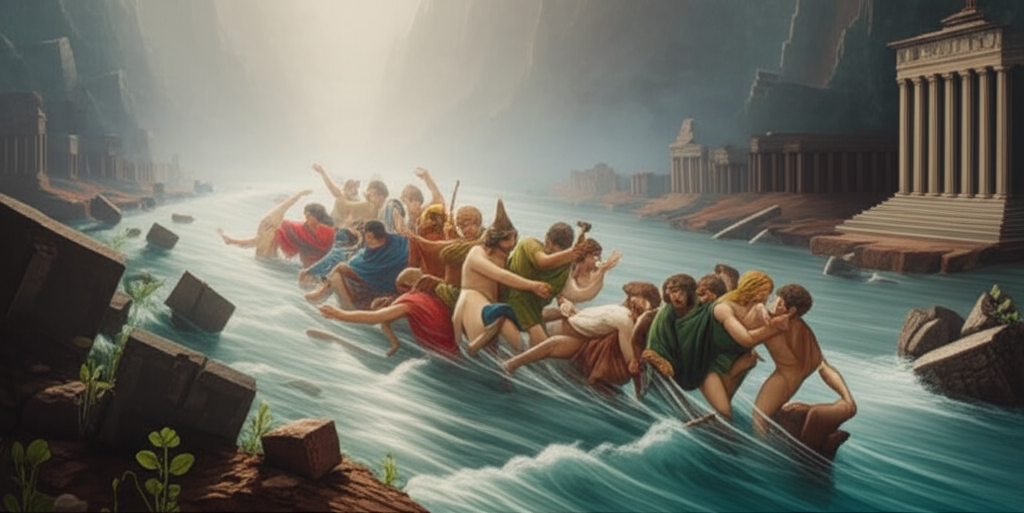
The cycle of creation and destruction, of old orders giving way to new ones, is a recurring theme in the History of the World. Empires fall, ideologies are discredited, and technological paradigms become obsolete. This constant renewal, born from the ashes of the old, is a testament to the inescapable nature of flux.
Embracing the Flux: A Modern Philosophical Stance
In our rapidly evolving World, understanding the Necessity of Change is more critical than ever. It encourages us to:
- Cultivate adaptability: Rigid adherence to outdated systems or beliefs can lead to stagnation and eventual collapse.
- Embrace critical thinking: Continuously questioning assumptions and seeking new knowledge is essential for navigating evolving realities.
- Recognize the impermanence of all things: This philosophical insight can foster both resilience in the face of loss and an appreciation for the present moment.
The lesson from the Great Books of the Western World and indeed, from History itself, is clear: Change is not an option but a constant. Our challenge, as inhabitants of this ever-shifting World, is not to halt the current, but to learn how to navigate its powerful, necessary flow.
YouTube Video Suggestions:
-
📹 Related Video: What is Philosophy?
Video by: The School of Life
💡 Want different videos? Search YouTube for: ""Heraclitus everything flows philosophy""
2. ## 📹 Related Video: What is Philosophy?
Video by: The School of Life
💡 Want different videos? Search YouTube for: ""Hegel philosophy of history explained""