

The Enduring Echo: Unpacking the Nature of Universal Law
At its core, the concept of Universal Law posits that there exist fundamental principles governing existence, morality, or even the cosmos itself, which transcend human decree and apply across all times, places, and cultures. This isn't merely a legal framework crafted by societies, but rather an inherent order, a deeper nature to reality that philosophers and thinkers have striven to understand for millennia. From the ancient Greeks pondering cosmic justice to modern scientists seeking unifying theories, the quest for these overarching laws reveals a profound human desire to find meaning and predictability in a vast and often chaotic world.
The Grand Tapestry of Order: What is "Universal"?
When we speak of "universal," we invoke a concept of boundless scope, something that is everywhere and always true. It stands in stark contrast to the particular—the specific instance, the individual case, the localized custom. A universal law, by its very nature, is not contingent on specific circumstances, historical periods, or cultural norms. It aims to capture an enduring truth.
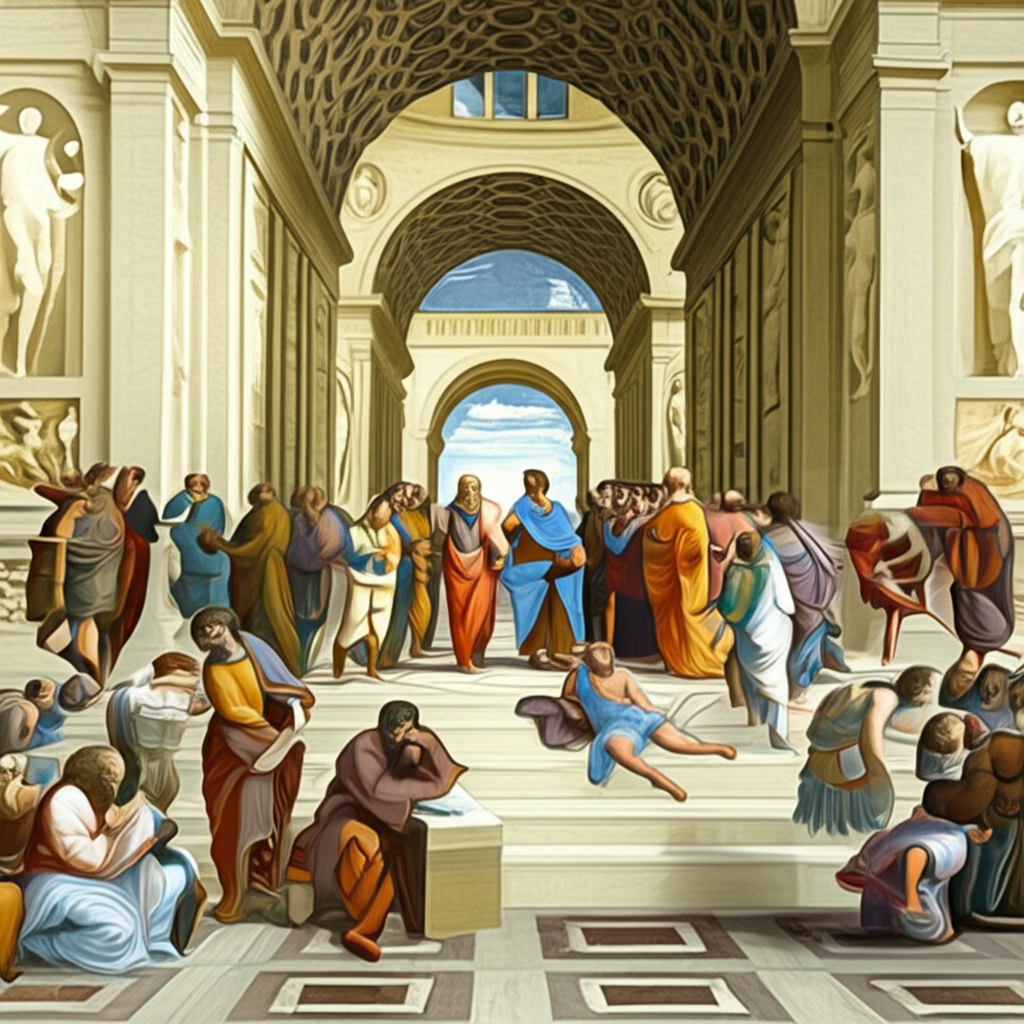
Thinkers throughout the Great Books of the Western World have grappled with this universality:
- Plato's Forms: For Plato, true reality lay in the unchanging, eternal Forms (e.g., Justice itself, Beauty itself), which exist independently of our imperfect world and serve as blueprints for all particular instances.
- Aristotle's Natural Teleology: Aristotle observed the inherent purposes and tendencies within nature, suggesting that things strive towards their full potential according to an intrinsic, universal design.
- Stoic Cosmology: The Stoics believed in a rational, divine principle—the Logos—that pervaded and ordered the entire cosmos, making the universe a coherent, lawful whole.
- Kantian Ethics: Immanuel Kant's categorical imperative posited a moral law that any rational being would necessarily assent to, universally binding and independent of individual desires or consequences.
The "Law" Component: More Than Just Rules
The term "law" in this context is far richer than mere human legislation. It encompasses several distinct, yet often interconnected, dimensions:
- Natural Law: This refers to an inherent moral order discoverable by human reason, independent of positive (man-made) law. It suggests that certain actions are inherently right or wrong because they align with or violate the fundamental nature of humanity and the universe. Thinkers like Thomas Aquinas articulated natural law as a reflection of God's eternal law, accessible through reason.
- Moral Law: Often overlapping with natural law, moral law speaks to universally binding ethical principles. It asks: What duties do we owe to each other, simply as rational beings? Kant's "Act only according to that maxim whereby you can at the same time will that it should become a universal law" is a quintessential example.
- Scientific Law: These are descriptions of phenomena in nature that are observed to occur consistently under given conditions. Laws of physics, like gravity or thermodynamics, are universal in their application across the observable cosmos. While descriptive rather than prescriptive, they reveal an underlying order that governs the physical nature of reality.
- Divine Law: For many theological traditions, universal laws originate from a divine source, revealed through scripture or prophetic insight. These are understood as the ultimate principles by which all creation is governed.
The Interplay of Universal and Particular
The tension between the universal and the particular is a fertile ground for philosophical inquiry. How do these grand, overarching principles manifest in the messy, diverse reality of individual lives and specific events?
- A universal moral law might state that "murder is wrong." Yet, the particular circumstances surrounding an act of killing (self-defense, war, accident) can complicate its moral assessment.
- The universal law of gravity applies to all objects, but the particular trajectory of a falling leaf is influenced by specific air currents, its shape, and its initial conditions.
Philosophers seek to bridge this gap, to understand how the universal informs and structures the particular, and how observing particular instances helps us infer or refine our understanding of universal principles. It's a continuous dialectic, where theory meets experience.
The Enduring Quest for Principle
The search for universal law is a testament to humanity's desire for meaning, order, and justice. It's the conviction that beneath the surface of fleeting phenomena lies an immutable bedrock of principles. Whether we frame these laws as divine commands, rational imperatives, or the inherent workings of nature, their pursuit reflects a deep-seated belief that the universe is not arbitrary but possesses a discoverable, intelligible structure.
This journey, eloquently documented in the Great Books, reminds us that understanding the nature of universal law is not just an academic exercise. It shapes our ethics, informs our science, and ultimately influences how we understand our place in the cosmos. It's the enduring echo of a cosmic order, inviting us to listen and learn.
Key Facets of Universal Law
| Facet | Description | Exemplar Thinker/Tradition |
|---|---|---|
| Natural Law | Inherent moral order discoverable by reason, based on human nature. | Thomas Aquinas |
| Moral Law | Universally binding ethical principles for rational beings. | Immanuel Kant |
| Scientific Law | Descriptive principles of observed natural phenomena. | Isaac Newton |
| Divine Law | Laws originating from a divine source, governing creation. | Abrahamic Religions |
| Metaphysical Law | Fundamental principles governing the nature of reality itself. | Plato, Aristotle |
📹 Related Video: KANT ON: What is Enlightenment?
Video by: The School of Life
💡 Want different videos? Search YouTube for: ""Natural Law Philosophy Explained" or "Kant Categorical Imperative Universal Law""