

The Enduring Shadow: Exploring the Nature of Tyranny and Government
The enduring questions surrounding the nature of tyranny and government have occupied the greatest minds throughout history, from the philosophers of ancient Greece to the architects of modern states. This article delves into these fundamental concepts, drawing upon the rich tapestry of thought found within the Great Books of the Western World. We will explore the origins and purposes of legitimate government, dissect the insidious characteristics that define tyranny, and differentiate between a functioning state and a regime that has succumbed to arbitrary rule. Ultimately, understanding these distinctions is crucial for safeguarding liberty and fostering just societies.
The Genesis of Government: Order from Chaos
The very impulse towards government arises from a fundamental human need for order, security, and the arbitration of justice. Before the advent of structured rule, humanity often found itself in a precarious state of nature, as theorized by philosophers like Thomas Hobbes, where life was "solitary, poor, nasty, brutish, and short."
-
From Polis to State: Early Conceptions
- For the ancient Greeks, particularly Plato and Aristotle, the polis (city-state) was the natural environment for human flourishing. Aristotle, in his Politics, famously declared man a "political animal," suggesting that our essence is realized through participation in community and governance. The polis was not merely a geographical location but a moral and ethical entity designed to facilitate the good life.
- The concept evolved into the modern state, a more expansive and complex entity defined by sovereignty, territory, and a monopoly on legitimate force. Yet, the underlying purpose remains: to provide a framework for collective existence.
-
The Social Contract: A Philosophical Foundation
The idea that government derives its legitimacy from the consent of the governed is a cornerstone of political philosophy. Thinkers like John Locke and Jean-Jacques Rousseau posited a "social contract," an implicit agreement among individuals to surrender certain freedoms in exchange for the protection and benefits of an organized state. This contract, however, carries with it an inherent vulnerability: what happens when the government breaches its side of the agreement, turning its power against its own people? This is often the precipice from which tyranny emerges.
The Spectrum of Rule: Forms and Fates
Philosophers have long categorized different forms of government, not merely as descriptive labels but as a means to understand their inherent strengths, weaknesses, and potential for degeneration.
-
Classical Classifications: Aristotle's Typology
Aristotle, in Politics, provided one of the most enduring classifications, distinguishing between governments that rule in the common interest and those that rule in the self-interest of the rulers. He identified six primary forms, three "good" and three "corrupt" or "tyrannical" deviations:Rule by In the Common Interest (Good) In the Self-Interest (Corrupt/Tyrannical) One Monarchy (Rule by a virtuous king) Tyranny (Rule by a despot for personal gain) Few Aristocracy (Rule by the virtuous elite) Oligarchy (Rule by the wealthy few) Many Polity (Constitutional rule by the populace) Democracy (Mob rule, rule by the poor for their own interest, often leading to anarchy) Aristotle understood that the nature of a government could shift, often cycling through these forms as power dynamics changed and human flaws asserted themselves.
-
The Inevitable Cycle of Corruption
Both Plato and Aristotle discussed how even the best forms of government could degrade. A virtuous monarchy could devolve into a tyranny; an aristocracy into an oligarchy; and a polity, or even a democracy, could collapse into anarchy from which a tyrant might rise to restore order, only to impose a new form of oppression. This cyclical view highlights the constant vigilance required to maintain good governance.
The Nature of Tyranny: When Power Corrupts Absolutely
Tyranny is not merely bad government; it is a fundamental perversion of the very purpose of rule. It represents a regime where power is exercised arbitrarily, without regard for law, justice, or the welfare of the governed.
-
Defining the Tyrant: Self-Interest vs. Public Good
The hallmark of tyranny is the ruler's pursuit of personal gain, power, or glory above the common good. Plato, in The Republic, paints the tyrant as the most unhappy of souls, enslaved by his own insatiable desires and fears, constantly battling external threats and internal anxieties. Unlike a king who governs by wisdom and law, the tyrant governs by whim and force. -
The Mechanisms of Oppression: Fear, Deception, Control
A tyrannical state relies on a specific set of tools to maintain its grip:- Fear: The constant threat of violence, imprisonment, or death keeps the populace subdued.
- Deception: Propaganda, censorship, and the manipulation of information distort reality and prevent independent thought.
- Control: Surveillance, suppression of dissent, and the dismantling of civil society organizations isolate individuals and prevent collective action.
- Division: Tyrants often sow discord among different groups to prevent them from uniting against the regime.
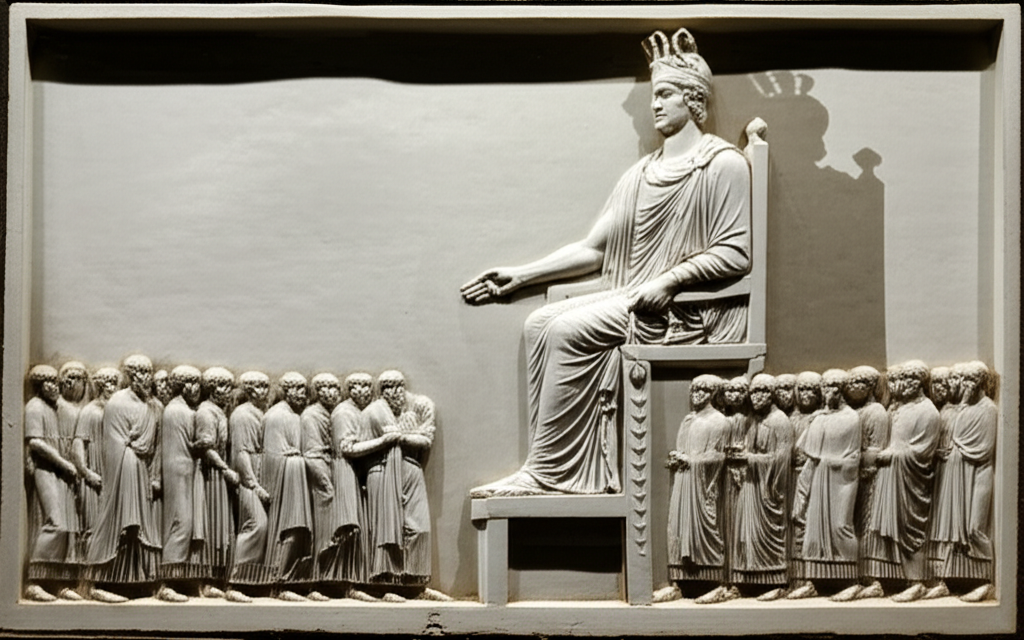
Distinguishing the State from Tyranny: The Rule of Law
The crucial distinction between a legitimate state and a tyrannical regime lies in the concept of the rule of law.
-
Legitimacy and Consent
A functioning state, even one with imperfections, operates under a framework of established laws that apply equally to rulers and ruled. Its authority is generally accepted as legitimate, often through some form of consent or tradition. Tyranny, by contrast, operates outside or above the law, with the ruler's will being the sole determinant of justice. The tyrant rules by force, not by right. -
The Fragility of Freedom
The presence of checks and balances, independent institutions (like a judiciary), and fundamental rights for citizens are characteristic of a non-tyrannical government. These mechanisms are designed to prevent the concentration of power and protect individual liberties. In a tyrannical state, these safeguards are systematically dismantled, leaving individuals vulnerable and freedom extinguished. The nature of such a state is one of perpetual insecurity for its citizens.
Philosophical Insights from the Great Books
The enduring relevance of the Great Books of the Western World lies in their timeless insights into human nature and political organization.
-
Plato's Republic: The Unhappy Soul of the Tyrant
Plato meticulously details the psychological degeneration that leads to tyranny. He argues that a society that prioritizes excessive freedom and indulgence will eventually succumb to anarchy, paving the way for a strongman to seize power. The tyrant, while seemingly powerful, is ultimately a slave to his own passions and fears, leading a life devoid of true happiness or justice. -
Aristotle's Politics: The Degeneration of Forms
Aristotle provides a pragmatic analysis of how governments change and decay. He warns that tyranny can arise from any of the "good" forms of government if the rulers cease to act in the common interest. His detailed observations on the methods tyrants use to maintain power – from disarming the populace to fomenting distrust – serve as a stark warning. -
Hobbes, Locke, and Rousseau: The Broken Covenant
The social contract theorists, while differing in their conclusions, all grappled with the problem of absolute power. For Locke, a government that becomes tyrannical, violating the natural rights of its citizens, forfeits its legitimacy and can be resisted. Hobbes, while advocating for a strong sovereign to prevent the state of nature, implicitly acknowledges the potential for such power to become tyrannical if unchecked by reason. Rousseau’s concept of the "general will" also serves as a bulwark against individual despotism. -
Machiavelli's Prince: A Mirror or a Manual?
Niccolò Machiavelli's The Prince remains one of the most controversial works in political philosophy. While often interpreted as a cynical guide to acquiring and maintaining power by any means necessary, some argue it can also be read as a cautionary tale, revealing the harsh realities and often brutal tactics employed by those who would rule. It forces us to confront the uncomfortable truths about power, and the lengths to which individuals will go, highlighting the ever-present shadow of tyranny.
Conclusion: Vigilance in the Pursuit of Justice
The philosophical journey through the nature of tyranny and government reveals a timeless struggle. The aspiration for a just state, one that upholds the rule of law and serves the common good, is a perennial human endeavor. Yet, the specter of tyranny, arising from the corruption of power and the erosion of ethical principles, remains a constant threat. The insights gleaned from the Great Books of the Western World are not merely historical curiosities; they are vital tools for understanding the present and for equipping us with the critical faculties necessary to recognize and resist the insidious descent into despotism. Eternal vigilance, as the saying goes, is indeed the price of liberty.
📹 Related Video: PLATO ON: The Allegory of the Cave
Video by: The School of Life
💡 Want different videos? Search YouTube for: "Plato Republic tyranny explained"
📹 Related Video: ARISTOTLE ON: The Nicomachean Ethics
Video by: The School of Life
💡 Want different videos? Search YouTube for: "Aristotle Politics forms of government"