

Unveiling Doxa: The Elusive Nature of True Opinion
A Journey into the Heart of Belief and Understanding
The concept of opinion, or doxa as the ancient Greeks termed it, sits at a fascinating crossroads in philosophical inquiry. It is not quite ignorance, yet it falls short of true knowledge. This article delves into the intricate landscape of doxa, exploring how an opinion can be aligned with truth without possessing the unshakeable certainty we associate with genuine understanding. We will navigate the classical distinctions, particularly those laid down by Plato, to illuminate the profound implications of distinguishing between merely holding a correct belief and truly knowing why it is correct.
The Platonic Divide: Opinion, Truth, and the Path to Knowledge
Our journey into the philosophical landscape of opinion begins with the ancient Greeks, particularly Plato, whose works, fundamental to the Great Books of the Western World, meticulously dissect the human mind's various states. For Plato, doxa (opinion or belief) occupied a curious middle ground between outright ignorance and genuine knowledge (episteme). It is often formed through our senses and perceptions of the ever-changing, material world – the realm of appearances.
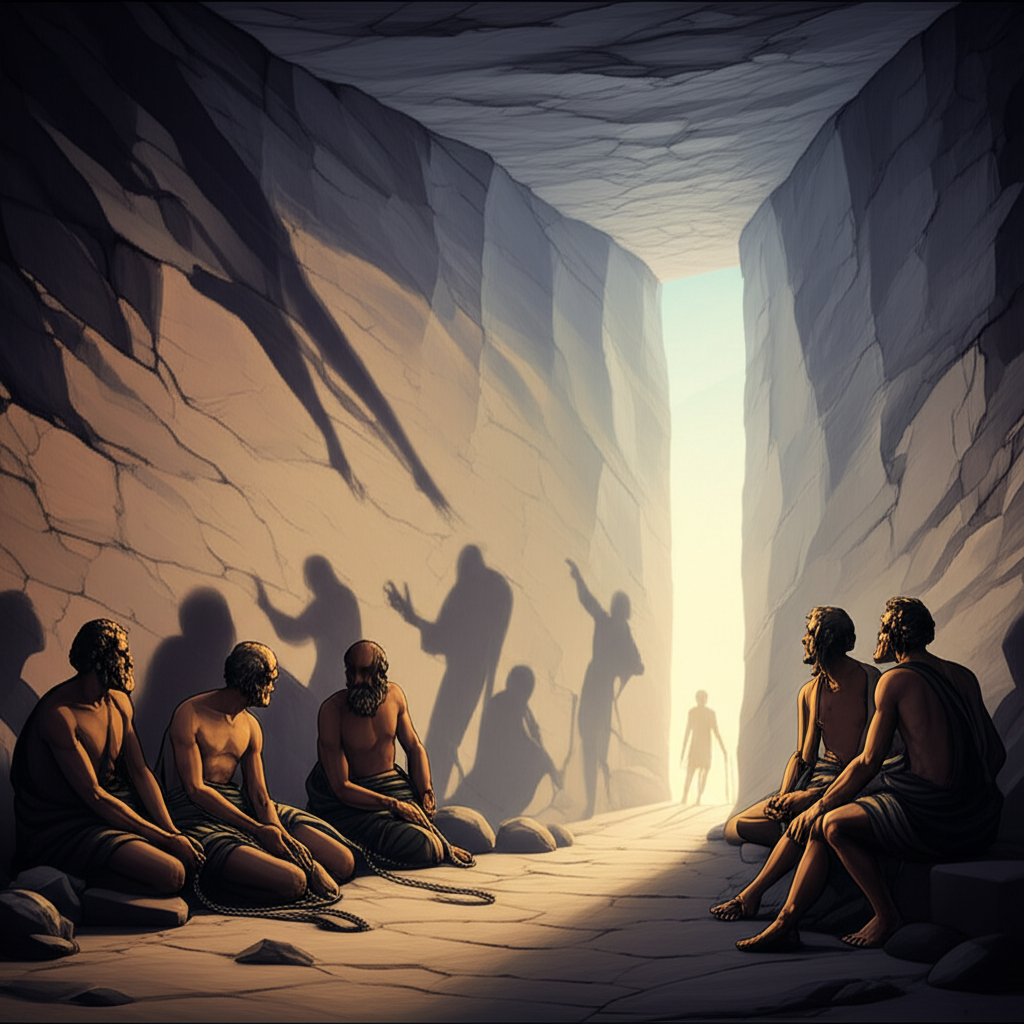
Consider Plato's allegory of the Cave. The prisoners, bound and facing a wall, perceive only shadows. These shadows are their reality, their opinions about what exists. If one shadow accurately represents a real object outside the cave, their opinion about that shadow might be "true" in a limited sense. However, it is not knowledge because they do not understand the true nature of the object casting the shadow, nor the mechanism by which the shadow is produced.
Plato articulated this distinction further with his "Divided Line," illustrating a hierarchy of cognitive states. Doxa occupies the lower segments, dealing with visible things and their images, while episteme resides in the higher segments, concerned with intelligible forms and rational understanding.
Doxa vs. Episteme: A Fundamental Distinction
To clarify Plato's perspective, let's outline the core differences between doxa and episteme:
| Feature | Doxa (Opinion) | Episteme (Knowledge) |
|---|---|---|
| Foundation | Sensory experience, belief, persuasion, convention | Rational understanding, Forms, unchanging truths |
| Reliability | Unstable, can be forgotten, easily swayed | Stable, secure, rationally justified, demonstrable |
| Source | Perception, custom, rhetoric, common belief | Reason, dialectic, recollection, intellectual grasp |
| Object | Particulars, appearances, the changing world | Universals, Forms, the intelligible realm |
| State of Mind | Conjecture (eikasia), Belief (pistis) | Understanding (dianoia), Intellection (noesis) |
The Paradox of True Opinion: When Doxa Meets Truth
The most intriguing aspect of doxa is its capacity for truth. How can an opinion be true without being knowledge? Plato explores this extensively in the Meno. Socrates, in his characteristic manner, demonstrates that a slave boy, uneducated in geometry, can arrive at a true geometrical conclusion through guided questioning, essentially recollecting innate knowledge. However, the slave boy's initial correct answers are presented as true opinions – he believes them to be correct, but he cannot yet fully explain why they are correct.
Socrates famously likens true opinions to the statues of Daedalus, which were said to run away if not tethered. A true opinion is valuable, guiding us correctly, but it is prone to fleeing or being forgotten because it lacks the rational "tether" of justification. Without this tether – the understanding of the underlying causes, reasons, and connections – a true opinion remains fragile.
- Example: A doctor might accurately diagnose a rare disease (a true opinion) based on intuition or a vague memory of a similar case, but without understanding the specific pathology, biological markers, and treatment mechanisms (the knowledge), their opinion, while true, is less reliable and less transferable than if it were grounded in comprehensive medical knowledge.
This distinction is crucial: true opinion gets us to the right answer, but knowledge tells us why it's the right answer, making it robust, defensible, and universal. It's the difference between guessing correctly and understanding.
The Role of Sense and Experience in Forming Opinion
Our immediate interaction with the world is primarily through our senses. We see, hear, touch, taste, and smell, forming countless opinions about phenomena. The sky is blue, the fire is hot, the apple is sweet. These are opinions rooted in sensory experience. While these might often be "true" in a practical sense, they are inherently subjective and limited. The blueness of the sky is an appearance, not the ultimate nature of light and atmosphere, which requires deeper scientific and philosophical knowledge.
The challenge lies in moving beyond these sensory-derived opinions. While they are necessary for navigating daily life, they are insufficient for grasping ultimate truth. Philosophy, for Plato, was the rigorous discipline of moving from the realm of doxa to the realm of episteme, from the shifting sands of sense perception to the firm ground of rational insight.
The Enduring Relevance of Doxa in Modern Thought
While classical philosophy meticulously distinguished opinion from knowledge, the concept of doxa continues to resonate. In our modern world, we are constantly bombarded with information, forming opinions based on news headlines, social media, and anecdotal evidence. Many of these opinions might be true, but how many are truly knowledge? Do we understand the underlying complexities, the causal chains, the broader context?
The philosophical journey from doxa to episteme is not merely an academic exercise; it's a call to intellectual rigor. It encourages us to question not just what we believe, but why we believe it. It pushes us to seek the rational "tethers" that transform fleeting true opinions into enduring knowledge.
Conclusion: The Pursuit Beyond Mere Opinion
The nature of true opinion (doxa) serves as a powerful reminder of the human intellectual struggle. It highlights that the alignment of a belief with truth is a significant step, but it is not the final destination. The ultimate goal, as philosophers throughout the Great Books of the Western World have shown, is the pursuit of knowledge – a deep, justified, and stable understanding that transcends mere belief. By understanding the distinction between doxa and episteme, we are better equipped to critically evaluate our own beliefs and the beliefs of others, fostering a more informed and intellectually robust approach to the world around us.
YouTube: Plato Meno True Opinion Knowledge
YouTube: Plato's Allegory of the Cave Explained
📹 Related Video: What is Philosophy?
Video by: The School of Life
💡 Want different videos? Search YouTube for: "The Nature of True Opinion (Doxa) philosophy"