

The Elusive Echo: Navigating the Nature of True Opinion (Doxa)
In the vast intellectual landscape charted by the Great Books of the Western World, few concepts prove as persistently challenging and practically significant as doxa – the ancient Greek term often translated as opinion or belief. This article delves into the nature of true opinion, exploring its precarious position somewhere between the shifting sands of mere conjecture and the bedrock of genuine knowledge. We will examine how doxa, though sometimes aligning with truth, fundamentally differs from knowledge due to its reliance on sense perception and its lack of robust justification. Understanding this distinction is crucial for anyone seeking to navigate the complexities of what we claim to know, believe, and assert in the world.
The Platonic Divide: Doxa and the Realm of Appearance
Plato, a towering figure in the Great Books canon, laid much of the groundwork for our understanding of doxa. For him, opinion occupies the middle segment of his famous Divided Line, residing in the visible realm, whereas true knowledge belongs to the intelligible realm.
The Influence of Sense Perception
Our opinions are largely forged in the crucible of our experiences, filtered through our sense perceptions. What we see, hear, touch, taste, and smell informs our initial understanding of the world. This immediate, empirical data forms the raw material for doxa.
- Sight: Observing a distant object and forming an opinion about its size or nature.
- Hearing: Listening to a rumor and forming a belief about an event.
- Touch: Feeling a surface and developing an opinion about its texture.
While these sense experiences are vital for interacting with reality, Plato argued they are inherently deceptive and mutable. The world of appearances is constantly in flux, and opinions derived solely from it are therefore unstable.
The Precariousness of True Opinion
A "true opinion" is one that happens to correspond with reality, that is, it aligns with truth. For example, if I believe it will rain, and it does indeed rain, my opinion was true. However, for Plato, this doesn't elevate it to the status of knowledge. Why? Because I might have arrived at that true opinion for entirely the wrong reasons, or without any real understanding of why it is true.
Consider the following points regarding true opinion:
- Lack of Justification: A person holding a true opinion cannot "give an account" of why it is true. They may state the fact, but they cannot explain the underlying causes, principles, or reasons that make it so.
- Accidental Correspondence: True opinion often feels like a lucky guess. It hits the mark, but without the precision or understanding of an archer who knows exactly how to aim.
- Vulnerability to Persuasion: Lacking firm foundations, true opinions are easily swayed by rhetoric or new, superficial information, as they are not rooted in a deep understanding.
The Meno's Dilemma: The Road to Larissa
Plato's dialogue Meno famously illustrates the distinction between true opinion and knowledge. Socrates poses the scenario of a person who knows the way to Larissa and another who merely has a true opinion about the way. Both will arrive at Larissa. In terms of practical outcome, their doxa is just as effective as knowledge.
However, Socrates argues that the person with knowledge possesses something more valuable: a deep, justified understanding of the route, its landmarks, and its rationale. Their knowledge is "tied down" with reasons, making it stable and transferable. The one with true opinion, while correct, might easily forget the way, or be unable to explain it to others, or be led astray by a slight change in circumstances. Their correct opinion is like a beautiful statue without a pedestal – it's admirable, but easily toppled.
From Sense to Knowledge: The Ascent of Reason
The journey from mere opinion to genuine knowledge is, for Plato, the very essence of philosophical inquiry. It involves transcending the immediate data of the sense and engaging with reason, logic, and dialectic.
Table: Opinion vs. Knowledge (Platonic View)
| Feature | True Opinion (Doxa) | Knowledge (Episteme) |
|---|---|---|
| Foundation | Sense perception, experience, belief | Reason, understanding, justification, Forms |
| Stability | Unstable, mutable, easily swayed | Stable, enduring, unshakeable |
| Justification | Lacks "an account" (logos) | Can "give an account" (logos) of its truth |
| Relation to Truth | Coincides accidentally or partially with Truth | Grasping of Truth itself, understanding its cause |
| Origin | Visible realm, world of becoming | Intelligible realm, world of being |
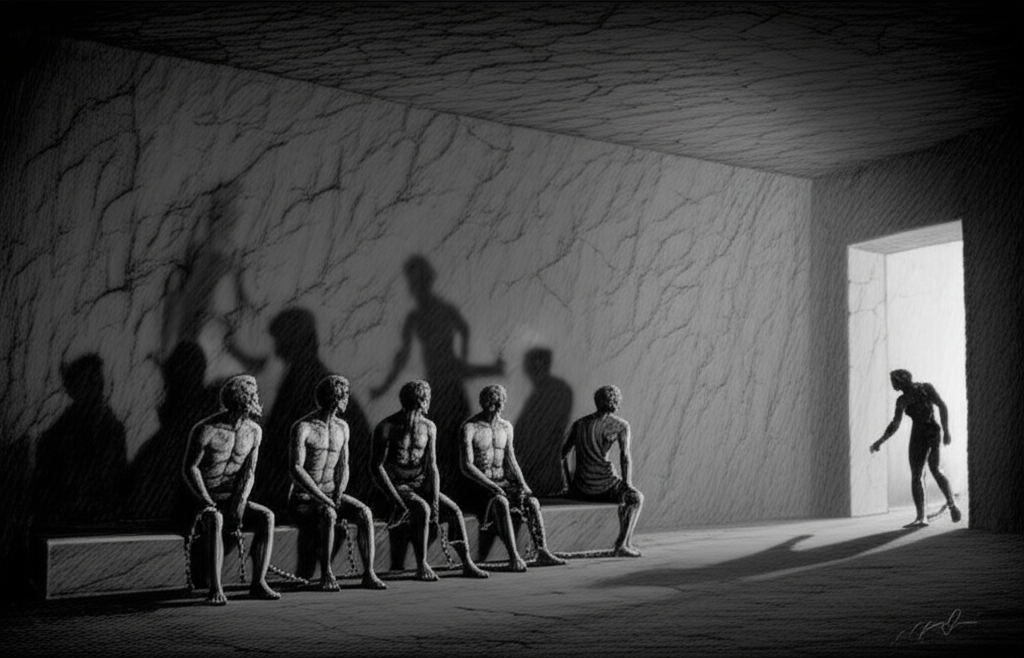
This ascent from the shadows of opinion to the light of knowledge requires rigorous intellectual effort. It's about moving beyond simply what is true to understanding why it is true.
The Practical Utility of True Opinion
Despite its philosophical limitations, we cannot dismiss the practical value of true opinion. In our daily lives, we constantly rely on beliefs that we hold to be true, even if we haven't subjected them to rigorous philosophical scrutiny.
- Guiding Action: If I have the true opinion that a certain bridge is safe, I will cross it. My action is successful, even if I don't understand the engineering principles behind its safety.
- Social Cohesion: Shared true opinions about ethical conduct or social norms can facilitate harmonious living, even if these norms are not universally justified as absolute knowledge.
- Starting Point for Inquiry: A true opinion can often serve as a hypothesis or a starting point for further investigation, eventually leading to knowledge.
The challenge lies in recognizing when we are operating on true opinion and when we have achieved knowledge. This self-awareness is crucial for intellectual honesty and growth.
Conclusion: The Ongoing Quest for Certainty
The nature of true opinion remains a vital topic in philosophy, prompting us to continually question the foundations of our beliefs. While a true opinion can be practically useful and align with truth, it fundamentally lacks the justified, stable, and reasoned understanding that defines genuine knowledge. The journey from reliance on sense data to the firm grasp of rational insight is the enduring quest of philosophy, inviting us to move beyond mere agreement with reality to a profound comprehension of it. In an age saturated with information, distinguishing between well-founded knowledge and mere, albeit sometimes correct, opinion has never been more critical.
📹 Related Video: PLATO ON: The Allegory of the Cave
Video by: The School of Life
💡 Want different videos? Search YouTube for: "Plato Meno true opinion knowledge; Plato Divided Line Allegory Cave explained"