

The Elusive Nature of True Opinion (Doxa): Navigating the Shifting Sands of Belief
In the vast landscape of human thought, few concepts are as fundamental yet as vexing as the nature of opinion (or doxa in its classical Greek sense). While we constantly form and act upon our beliefs, the distinction between a mere opinion and genuine knowledge is profound, a chasm explored by the greatest minds in the Great Books of the Western World. This article delves into doxa, examining how an opinion can be true, what differentiates it from the certainty of knowledge, and why this philosophical distinction remains crucial for understanding ourselves and the world around us. We aim to illuminate the often-slippery path from subjective belief to objective truth, guided by the insights of antiquity.
Doxa Defined: More Than Just a Hunch
To truly grasp the nature of true opinion, we must first understand doxa itself. In ancient Greek philosophy, particularly in Plato's works like the Republic and Meno, doxa refers to common belief, conviction, or opinion. It stands in stark contrast to episteme, which signifies certain, justified knowledge.
Doxa is characterized by:
- Fallibility: It can be true or false.
- Lack of Justification: Even if true, the holder may not understand why it is true.
- Reliance on Perception: Often rooted in sense experience and appearances.
- Instability: It can be swayed by rhetoric, emotion, or new, unexamined information.
- Variability: What is opinion for one may not be for another.
Consider the everyday scenarios where we operate on doxa. We have an opinion that the bus will arrive on time, or that a certain food tastes good. These are beliefs, often formed from past experience or hearsay, but they lack the rigorous justification that elevates them to knowledge.
The Slippery Slope from Opinion to Truth
The intriguing paradox of doxa lies in its capacity to be true. An individual can hold an opinion that, by sheer coincidence or correct sense perception, happens to align with reality. Plato illustrates this beautifully in the Meno with the example of someone who has a true opinion about the road to Larissa. They can guide others just as effectively as someone with genuine knowledge of the route. Both arrive at the correct destination.
However, the person with true opinion lacks the "tether" that binds their belief to understanding. They might forget the way, or be unable to explain why that particular path is the correct one. Their belief is a lucky guess, not a reasoned conviction. This distinction is vital: truth is a characteristic of a proposition, while knowledge is a state of mind that understands and can justify that proposition's truth.
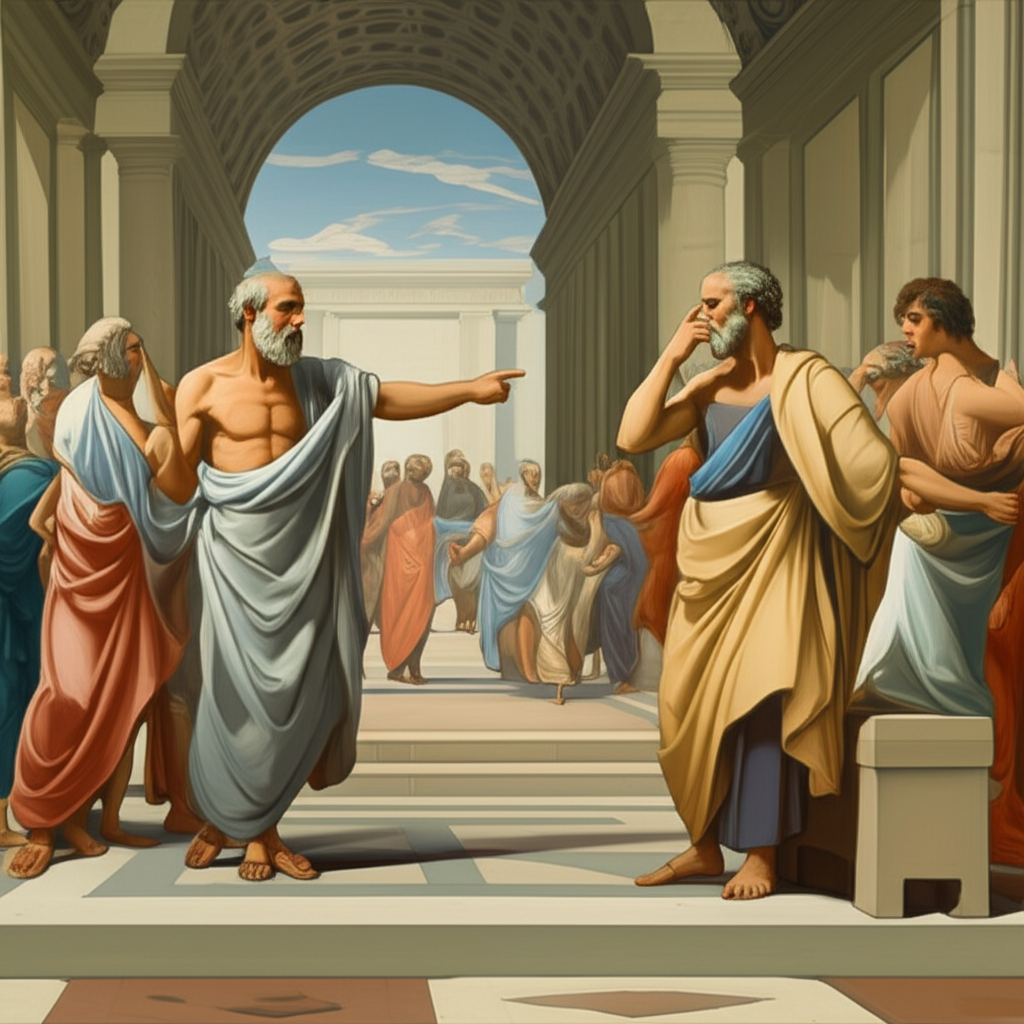
The Role of Sense and Experience in Forming Opinion
Much of our opinion is born from our interaction with the world through our senses. We see, hear, touch, taste, and smell, and these perceptions form the raw data for our beliefs. If we repeatedly see a red apple, we form the opinion that apples are red. This empirical foundation is powerful and necessary for navigating life.
Yet, the limitations of sense experience are also a cornerstone of philosophical inquiry. Our senses can deceive us, be incomplete, or be subject to individual interpretation. What appears red to one person might be subtly different to another. Optical illusions demonstrate how our senses can misrepresent reality. Therefore, opinions derived solely from sense perception, while often true, remain vulnerable to error and lack the unshakeable certainty sought by philosophers for genuine knowledge.
Distinguishing True Opinion from Genuine Knowledge (Episteme)
The core philosophical challenge, particularly evident in the Great Books, is to differentiate between an opinion that happens to be true and knowledge that is inherently true and justified.
| Feature | True Opinion (Doxa) | Knowledge (Episteme) |
|---|---|---|
| Accuracy | Correct, aligns with reality. | Correct, aligns with reality. |
| Justification | Lacks a firm, reasoned basis; often accidental. | Fully justified by reason, evidence, or principles. |
| Stability | Easily swayed, forgotten, or lost. | Stable, enduring, and resistant to counter-arguments. |
| Understanding | Believes that something is true. | Understands why something is true. |
| Origin | Often from sense perception, hearsay, habit. | From rigorous inquiry, demonstration, or insight. |
For Plato, knowledge is a true belief plus an account (logos). It's not enough to simply hold a correct belief; one must be able to explain the reasons for that belief, to "tie it down with a chain of reasoning." This justification transforms a lucky guess into an undeniable understanding.
The Justification Imperative: From Belief to Understanding
The journey from a true opinion to knowledge is paved with justification. It involves a critical examination of one's beliefs, questioning their foundations, and seeking rational explanations. The Socratic method, for instance, is a powerful tool for this. By relentlessly questioning assumptions and definitions, Socrates aimed to expose the fragility of unexamined opinion and guide individuals towards a more robust understanding – towards knowledge.
This process of justification moves beyond mere observation. It requires:
- Reasoned Argumentation: Constructing logical arguments to support a belief.
- Evidence: Adducing facts, data, or experience that directly supports the belief.
- Coherence: Ensuring the belief fits within a larger, consistent framework of understanding.
- Refutation of Alternatives: Demonstrating why opposing views are incorrect or less plausible.
Without this intellectual labor, even a true opinion remains vulnerable, susceptible to being overturned by a more convincing, albeit false, argument.
The Practical Value of True Opinion in Daily Life
Despite the philosophical emphasis on knowledge, we must acknowledge the immense practical value of true opinion. In the hurly-burly of everyday existence, we rarely have the luxury of fully justifying every single belief we hold. We often operate on well-founded true opinions derived from experience or reliable sources. Knowing that the bridge is safe to cross, based on past experience and a general understanding of engineering, is a true opinion that serves us well, even if we can't recite the precise stress calculations.
However, the danger lies not in holding true opinions, but in mistaking them for knowledge, or in holding opinions that are merely convenient or emotionally satisfying, without any grounding in truth. The philosophical quest is not to eradicate opinion, but to cultivate an awareness of its nature and to strive for knowledge where it is most critical.
Conclusion: The Ongoing Quest for Certainty
The nature of true opinion (doxa) stands as a testament to the enduring human struggle to understand the world and our place within it. From the ancient Greeks to contemporary thought, the distinction between a fortunate belief and a justified understanding has shaped epistemology, ethics, and even political philosophy. While opinion forms the bedrock of our daily interactions, the pursuit of truth through rigorous justification elevates us towards knowledge.
At planksip.org, we believe this journey of questioning and seeking deeper understanding is paramount. To constantly probe our beliefs, to challenge the apparent truth of our opinions, and to strive for the unwavering certainty of knowledge is not merely an academic exercise, but a fundamental aspect of a well-examined life.
📹 Related Video: PLATO ON: The Allegory of the Cave
Video by: The School of Life
💡 Want different videos? Search YouTube for: "Plato Meno Doxa Episteme Explained"
📹 Related Video: What is Philosophy?
Video by: The School of Life
💡 Want different videos? Search YouTube for: "What is Knowledge? Justified True Belief Philosophy"